Seoul Low-Rise Housing Supply Drop: Rents and How to Respond
The decline in Seoul's supply of low-rise housing is one factor reducing the choice of new rental homes. You should check what the supply statistics cover and whether they have been revised, along with jeonse guarantee criteria and the 2026 housing benefit requirements.
The 86.1% decline in low-rise housing completions in Seoul reported in March 2026 compares 2018 with 2025.
These completion figures include not only row houses and multi-unit homes but also multi-family homes.
For HUG guarantee assessments that use officially assessed property values, senior claims are also factored into the guarantee limit calculation.
The 2026 standard rent of 369,000 won per month for a one-person household in Seoul is not a fixed amount paid to every applicant.
When comparing jeonse and monthly rent, calculate the monthly cost, including loan interest and maintenance fees.
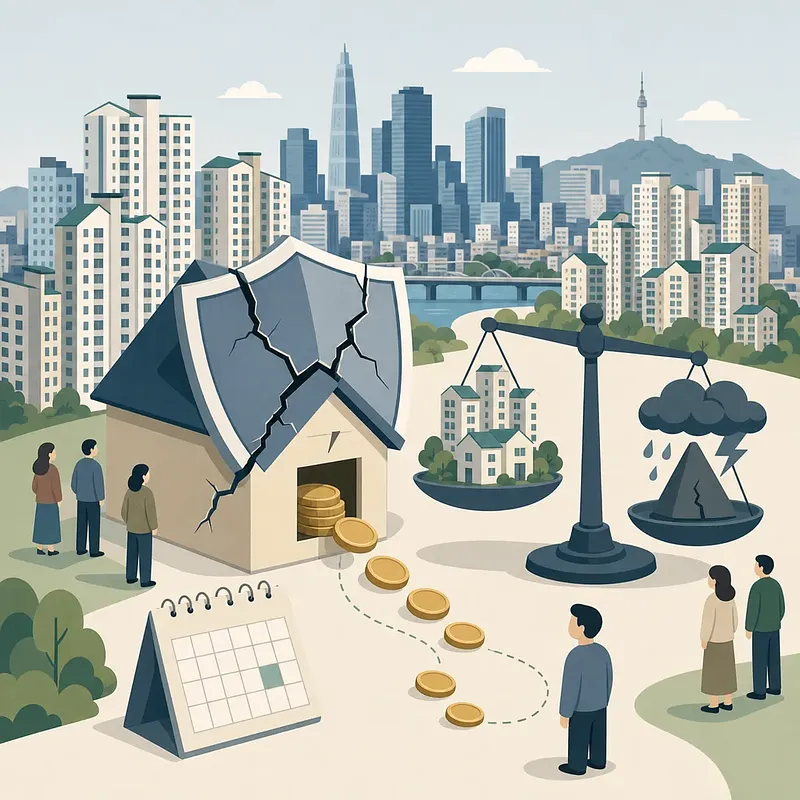
The decline in new villa supply in Seoul reduces the choice of affordable rental homes. This does not mean that existing villas have disappeared. If you are preparing to move, check the deposit return terms first. You can also review your monthly housing costs and whether you qualify for housing benefits.
The supply figures are 2025 results reported in March 2026, while the housing benefit information is based on 2026 standards.
How much has villa supply in Seoul declined?
A March 2026 report showed that villa completions in Seoul had fallen by 86.1% compared with 2018. Seoul Shinmun cited statistics from the Ministry of Land, Infrastructure and Transport. The figures cover row houses, multi-unit houses, and multi-household houses. You can check the comparison figures in the Seoul Shinmun report.
Comparison item | Figure cited in the report | Scope of interpretation
Seoul completions in 2018 | 35,006 homes | Total for row houses, multi-unit houses, and multi-household houses
Seoul completions in 2025 | 4,858 homes | Total for the same housing types
Difference between the two years | Decrease of 30,148 homes | Calculated from the figures above
Rate of decline | 86.1% | 2025 compared with 2018
These figures do not represent the total stock of existing homes. They compare the number of newly completed homes in a year. It would therefore be wrong to interpret them as meaning that 86.1% of Seoul's villas have disappeared.
The figures available when the report was published should not be assumed to be the latest finalized figures, either. The Ministry of Land, Infrastructure and Transport published the final 2025 construction figures on September 30, 2026. The final figures for each housing type in Seoul need to be checked against those finalized tables. A list of the data is available under Housing Construction Permits and Approvals on e-Nara Indicators.
Villa supply statistics and their scope
Villa statistics vary depending on the housing types included. “Villa” is often used as a general term for row houses and multi-unit houses. However, supply reports sometimes include multi-household houses as well.
Category | Meaning | What to check when comparing
Row houses and multi-unit houses | Homes classified as communal housing | Whether only these two types were counted
Multi-household houses | Homes classified as detached housing | Whether they were included in the villa total
Permits and approvals | Construction permits or approvals issued | Whether these were distinguished from actual construction starts
Construction starts | Projects where construction has begun | Whether expected completion dates were checked separately
Completions | Projects where construction is finished and approval for use has been granted | Whether the figures are provisional or final
Directly comparing rental statistics for row houses and multi-unit houses with the completion total above would mean comparing different scopes. A decline in construction starts also needs a reference year and region to be interpreted. Simply describing it as a certain percentage of a typical year leaves the basis for comparison unclear.
What factors are reducing villa supply?
Uncertainty over jeonse transactions and the burden of construction costs are factors that constrain supply. Seoul Shinmun cited the fallout from jeonse fraud and rising construction costs as background factors. However, a separate analysis is needed to determine how much each factor contributed to the decline.
Factor | How it could affect supply | Limits to interpretation
Concerns about deposit returns | Weaker jeonse demand and delayed contracts | Not all villas carry the same risk
Guarantee eligibility criteria | Limits on the deposit amount eligible for a guarantee | Varies with each home's value and claims against it
Construction and financing costs | Higher project costs and lower expected profits | Varies with land costs and financing terms for each project
These are economic mechanisms that could explain a decline in supply. No causal link has been established showing that a single guarantee criterion caused the entire decline. For construction cost increases, the type of index and comparison period must also be checked.
The number of jeonse fraud victims must also be distinguished from the number of people who lost their entire deposits. Recognized victim cases alone cannot be used to calculate the final scale of losses. Amounts recovered through guarantee payouts or distributions must also be examined.
What does 126% of the officially assessed value mean?
The 126% figure comes from calculations used in HUG guarantee screening based on officially assessed values. A housing valuation rate of 140% is applied to the officially assessed value. Multiplying this by a loan-to-value ratio of 90% gives 126%.
The combined amount of the jeonse deposit and senior claims must meet the screening criteria. Senior claims are claims repaid before the tenant's deposit. If there are mortgages or similar claims, the deposit amount eligible for a guarantee decreases.
· Housing valuation: officially assessed value × 140%
· Applying the loan-to-value ratio: calculated housing value × 90%
· Calculating the deposit limit: subtract senior claims from the amount above
This ratio is not a legal ceiling that sets jeonse prices for all villas. It is part of the screening criteria for guarantee eligibility. Check the valuation sequence and other requirements in the HUG Jeonse Deposit Return Guarantee product overview.
Example calculation for an officially assessed value of 120 million won
If the officially assessed value is 120 million won, the calculated threshold is 151.2 million won. This example assumes that the officially assessed value is used and there are no senior claims. It does not represent an actual listing or approval result.
Calculation item | Amount
Example officially assessed value | 120,000,000 won
Officially assessed value × 140% | 168,000,000 won
Amount above × 90% | 151,200,000 won
Difference assuming an existing deposit of 180,000,000 won | 28,800,000 won
If the landlord renews the lease with a lower deposit, they must raise the difference. Switching to monthly rent is an option the parties can consider. However, this calculation alone does not mean that a switch to monthly rent or an auction is inevitable.
How could this affect small apartments and monthly rentals?
A decline in villa supply could increase demand for other rental housing. Demand may also shift as tenants try to avoid jeonse deposit risks. However, a separate transaction analysis is needed to establish the scale of that shift.
Application competition ratios for small apartments do not show how many tenants have moved. Applications measure demand to buy newly offered homes. The number of homes offered and their sale prices also affect competition ratios.
Trend to examine | Suitable data | What that data alone cannot tell you
Increase in monthly rental contracts | Share of rental contracts in the same area and housing category | Increase in housing costs for individual households
Rising rents | Rental price indices for the same housing type and contracts for similar properties | Housing cost burden for all tenants
Shift in demand toward apartments | Analysis of moves, including previous places of residence | Number of people moving calculated solely from application competition ratios
Reduced capacity to save | Household income and actual housing costs | Savings calculated solely from the share of monthly rental contracts
The claim that 80% of Seoul villa transactions involve monthly rent also requires details about how the figures were compiled. First, check whether this is a share of rental transactions only. Whether semi-jeonse is included and the survey period must also be distinguished.
A decline in supply alone cannot establish the future rate of rent increases. Income, interest rates, and local demand also play a role. There is also insufficient evidence to conclude that supply will recover in 2028 or later.
Comparing the actual costs of jeonse and monthly rent
When comparing housing costs, include loan interest and maintenance fees, not just monthly rent. A lower deposit may reduce the amount you need to borrow. Conversely, higher monthly rent payments may leave you with less money each month.
Comparison item | Jeonse | Monthly rent with a deposit and semi-jeonse
Money needed when signing the contract | Relatively large deposit | Varies with the deposit terms
Monthly payments | Deposit loan interest, maintenance fees, and other costs | Monthly rent, loan interest, maintenance fees, and other costs
Amount exposed to deposit return risk | Deposit paid | Deposit paid
What to check for comparison | Guarantee eligibility and loan terms | Monthly rent, maintenance fees, and deposit return terms
You can calculate your monthly burden by adding deposit loan interest and maintenance fees to monthly rent. Use the same cost items when comparing annual expenses. If you pay the entire deposit with your own funds, you can also consider the fact that the money will be tied up.
For example, if monthly income is 2.5 million won and housing costs are 1 million won, the burden is 40%. This is the result of dividing the two amounts. It does not represent the actual average for tenant households in Seoul or a forecast.
Who can receive housing benefits in 2026?
Housing benefit eligibility is determined by a household's recognized income. Recognized income is the sum of assessed income and the income equivalent of assets. It is difficult to determine eligibility from salary alone.
The 2026 eligibility threshold is at most 48% of the standard median income. For a one-person household, the threshold is recognized monthly income of at most 1,230,834 won. Criteria by household size are available in the MyHome housing benefit guide.
2026 standards for a one-person household | Amount
Housing benefit eligibility threshold | Recognized monthly income of at most 1,230,834 won
Standard rent in Seoul | 369,000 won per month
Standard rent in Gyeonggi and Incheon | 300,000 won per month
Standard rent in metropolitan cities, Sejong, and special-status cities outside the Seoul metropolitan area | 247,000 won per month
Standard rent in other areas | 212,000 won per month
Seoul's 369,000 won per month is the standard rent for a one-person household. The actual payment varies with rent and recognized income. The calculation method follows the MyHome support guide for tenant households.
Example calculation for monthly rent of 450,000 won
Subtracting a benefit of 369,000 won from monthly rent of 450,000 won leaves 81,000 won. This calculation assumes that the conditions for receiving the full benefit are met. Maintenance fees and loan interest are not included in this amount.
If recognized income exceeds the livelihood benefit eligibility threshold, a household contribution is deducted. Actual rent also includes an amount calculated by converting the deposit into monthly rent. The benefit amount therefore should not be determined from monthly rent alone.
What to check before moving or renewing a lease
Check both the property's guarantee conditions and your monthly spending. Regional supply statistics alone are not enough to assess an individual contract. Gathering information in the following order can help you compare on a consistent basis.
· Check the building register for the actual housing type and any indication of building violations.
· Check the property register for the owner and rights such as mortgages.
· Ask the guarantee provider about the property's guarantee eligibility requirements.
· Calculate the monthly burden for each property by adding rent, loan interest, and maintenance fees.
· Consult your community service center or the housing benefit call center about whether you qualify for housing benefits.
HUG guarantees also have separate requirements, such as registering your move-in and obtaining a fixed date on the lease. Simply checking eligibility before signing a contract does not complete enrollment. Check the guarantee provider's guidance on when to apply and which documents are required.
Housing benefit consultations are available at 1600-0777. It helps to organize information about your income, assets, and rental terms before calling. The number is listed in the LH housing benefit guide.
 Injoys