Injoys
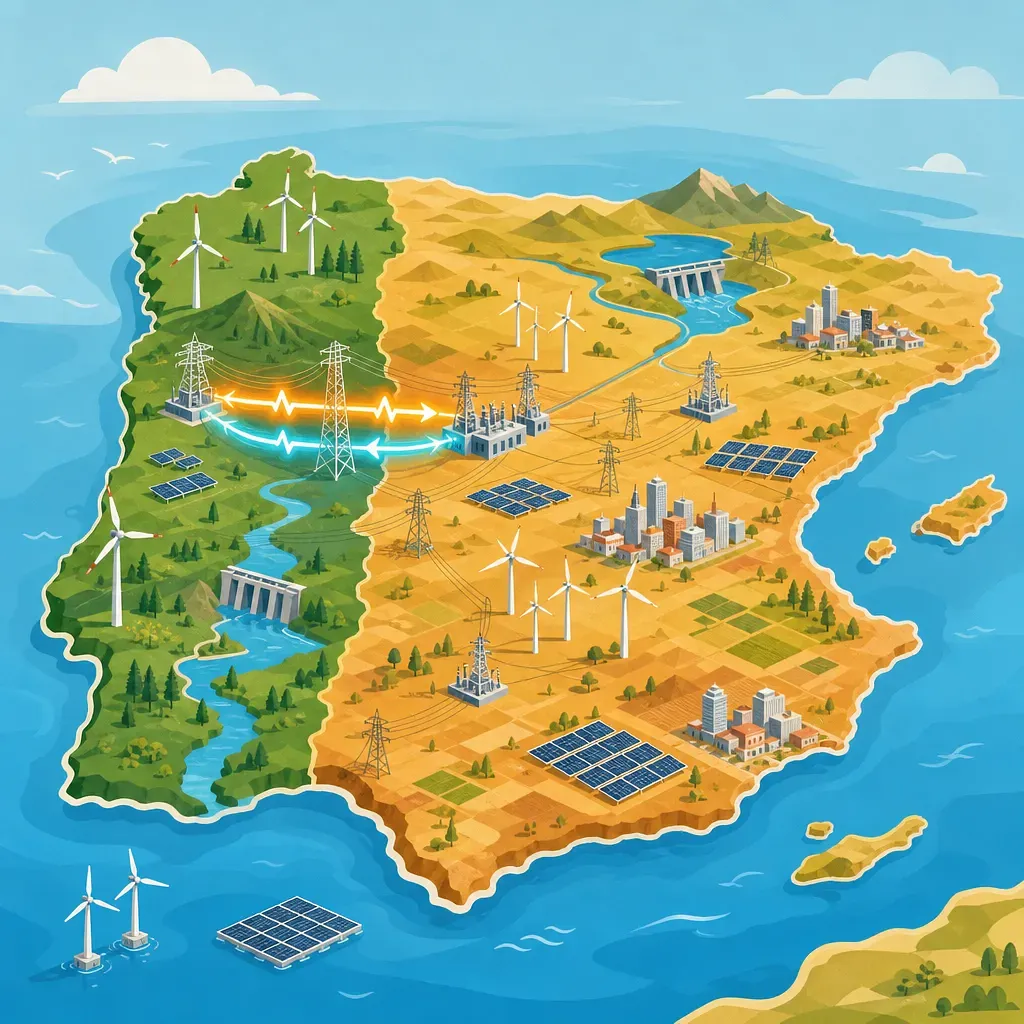
A new power interconnector linking Galicia in Spain with northern Portugal began operations on July 2, 2026. According to the European Commission, the facility added approximately 1GW of electricity exchange capacity between the two countries, raising the maximum to about 4.2GW.
The significance of this project goes beyond simply adding another transmission line across the border. When wind and solar generation exceeds regional demand, electricity can be sent to a broader market, while regions experiencing generation shortages or equipment failures have greater scope to receive power from the grid on the other side. However, the announced maximum capacity may differ from the capacity actually available to the market.
Key Figures and Structure of the New Interconnector
| Item | Details | Points to Note When Interpreting |
|---|---|---|
| Operational date | July 2, 2026 | The date of the completion or opening announcement and the point at which all operating conditions apply may differ depending on operational procedures. |
| Connected regions | Galicia in Spain and northern Portugal | The interconnector also uses substations within both countries and the existing 400kV-class transmission network. |
| Additional exchange capacity | Approximately 1GW | This does not mean that a new 1GW power plant has been built, but that the limit on the amount of electricity that can be transferred across the border has increased. |
| Maximum exchange capacity after expansion | Approximately 4.2GW | Real-time available capacity may be lower due to outages, maintenance, temperature, grid stability criteria, and internal congestion. |
| Power flow | Bidirectional | This is not a dedicated line that carries electricity only from Spain to Portugal; the direction changes according to market and grid conditions. |
Here, MW or GW represents the amount of power that can be transmitted at a specific moment. The amount of electricity actually transferred over a given period is measured in MWh or GWh. Therefore, the fact that the maximum exchange capacity is 4.2GW alone does not indicate the annual volume of electricity traded.
The term bidirectional also does not mean that the same 4.2GW is always available in both directions. The transmission system operators of the two countries separately calculate the capacity that can be offered to the market, taking into account the generation mix, demand, maintenance status, and grid safety criteria in each direction. As a result, the available capacity from Spain to Portugal may differ from that in the opposite direction.
How Surplus Wind and Solar Power Crosses the Border
Spain and Portugal operate power systems with high shares of wind, solar, and hydroelectric generation. Because generation changes rapidly with the weather, there may simultaneously be periods when one region has surplus electricity and another region needs power.
The process through which surplus renewable energy is used generally works as follows.
- Power producers submit hourly generation volumes and prices to the Iberian electricity market.
- Market results are determined based on demand in Spain and Portugal, generation offers, and available cross-border capacity.
- Commercial exchange schedules are created from regions able to produce inexpensive electricity to relatively more expensive regions.
- Transmission system operators manage actual operations by checking voltage, frequency, line overloads, and safety criteria in the event of failures.
- If forecasting errors or unexpected failures occur, reserve capacity and real-time balancing resources are deployed.
Renewable electricity does not travel to its destination through a separate physical route. In an alternating-current power grid, actual current is distributed across multiple lines according to electrical impedance and overall grid conditions. This is why cross-border transactions determined by the market may not fully match physical power flows.
Conditions for Reducing Grid Congestion and Curtailment
Curtailment refers to measures that reduce the output of wind and solar facilities capable of generating electricity because of grid safety or supply-demand balancing requirements. The new interconnector can reduce the likelihood of curtailment by providing an additional route for sending surplus electricity across the border.
However, the following conditions must also be met for this effect to materialize.
- There must be demand on the other side. If both countries simultaneously produce excess renewable energy, there may be insufficient export destinations even when cross-border capacity remains available.
- The domestic grids of both countries must have spare capacity. If domestic transmission lines between wind and solar farms and the cross-border connection point are congested, the new interconnector cannot be fully utilized.
- Storage and demand-response resources must operate. Pumped-storage hydropower, batteries, industrial demand adjustment, and electric-vehicle charging help shift surplus electricity to other periods.
- Capacity must be made available to the market. Transmission operators offer only the capacity remaining after accounting for maintenance and safety margins.
- The system must remain safe during failures. Operating limits are set so that the loss of one critical facility does not lead to a widespread blackout.
Expanding interconnection capacity is therefore not a sufficient condition for reducing curtailment, but one of several solutions. Domestic transmission networks, storage facilities, flexible generation sources, and demand response must also be expanded to increase renewable-energy hosting capacity reliably.
Impact on the Iberian Electricity Market and Wholesale Prices
Spain and Portugal operate MIBEL, a joint wholesale market, but cross-border interconnection capacity is not always sufficient. When adequate exchange capacity is available, generators in the relatively less expensive region can serve demand more broadly across both countries, allowing prices to converge or become equal.
Conversely, the market becomes congested when the required volume of electricity exchange exceeds interconnection capacity. Prices in the two countries then separate, and prices may be higher on the side facing an electricity shortage. The new interconnector could reduce the frequency and duration of such price separation.
For example, when wind power is abundant in northwestern Spain and demand is high in Portugal, electricity transfers from Spain to Portugal may increase. In the evening, when hydropower conditions are favorable in Portugal and solar output declines in Spain, flow in the opposite direction may be economically advantageous.
However, expanding interconnection capacity does not lower prices during every period. Prices may rise somewhat from previous levels in regions that export more electricity and may fall in importing regions. The main effects are to narrow the price gap between the two markets and enable lower-cost generation sources to be used across a broader area.