Risk of U.S.-Iran Conflict and the Global Economy: Worst-Case Scenarios and Transmission Channels
The conflict between the United States and Iran is a complex crisis involving not only the nuclear issue but also sanctions relief, ballistic missiles, regional armed groups, and Israel's security. The worst economic shock would occur not from limited hostilities alone, but when prolonged shipping disruptions in the Strait of Hormuz and rising oil prices spread through inflation, interest rates, and trade.
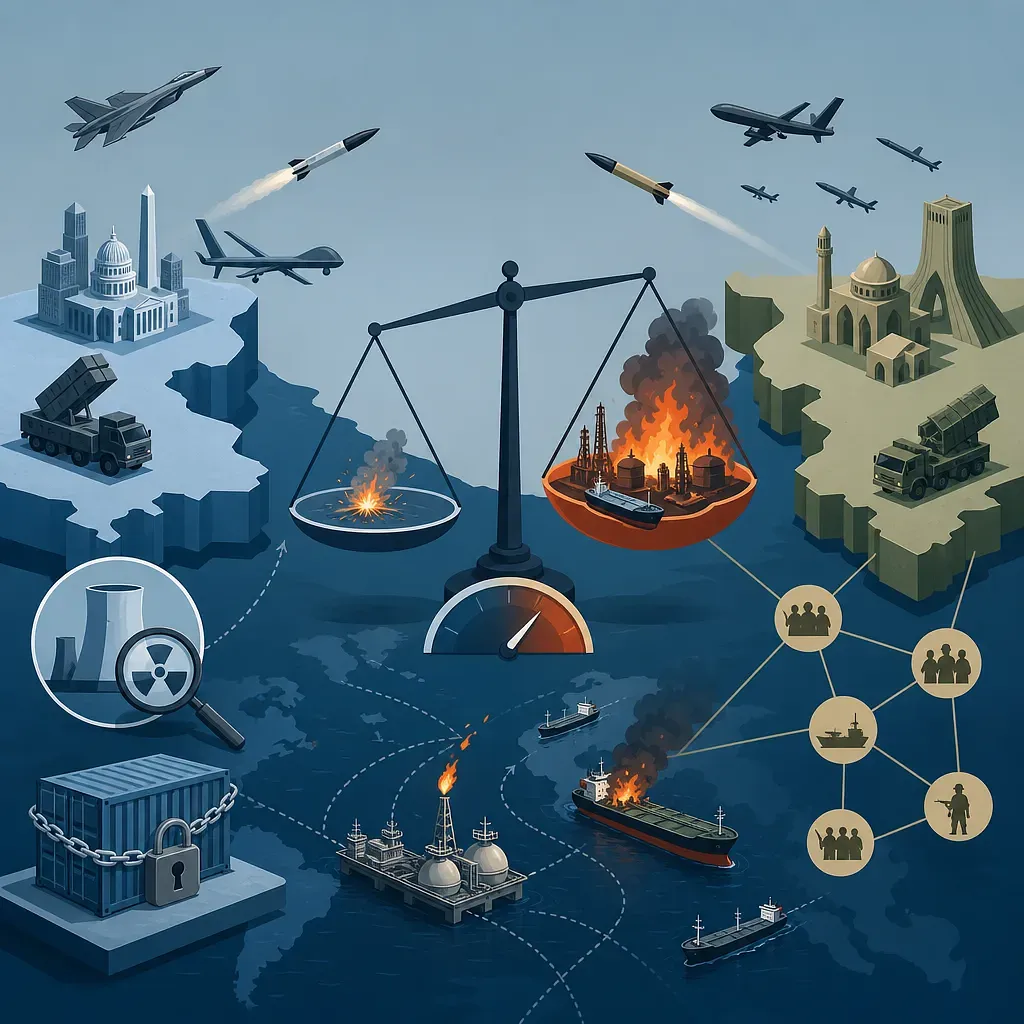
The main obstacles to U.S.-Iran negotiations are nuclear verification, the sequencing of sanctions relief, ballistic missiles, regional armed groups, and accumulated mistrust.
There is less room for compromise on ballistic missiles than on the nuclear issue because Iran's deterrence strategy directly conflicts with Israel's security concerns.
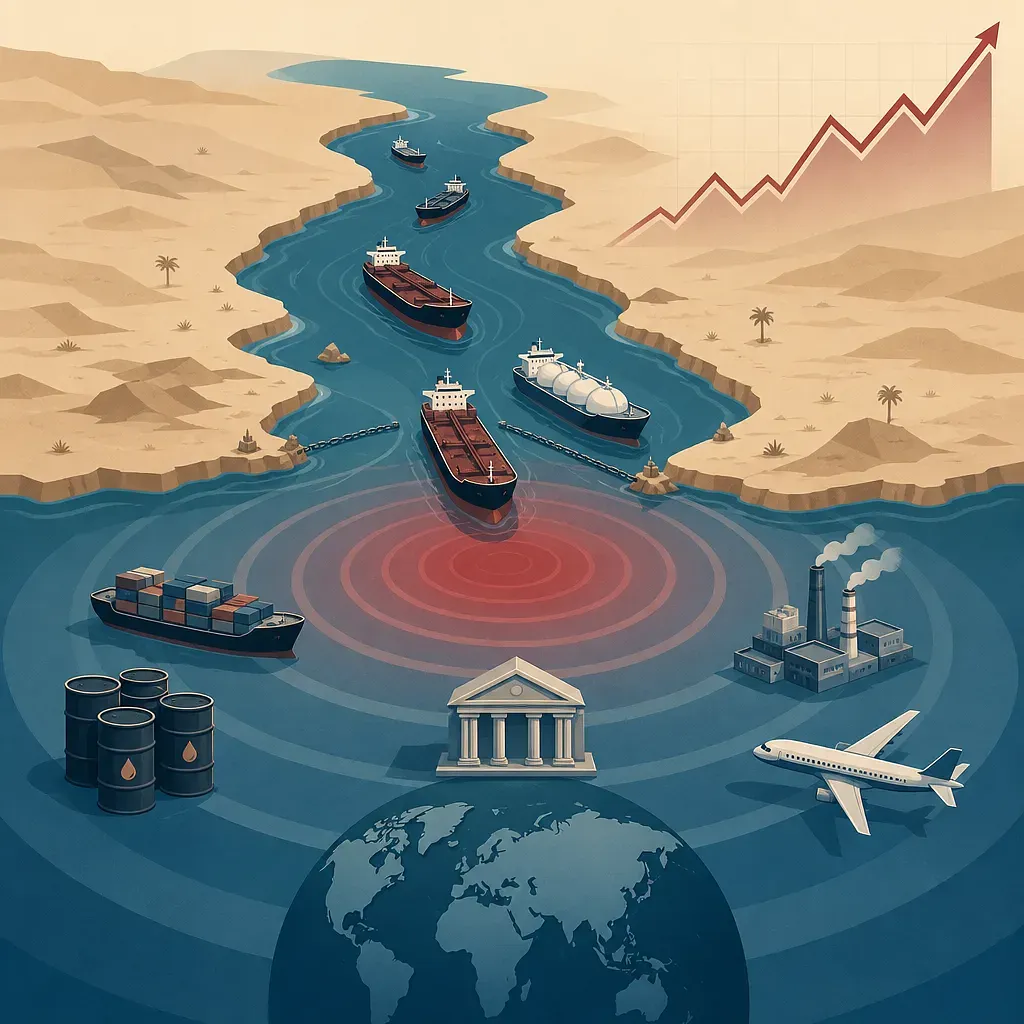
The most important risk transmission channel for the global economy is shipping disruption in the Strait of Hormuz driving up crude oil and LNG prices alongside marine insurance premiums.
A prolonged low-intensity conflict could weaken business investment and employment and entrench uncertainty over inflation even without escalating into a full-scale war.
A complete closure of the strait and a regional war constitute the worst-case scenario, but the likelihood of occurrence and the scale of economic damage must be assessed separately.
The confrontation between the United States and Iran is difficult to explain through a single war or one round of negotiations. This is because not only nuclear activities and economic sanctions but also ballistic missiles, Israeli security, regional armed groups, and maritime shipping routes are interconnected. Therefore, when analyzing the risk of conflict, confirmed facts, political claims, and possible scenarios must be kept separate.
This article does not adopt as confirmed fact the premise that the United States and Iran are engaged in a full-scale war at a particular point in time or that the United States has bombed Iran for at least 40 days. Because whether hostilities are occurring and their scope may change over time, the latest announcements from the U.S. government, the Iranian government, the International Atomic Energy Agency (IAEA), the United Nations, and major news agencies should be checked together.
Why Does the U.S.–Iran Conflict Keep Recurring?
There are broadly five central issues in U.S.–Iran relations.
· Nuclear activities and verification: The dispute concerns uranium enrichment levels, stockpiles, access to facilities, and the scope of IAEA verification.
· Economic sanctions and the sequence of relief: Iran demands meaningful sanctions relief, while the United States may take the position that verifiable measures must be implemented first.
· Ballistic missiles: Iran sees missiles as a core capability for deterring external attacks, while the United States and Israel regard them as a direct security threat.
· Regional armed groups: Iran’s relationships with pro-Iranian forces operating in Lebanon, Syria, Iraq, Yemen, and elsewhere broaden the scope of potential conflict.
· Mutual distrust: The experience of the Joint Comprehensive Plan of Action (JCPOA), concluded in 2015, and the U.S. withdrawal in 2018 has intensified doubts over whether a new agreement would survive a change of government.
The JCPOA was an agreement focused on limiting and verifying Iran’s nuclear program. It was not an agreement to comprehensively dismantle its ballistic missile capabilities. United Nations Security Council Resolution 2231 also addressed implementation of the nuclear agreement and missile-related issues, but it should not be interpreted as an agreement requiring the uniform elimination of all missiles.
Why Ballistic Missiles Are the Most Difficult Negotiating Issue
Iran does not possess an air force or overseas military bases comparable to those of the United States. Amid this asymmetry, Iran views missiles and drones as tools that can deter Israel, U.S. military bases, or regional rivals. This is why the Iranian leadership is likely to perceive missile restrictions not as simple disarmament but as an issue of regime survival.
From the perspective of Israel and the United States, however, missiles equipped with conventional warheads can attack cities, bases, ports, and energy facilities regardless of whether they can carry nuclear warheads. This may prompt the counterargument that an agreement limiting only nuclear activities while leaving delivery systems and regional strike capabilities intact is insufficient.
For this reason, the following interim agreements may also be considered, but each presents verification challenges.
· Limits on missile ranges or the number of tests
· A ban on transfers of certain types of launch vehicles and related technologies
· Restrictions on supplying missiles and drones to regional armed groups
· A phased exchange of nuclear facility verification and sanctions relief
· Establishment of a separate communication channel for maritime safety and the prevention of accidental clashes
Nuclear material can be verified to some extent through facilities and measuring equipment, but mobile launchers and transfers of components and technology are more difficult to track. Therefore, comprehensive negotiations seeking to resolve the missile issue all at once may be politically attractive but could have a lower chance of producing an actual agreement.
How U.S. Domestic Politics Affects Policy
Explaining U.S. policy toward Iran solely as a confrontation between pro-Israel hardliners and pro-capitalist moderates is an excessive simplification. Actual decisions involve the president and the National Security Council, the Department of Defense, the Department of State, the Department of the Treasury, intelligence agencies, Congress, allies, and domestic public opinion in different ways.
Policy objective | Factors encouraging a hard-line response | Factors restraining escalation
Limiting Iran’s nuclear capabilities | Concerns over verification gaps and highly enriched uranium | Difficulty of completely eliminating nuclear knowledge and facilities through attacks
Protecting Israel and U.S. forces | Missile and drone attacks and proxy-force activities | Risk of U.S. casualties and a cycle of retaliation
Stabilizing the U.S. economy | Need to protect maritime routes | Higher oil and gasoline prices and fiscal burdens
Securing political credibility | Avoiding criticism that deterrence has failed | Backlash against a prolonged war and unclear war aims
Higher oil prices can influence U.S. voters and policy decisions, but they do not automatically lead to a particular election result or presidential impeachment. Elections are affected by multiple variables, including employment, real income, and candidate competitiveness, while impeachment requires a separate constitutional and political process.
Why Iran Endures Despite Pressure
It is insufficient to explain Iran’s ability to endure solely through repression by an authoritarian regime. The characteristics of its political system may enable it to control economic suffering politically, but prolonged sanctions and war genuinely weaken state finances, industrial production, the currency’s value, and the regime’s legitimacy.
Iran’s strategic calculations may include the following elements.
· Asymmetric deterrence using missiles and drones
· Dispersed influence through friendly regional forces
· Expectations that opposing countries will face the burdens of escalation and war fatigue
· Securing foreign currency through crude oil exports and sanctions-evasion networks
· Distrust that an agreement could once again be abandoned after a change of government in the United States
However, without internal leadership documents or reliable evidence, it is difficult to conclude that Iran deliberately chose the current conflict as an opportunity more favorable than a future full-scale war. This is a possible strategic interpretation, not a confirmed fact.
Why the Strait of Hormuz Is a Key Variable for the Global Economy
The Strait of Hormuz is a narrow maritime passage connecting the Persian Gulf and the Gulf of Oman. A substantial share of the crude oil or LNG from Saudi Arabia, Iraq, Kuwait, the United Arab Emirates, Qatar, and Iran passes through this route.
In estimates compiled at different times, the U.S. Energy Information Administration (EIA) has assessed the volume of oil passing through the Strait of Hormuz as equivalent to approximately one-fifth of global oil consumption. The figures vary depending on production levels and the period measured, but it is clear that the strait’s importance extends beyond the export problems of any single country.
An economic shock can occur even without a complete closure of the strait.
· As the risk of attack increases, war-risk insurance premiums for vessels rise.
· Shipping and energy companies suspend operations or impose security surcharges.
· A geopolitical risk premium is added to spot crude oil and LNG prices.
· Costs rise for the refining, petrochemical, aviation, and transportation industries.
· Consumer prices increase, reducing central banks’ room to lower interest rates.
· Energy-importing countries face pressure on their trade balances and currency values.
Some oil-producing countries can bypass the strait through pipelines, but alternative transport capacity cannot replace all maritime volumes. Therefore, the magnitude of the shock depends less on whether the strait is formally closed than on the scale and duration of transportation disruptions, inventories, spare production capacity among oil-producing countries, and releases from national strategic reserves.
Four Conflict Scenarios
Presenting the worst-case scenario as the baseline outlook can exaggerate the risks. Analyses should distinguish between the likelihood of occurrence and the scale of damage.
Scenario | Key characteristics | Impact on energy markets | Impact on the global economy
Limited conflict and managed deterrence | Private mediation after one-off attacks | Temporary risk premium | Possible stabilization after a limited rise in prices
Prolonged low-intensity conflict | Repeated drone attacks, threats to vessels, and proxy-force clashes | Structural increase in insurance premiums and freight rates | Delayed investment and higher manufacturing costs
Sustained shipping disruptions in Hormuz | Seizures, concerns over mines, and attacks on ports and tankers | Sharp increase in crude oil and LNG supply uncertainty | Renewed acceleration of inflation and slower growth
Broad regional war | Expansion of direct hostilities among the United States, Iran, Israel, and regional forces | Simultaneous shocks to production facilities and transportation networks | Stagflation, financial market instability, and reduced trade
Scenario 1: De-escalation After a Limited Conflict
In this case, both sides demonstrate their military resolve without directly threatening the other side’s regime or critical infrastructure. A private agreement could be reached through mediation by Oman, Qatar, or a European country. Oil prices may surge and then surrender part of those gains once it is confirmed that no supply disruption has occurred.
Scenario 2: Chronic Low-Intensity Conflict in the Middle East
This is a situation in which attacks on vessels, drone and missile launches, and retaliation recur without either a formal end to hostilities or a full-scale war. In this case, the greatest harm is the normalization of uncertainty. Companies incorporate higher transportation and insurance costs into their cost structures, while investors demand a higher risk premium for business in the Middle East.
Caution is required when comparing this with the Russia–Ukraine war. A war centered on interstate ground combat, territorial occupation, and front lines has a different military and economic structure from a conflict centered on maritime routes, proxy forces, and limited strikes.
Scenario 3: Sustained Shipping Disruptions in the Strait of Hormuz
This scenario has the greatest potential to deliver a direct shock to the global economy. Even without a complete closure, actual transportation capacity would decline if major shipping companies suspended operations and insurance became difficult to obtain. Prices could rise not only for crude oil but also for LNG and petroleum products.
Scenario 4: Broad Regional War
If attacks by U.S. forces or Israel on critical facilities, large-scale casualties, and sustained attacks on Iranian territory occur together, the scope of retaliation could expand. In this case, production facilities and ports in the Gulf region, U.S. military bases, and Israeli cities would be exposed to danger simultaneously. This is a worst-case scenario with extremely severe damage, but whether there is sufficient basis to conclude that it is the most likely outcome must be assessed separately.
Channels Through Which the Effects Spread to the Global Economy
An energy shock is transmitted to the real economy in the following sequence.
Channel | Initial shock | Subsequent effects
Crude oil | Higher international oil prices and refining margins | Higher gasoline, diesel, and jet fuel prices
Natural gas | LNG shipping uncertainty and higher spot prices | Increased costs for electricity, municipal gas, and industrial fuel
Shipping | Higher insurance premiums, freight rates, and security costs | Higher import prices and delivery delays
Prices | Pass-through of energy and transportation costs | Delayed interest-rate cuts and lower real income
Financial markets | Greater preference for safe-haven assets and increased volatility | Possible stock market corrections and weaker emerging-market currencies
Business activity | Uncertainty over costs and the demand outlook | Investment, hiring, and inventory expansion put on hold
The severity of the shock differs by country. Net importers of oil and gas, countries with energy-intensive manufacturing sectors, and countries with weakening currencies are relatively vulnerable. Conversely, energy exporters may benefit from higher prices, but they do not necessarily gain if attacks on facilities and logistics disruptions occur.
Potential Effects on the South Korean Economy and Cost of Living
South Korea is highly dependent on overseas supplies of crude oil and natural gas, and energy from the Middle East accounts for an important share. Disruptions in the Strait of Hormuz could affect not only prices at domestic gas stations but also electricity and gas costs, airfares, chemical products, plastics, and transportation costs for agricultural and fishery products.
However, increases in international oil prices are not immediately reflected in domestic prices to the same extent. Exchange rates, refiners’ inventories and procurement contracts, taxes, fuel tax adjustments, and lags in price pass-through all play a role. Therefore, a specific conflict-related news report alone should not be used to conclude what the domestic inflation rate will be.
Key Indicators for Assessing a Deteriorating Situation
Rather than focusing on sensational breaking news, it is more useful to determine whether multiple indicators are simultaneously moving in the same direction.
· Actual vessel traffic through the Strait of Hormuz and increases in diversions and anchoring
· War-risk insurance premiums and maritime freight rates for oil tankers and LNG carriers
· Spot premiums for Brent crude, Dubai crude, and Middle Eastern crude oil
· Announcements of production facility and port shutdowns by major oil-producing countries
· Changes in deployments of troops, air-defense systems, and aircraft carriers by the United States and regional countries
· Embassy evacuations, elevated travel advisories, and cancellations of civilian flights
· IAEA inspection access and reports concerning Iranian nuclear material
· Strategic petroleum reserve releases and coordinated responses by International Energy Agency member countries
· Attacks by Iran-linked armed groups and the scope of U.S. and Israeli retaliation
An attack on a single tanker or a one-day surge in oil prices is a serious event, but it does not immediately mean a full-scale war or a global economic crisis. What matters more is how long physical supply reductions and transportation disruptions persist.
Conclusion
It is difficult to say that the solution to the U.S.–Iran conflict lies solely in Washington or solely in Tehran. U.S. domestic politics, Israel’s security judgments, Iran’s logic of regime survival, independent actions by regional armed groups, and mediation by Gulf states all help determine the outcome.
The situation the global economy must guard against most is not a one-off missile strike itself but a prolonged disruption of shipping through the Strait of Hormuz. This could trigger a chain reaction in oil and LNG prices, maritime insurance premiums, exchange rates, consumer prices, and interest rates. However, the worst-case outcome should not be treated as a firm prediction; risks should instead be updated based on the triggers and real-time indicators for each scenario.
 Injoys