Skip to content
History and People, records and timelines of how people and nations overcame adversity Case Study

Park Seong-chun's 1898 Gwanmin Gongdonghoe Speech

Listen or read this article

18:14

Listen, or read the text only.

Park Seong-chun's 1898 Gwanmin Gongdonghoe Speech

Kokoro 82M AI-generated voice 19 min read

0:00 18:14

Advertisement

Download audio

File name
park-seong-chun-1898-public-speech-significance-en.mp3
Format
MP3 (audio/mpeg)
Duration
18:14
File size
12.5 MB
Engine
Kokoro 82M

This audio was generated by AI.

You may download and use it freely for personal use.

Advertisement

Park Seong-chun's 1898 Gwanmin Gongdonghoe Speech

11 min read

Park Seong-chun's 1898 Gwanmin Gongdonghoe Speech
Park Seong-chun called for cooperation between officials and the people at the Gwanmin Gongdonghoe in 1898. The applause for his remarks was an example of an opinion being respected regardless of social status, but it did not mean discrimination had ended or political reform was complete.
Park Seong-chun's public speech is recorded in the entry for October 29, Gwangmu 2, in volume 3 of Daehan Gyenyeonsa.
The speech explained cooperation between officials and the people through an analogy of several bamboo poles supporting a canopy.
The audience's applause shows that the political views of a man from the baekjeong caste were respected.
The 6-Article Proposal was a joint resolution of the Gwanmin Gongdonghoe, and there is no basis for treating it as a document authored by Park Seong-chun himself.
Repression thwarted the political reform movement in late 1898, and discrimination based on social status continued.
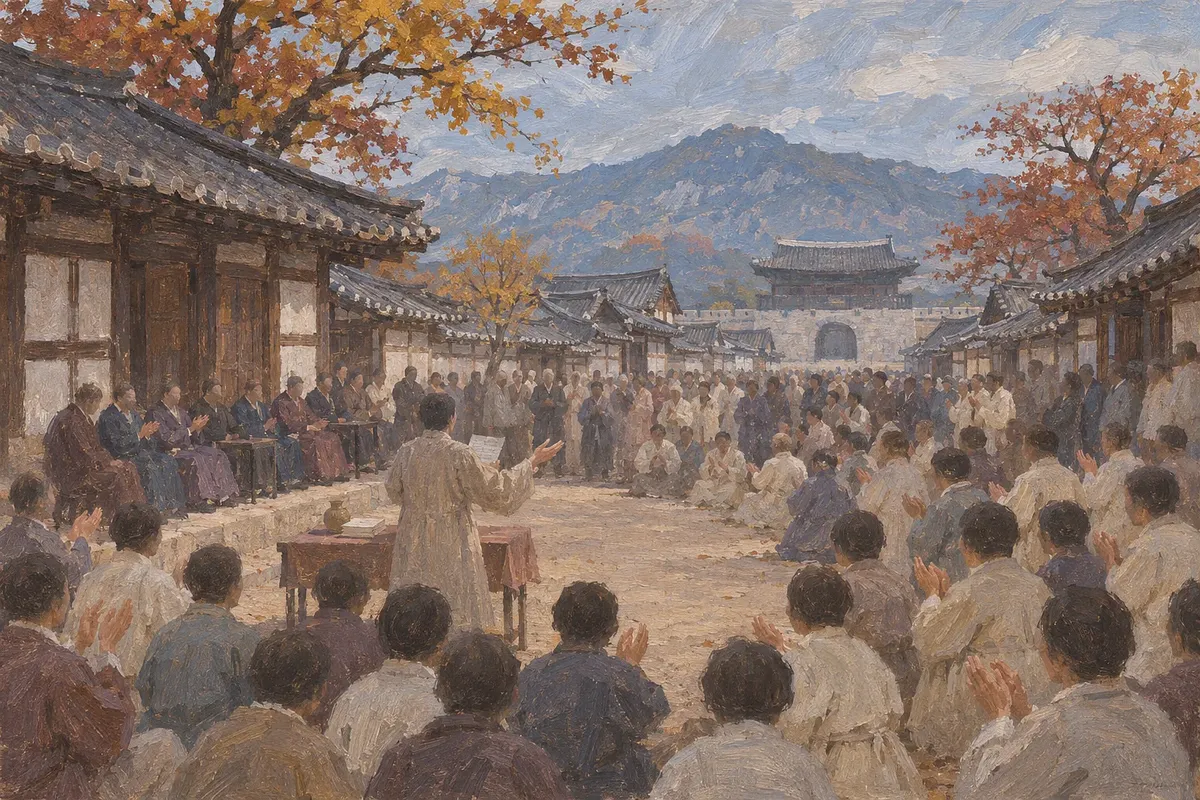
Park Seong-chun faced discrimination because of his background as a baekjeong, a member of an outcast group associated with butchery. At the Joint Assembly of Officials and People in 1898, he called for cooperation between officials and the people. His speech, which received applause, is remembered as an instance in which a person's political views were respected across status barriers.
This article follows the Daehan gyenyeonsa in the Korean History Database, consulted in November 2026.
Park Seong-chun's Life and Discrimination as a Former Baekjeong
Park Seong-chun was a Protestant who was born in 1862 and died in 1933. He was born the son of a baekjeong in Gwanjagol, Seoul. He also worked as a baekjeong before becoming involved with a church.
The baekjeong were a socially despised group whose occupations included butchery. The Gabo Reforms of 1894 abolished legal status distinctions. However, the custom of judging people by their background remained in everyday life.
Discrimination also appeared in Park Seong-chun's church life. Around 1894, after receiving medical treatment from Avison, he began attending Gondanggol Church. Some yangban members refused to worship with him. The missionary Moore refused to expel him, citing equality.
The entry on Park Seong-chun in the Encyclopedia of Korean Culture describes this process. He was later elected an elder of Seungdong Church in 1911. His son, Park Seo-yang, graduated from Severance Medical School and worked as a physician.
Timeline of His Life and Political Participation
This timeline presents his life alongside developments in political reform.
Date | Event | Source 1862 | Born in Gwanjagol, Seoul | Encyclopedia of Korean Culture, “Park Seong-chun” Around 1894 | Began attending church after receiving treatment from Avison | Encyclopedia of Korean Culture, “Park Seong-chun” 1894 | Legal status distinctions abolished through the Gabo Reforms | History Net, glossary entry on “Joseon Hyeongpyeongsa” October 29, 1898 | Delivered a speech calling for cooperation between officials and the people at the Joint Assembly of Officials and People in Jongno | Daehan gyenyeonsa, volume 3, entry for that date December 1898 | The Independence Club and All People's Assembly movement were thwarted by forced dissolution | History Net, Sinpyeon Hanguksa, volume 41 1911 | Elected an elder of Seungdong Church | Encyclopedia of Korean Culture, “Park Seong-chun” 1933 | Died | Encyclopedia of Korean Culture, “Park Seong-chun”
Why the Joint Assembly of Officials and People Became a Turning Point for His Public Voice
The Joint Assembly of Officials and People was a gathering where officials and the people discussed reforms to state affairs together. In 1898, the Independence Club campaigned against foreign powers' encroachment on Korea's economic rights. Public gatherings became a channel for bringing the people's views into politics.
The All People's Assembly was a public gathering attended by people from various social groups. The Joint Assembly of Officials and People grew out of that movement and included government officials. The two names are related, but they differ in who participated and how discussions were conducted.
Category | All People's Assembly | Joint Assembly of Officials and People Main character | Public gathering of the people | Joint consultation between officials and the people Political function | Shaping public opinion and demanding reforms | Discussing reform proposals with government officials Connection to this event | A foundation for the public expression of the people's views | The setting for Park Seong-chun's speech and the adoption of the Six Articles of Recommendations
The Daehan gyenyeonsa states that students, merchants, and others attended alongside officials. It also records the attendance of women's groups, Buddhist monks, and baekjeong. The turning point was that a person who faced discrimination participated in discussions of state affairs.
The Core of Park Seong-chun's Speech and His Canopy Analogy
The central argument of the speech was that officials and the people should cooperate for the country's sake. He first mentioned his low social position. He then expressed loyalty to the ruler and love for the country.
A single bamboo pole is not strong enough to support it, but when several bamboo poles are brought together, their combined strength is very solid.
This is from Park Seong-chun's speech recorded in Jeong Gyo's Daehan gyenyeonsa, volume 3, in the entry for October 29 in year 2 of Gwangmu.
A canopy is a cloth shelter spread out to block sunlight. The point of the analogy is that several bamboo poles must support it together to make it sturdy. His reasoning was that the strength supporting the country likewise comes from cooperation between officials and the people.
This was not a speech that demanded only better treatment for the baekjeong. After explaining his own position, he presented a principle for governing the country. The record states that the audience applauded after his speech.
The Content of the Joint Assembly's Six Articles of Recommendations
The Six Articles of Recommendations were reform demands that the Joint Assembly of Officials and People agreed on and submitted to the emperor. They emerged from the same political movement as Park Seong-chun's speech. However, the record provides no evidence that he wrote them alone.
The table below summarizes the intent of each article in plain language. It is not a direct quotation from the original text or a modern translation. The articles' content can be found in History Net's The Six Articles of Recommendations and Emperor Gojong's Edict.
Article | Demand Article 1 | Officials and the people should cooperate to uphold imperial authority without relying on foreign powers Article 2 | Foreign agreements involving economic rights, loans, or borrowed troops should require the joint signatures and seals of the ministers of each department and the president of the Privy Council Article 3 | State finances should be centralized under the Takjibu, and budgets and final accounts should be disclosed to the people Article 4 | Serious crimes should be tried publicly, with punishment imposed after the accused has given a full explanation and confessed Article 5 | Appointments of high-ranking officials directly appointed by the emperor should reflect the majority opinion of the government Article 6 | Regulations already established should be put into practice
The Takjibu was the government office responsible for state finances. Foreign borrowing meant borrowing money from abroad. Borrowing troops meant obtaining military forces from a foreign country.
Article 1 expressed support for imperial authority. The other articles called for procedures and constraints in finance, trials, and appointments. The document combined loyalty to the emperor with checks on the exercise of power.
Why Speeches, Resolutions, and Implementation Must Be Distinguished
Having a political opinion welcomed and having an institution put into practice are different achievements. The Daehan gyenyeonsa records that participants offered their views after the speech. It then describes the process of organizing the proposals and submitting them to the emperor.
Stage | What the record confirms | What that fact alone does not establish Speech | Park Seong-chun's call for cooperation and the audience's applause | A guarantee of equal political participation for all baekjeong Resolution | A reform proposal incorporating participants' views and the ministers' agreement | Park Seong-chun's personal authorship of the Six Articles of Recommendations Implementation | The procedure for submitting the reform demands to the emperor | Sustained implementation of the entire reform proposal
This distinction is an analysis based on the sequence of events in the record. One person's speech can be read as an instance of participation in a shared discussion. It cannot immediately be taken to mean that institutional reform was complete.
The Achievement of Public Speech and the Defeat of Reform
The speech's achievement was that the views of someone devalued because of his background were respected. History Net's commentary also interprets the applause as respect for the people's views. This shows how public gatherings at the time broadened the scope of political participation.
The foundation for sustaining political reform did not last long. Conflicts continued over the scope of imperial authority and the reorganization of the Privy Council. At the end of 1898, the Independence Club and All People's Assembly movement were thwarted by forced dissolution. This process is described in the relevant section of Sinpyeon Hanguksa.
Social discrimination did not disappear after a single speech either. Exclusion of people from baekjeong backgrounds continued during Japanese colonial rule. The founding of Hyeongpyeongsa in 1923 shows that ending discrimination remained an unresolved task.
Records and Interpretation
What the records convey must be distinguished from later interpretations. The content of the speech and the audience's response are facts recorded in historical sources. The participants' motives and political aims require further interpretation.
What the Record Directly Conveys
Jeong Gyo's Daehan gyenyeonsa records both the speech and the applause. The entry appears under October 29 in year 2 of Gwangmu. The passage quoted here is part of the speech included in that record.
This article does not treat the entry as an on-site stenographic transcript. It does not reconstruct the speaker's actual tone or facial expressions, or the thoughts of individual audience members. The record can be located in the original text in the Korean History Database.
Significance Commonly Highlighted in Historical Commentary
Published historical commentary emphasizes the expansion of the people's political participation. History Net explains how opinions were respected across status boundaries. The Encyclopedia of Korean Culture highlights the role of the Six Articles of Recommendations in checking power.
Differing Interpretations of Participants' Motives
It is difficult to explain participation in the gathering through a single motive. Alongside awareness of people's rights, History Net introduces traditional ideas of duty and loyalty. Loyalty to the king and the country is also presented as a reason for participation.
Park Seong-chun's speech expressed support for the emperor. It therefore cannot be equated with a declaration of modern democracy. It is more accurate to read it as an example combining loyalty to the ruler and love for the country with expanded political participation.
Its Significance for Learning History Today
This case is useful for explaining the difference between legal changes and social treatment. Exclusion based on background continued after the Gabo Reforms. The speech at the Joint Assembly of Officials and People was an opportunity for participation that became possible under those conditions.
The following distinctions are helpful when reading historical sources.
· The legal abolition of status distinctions and the elimination of everyday discrimination are not the same event. · Speaking at a public gathering differs from having institutionally guaranteed political rights. · The adoption of a joint resolution and the actual implementation of a reform proposal must be verified separately. · An individual's life must be distinguished from the career of another person with the same name.
Frequently Asked Questions
When Was the Speech Delivered?
This article gives the date as October 29, 1898. The speech appears in the entry for that date in volume 3 of the Daehan gyenyeonsa. History Net's commentary on the historical source also specifies the same date.
Did Park Seong-chun Write the Six Articles of Recommendations?
There is no basis for concluding that he wrote them alone. The record states that participants offered their views and compiled the proposals. The speaker must be distinguished from those who drafted the joint resolution.
Does the Applause Mean Status Discrimination Had Ended?
It cannot be understood that way. The applause was a response showing that his speech was respected on that occasion. Social discrimination against the baekjeong continued afterward.
Was He the Same Person as the Righteous Army Member Park Seong-chun?
The speaker at the Joint Assembly of Officials and People must be distinguished from the righteous army member Park Seong-chun. The righteous army member listed in the Independence Hall of Korea's biographical dictionary was from Yeoju. That entry estimates his birth year as 1864.
Category | Speaker at the Joint Assembly of Officials and People | Righteous army member Birth and death | Born in 1862, died in 1933 | Estimated to have been born in 1864, date of death unknown Place of origin | Gwanjagol, Seoul | Yeoju, Gyeonggi Province Main activities | Speech at the Joint Assembly of Officials and People, activities at Seungdong Church | Activities in Park Jang-ho's righteous army unit Reference source | Encyclopedia of Korean Culture | Independence Hall of Korea, Biographical Dictionary of the Korean Independence Movement
0:00 0:00
1 / 66

Advertisement

Download text

File name
park-seong-chun-1898-public-speech-significance-en.txt
Format
TXT (text/plain)
Paragraphs
66

Downloads exactly what you see as a text file.

Please cite the source when quoting.

Advertisement

Large text

Makes the text larger and the colors clearer. Turn it on if the text feels too small.

Park Seong-chun’s speech marked a moment when political views were respected across status barriers.AI-generated image

Key points

  • Park Seong-chun's public speech is recorded in the entry for October 29, Gwangmu 2, in volume 3 of Daehan Gyenyeonsa.
  • The speech explained cooperation between officials and the people through an analogy of several bamboo poles supporting a canopy.
  • The audience's applause shows that the political views of a man from the baekjeong caste were respected.
  • The 6-Article Proposal was a joint resolution of the Gwanmin Gongdonghoe, and there is no basis for treating it as a document authored by Park Seong-chun himself.
  • Repression thwarted the political reform movement in late 1898, and discrimination based on social status continued.

Park Seong-chun faced discrimination because of his background as a baekjeong, a member of an outcast group associated with butchery. At the Joint Assembly of Officials and People in 1898, he called for cooperation between officials and the people. His speech, which received applause, is remembered as an instance in which a person's political views were respected across status barriers.

This article follows the Daehan gyenyeonsa in the Korean History Database, consulted in November 2026.

Park Seong-chun's Life and Discrimination as a Former Baekjeong

Park Seong-chun was a Protestant who was born in 1862 and died in 1933. He was born the son of a baekjeong in Gwanjagol, Seoul. He also worked as a baekjeong before becoming involved with a church.

The baekjeong were a socially despised group whose occupations included butchery. The Gabo Reforms of 1894 abolished legal status distinctions. However, the custom of judging people by their background remained in everyday life.

Discrimination also appeared in Park Seong-chun's church life. Around 1894, after receiving medical treatment from Avison, he began attending Gondanggol Church. Some yangban members refused to worship with him. The missionary Moore refused to expel him, citing equality.

The entry on Park Seong-chun in the Encyclopedia of Korean Culture describes this process. He was later elected an elder of Seungdong Church in 1911. His son, Park Seo-yang, graduated from Severance Medical School and worked as a physician.

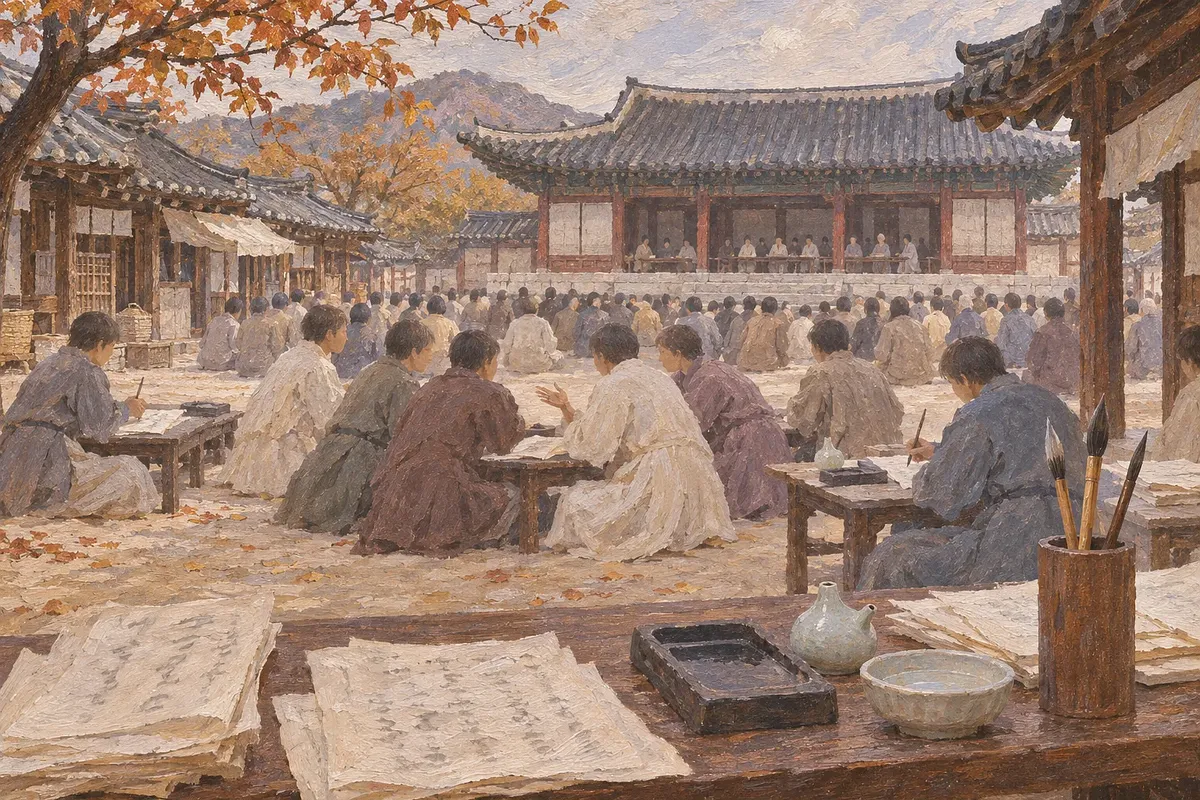
The Six Articles were a collective resolution of the government–people assembly, not Park Seong-chun’s individual work.AI-generated image

Timeline of His Life and Political Participation

This timeline presents his life alongside developments in political reform.

Date Event Source
1862 Born in Gwanjagol, Seoul Encyclopedia of Korean Culture, “Park Seong-chun”
Around 1894 Began attending church after receiving treatment from Avison Encyclopedia of Korean Culture, “Park Seong-chun”
1894 Legal status distinctions abolished through the Gabo Reforms History Net, glossary entry on “Joseon Hyeongpyeongsa”
October 29, 1898 Delivered a speech calling for cooperation between officials and the people at the Joint Assembly of Officials and People in Jongno Daehan gyenyeonsa, volume 3, entry for that date
December 1898 The Independence Club and All People's Assembly movement were thwarted by forced dissolution History Net, Sinpyeon Hanguksa, volume 41
1911 Elected an elder of Seungdong Church Encyclopedia of Korean Culture, “Park Seong-chun”
1933 Died Encyclopedia of Korean Culture, “Park Seong-chun”

Why the Joint Assembly of Officials and People Became a Turning Point for His Public Voice

The Joint Assembly of Officials and People was a gathering where officials and the people discussed reforms to state affairs together. In 1898, the Independence Club campaigned against foreign powers' encroachment on Korea's economic rights. Public gatherings became a channel for bringing the people's views into politics.

The All People's Assembly was a public gathering attended by people from various social groups. The Joint Assembly of Officials and People grew out of that movement and included government officials. The two names are related, but they differ in who participated and how discussions were conducted.

Category All People's Assembly Joint Assembly of Officials and People
Main character Public gathering of the people Joint consultation between officials and the people
Political function Shaping public opinion and demanding reforms Discussing reform proposals with government officials
Connection to this event A foundation for the public expression of the people's views The setting for Park Seong-chun's speech and the adoption of the Six Articles of Recommendations

The Daehan gyenyeonsa states that students, merchants, and others attended alongside officials. It also records the attendance of women's groups, Buddhist monks, and baekjeong. The turning point was that a person who faced discrimination participated in discussions of state affairs.

The Core of Park Seong-chun's Speech and His Canopy Analogy

The central argument of the speech was that officials and the people should cooperate for the country's sake. He first mentioned his low social position. He then expressed loyalty to the ruler and love for the country.

A single bamboo pole is not strong enough to support it, but when several bamboo poles are brought together, their combined strength is very solid.

This is from Park Seong-chun's speech recorded in Jeong Gyo's Daehan gyenyeonsa, volume 3, in the entry for October 29 in year 2 of Gwangmu.

A canopy is a cloth shelter spread out to block sunlight. The point of the analogy is that several bamboo poles must support it together to make it sturdy. His reasoning was that the strength supporting the country likewise comes from cooperation between officials and the people.

This was not a speech that demanded only better treatment for the baekjeong. After explaining his own position, he presented a principle for governing the country. The record states that the audience applauded after his speech.

The Content of the Joint Assembly's Six Articles of Recommendations

The Six Articles of Recommendations were reform demands that the Joint Assembly of Officials and People agreed on and submitted to the emperor. They emerged from the same political movement as Park Seong-chun's speech. However, the record provides no evidence that he wrote them alone.

The table below summarizes the intent of each article in plain language. It is not a direct quotation from the original text or a modern translation. The articles' content can be found in History Net's The Six Articles of Recommendations and Emperor Gojong's Edict.

Article Demand
Article 1 Officials and the people should cooperate to uphold imperial authority without relying on foreign powers
Article 2 Foreign agreements involving economic rights, loans, or borrowed troops should require the joint signatures and seals of the ministers of each department and the president of the Privy Council
Article 3 State finances should be centralized under the Takjibu, and budgets and final accounts should be disclosed to the people
Article 4 Serious crimes should be tried publicly, with punishment imposed after the accused has given a full explanation and confessed
Article 5 Appointments of high-ranking officials directly appointed by the emperor should reflect the majority opinion of the government
Article 6 Regulations already established should be put into practice

The Takjibu was the government office responsible for state finances. Foreign borrowing meant borrowing money from abroad. Borrowing troops meant obtaining military forces from a foreign country.

Article 1 expressed support for imperial authority. The other articles called for procedures and constraints in finance, trials, and appointments. The document combined loyalty to the emperor with checks on the exercise of power.

Why Speeches, Resolutions, and Implementation Must Be Distinguished

Having a political opinion welcomed and having an institution put into practice are different achievements. The Daehan gyenyeonsa records that participants offered their views after the speech. It then describes the process of organizing the proposals and submitting them to the emperor.

Stage What the record confirms What that fact alone does not establish
Speech Park Seong-chun's call for cooperation and the audience's applause A guarantee of equal political participation for all baekjeong
Resolution A reform proposal incorporating participants' views and the ministers' agreement Park Seong-chun's personal authorship of the Six Articles of Recommendations
Implementation The procedure for submitting the reform demands to the emperor Sustained implementation of the entire reform proposal

This distinction is an analysis based on the sequence of events in the record. One person's speech can be read as an instance of participation in a shared discussion. It cannot immediately be taken to mean that institutional reform was complete.

The Achievement of Public Speech and the Defeat of Reform

The speech's achievement was that the views of someone devalued because of his background were respected. History Net's commentary also interprets the applause as respect for the people's views. This shows how public gatherings at the time broadened the scope of political participation.

The foundation for sustaining political reform did not last long. Conflicts continued over the scope of imperial authority and the reorganization of the Privy Council. At the end of 1898, the Independence Club and All People's Assembly movement were thwarted by forced dissolution. This process is described in the relevant section of Sinpyeon Hanguksa.

Social discrimination did not disappear after a single speech either. Exclusion of people from baekjeong backgrounds continued during Japanese colonial rule. The founding of Hyeongpyeongsa in 1923 shows that ending discrimination remained an unresolved task.

Records and Interpretation

What the records convey must be distinguished from later interpretations. The content of the speech and the audience's response are facts recorded in historical sources. The participants' motives and political aims require further interpretation.

What the Record Directly Conveys

Jeong Gyo's Daehan gyenyeonsa records both the speech and the applause. The entry appears under October 29 in year 2 of Gwangmu. The passage quoted here is part of the speech included in that record.

This article does not treat the entry as an on-site stenographic transcript. It does not reconstruct the speaker's actual tone or facial expressions, or the thoughts of individual audience members. The record can be located in the original text in the Korean History Database.

Significance Commonly Highlighted in Historical Commentary

Published historical commentary emphasizes the expansion of the people's political participation. History Net explains how opinions were respected across status boundaries. The Encyclopedia of Korean Culture highlights the role of the Six Articles of Recommendations in checking power.

Differing Interpretations of Participants' Motives

It is difficult to explain participation in the gathering through a single motive. Alongside awareness of people's rights, History Net introduces traditional ideas of duty and loyalty. Loyalty to the king and the country is also presented as a reason for participation.

Park Seong-chun's speech expressed support for the emperor. It therefore cannot be equated with a declaration of modern democracy. It is more accurate to read it as an example combining loyalty to the ruler and love for the country with expanded political participation.

Its Significance for Learning History Today

This case is useful for explaining the difference between legal changes and social treatment. Exclusion based on background continued after the Gabo Reforms. The speech at the Joint Assembly of Officials and People was an opportunity for participation that became possible under those conditions.

The following distinctions are helpful when reading historical sources.

  • The legal abolition of status distinctions and the elimination of everyday discrimination are not the same event.
  • Speaking at a public gathering differs from having institutionally guaranteed political rights.
  • The adoption of a joint resolution and the actual implementation of a reform proposal must be verified separately.
  • An individual's life must be distinguished from the career of another person with the same name.

Questions checked against the record

When Was the Speech Delivered?

This article gives the date as October 29, 1898. The speech appears in the entry for that date in volume 3 of the Daehan gyenyeonsa. History Net's commentary on the historical source also specifies the same date.

Did Park Seong-chun Write the Six Articles of Recommendations?

There is no basis for concluding that he wrote them alone. The record states that participants offered their views and compiled the proposals. The speaker must be distinguished from those who drafted the joint resolution.

Does the Applause Mean Status Discrimination Had Ended?

It cannot be understood that way. The applause was a response showing that his speech was respected on that occasion. Social discrimination against the baekjeong continued afterward.

Was He the Same Person as the Righteous Army Member Park Seong-chun?

The speaker at the Joint Assembly of Officials and People must be distinguished from the righteous army member Park Seong-chun. The righteous army member listed in the Independence Hall of Korea's biographical dictionary was from Yeoju. That entry estimates his birth year as 1864.

Category Speaker at the Joint Assembly of Officials and People Righteous army member
Birth and death Born in 1862, died in 1933 Estimated to have been born in 1864, date of death unknown
Place of origin Gwanjagol, Seoul Yeoju, Gyeonggi Province
Main activities Speech at the Joint Assembly of Officials and People, activities at Seungdong Church Activities in Park Jang-ho's righteous army unit
Reference source Encyclopedia of Korean Culture Independence Hall of Korea, Biographical Dictionary of the Korean Independence Movement
Open the link

Opens in a new window.

Advertisement

Sign-in required

Sign in with your Google or Apple account to like, comment, and save highlights.

FAQ

Who was Park Seong-chun, who spoke at the Joint Assembly of Officials and the People?

He was a Protestant born into the baekjeong caste in 1862 in Gwanjagol, Seoul. He spoke at the Joint Assembly of Officials and the People in 1898. He later served as an elder at Seungdong Church and died in 1933.

When and where did Park Seong-chun deliver his speech?

It appears in the entry for October 29, year 2 of Gwangmu, in volume 3 of Daehan Gyenyeonsa. Our History Net describes it as a speech delivered in Jongno on October 28, 1898.

Why did he mention several bamboo poles in his speech?

He used the analogy of a canopy becoming sturdy when several bamboo poles support it together. Through this, he argued that officials and the people must cooperate to sustain the country.

Is there a record of the audience's reaction?

Daehan Gyenyeonsa states that the audience applauded after the speech. Our History Net interprets this as an example of political opinions being respected regardless of social status.

Did Park Seong-chun write the 6 Articles of Reform alone?

There is no basis for that view. The record states that the participants pooled their opinions and drew up the proposal. The 6 Articles of Reform should be regarded as a collective resolution of the Joint Assembly of Officials and the People.

Did discrimination against the baekjeong persist after the Gabo Reform?

Social discrimination remained even after legal distinctions based on social status were abolished. People continued to be excluded from churches, schools, and other institutions because of their background.

Can this speech be interpreted as a call to establish a republic?

The speech alone does not support that interpretation. His remarks express loyalty to the king and support for the emperor. The speech called for governing the country through cooperation between officials and the people.

Were the reform demands of the Joint Assembly of Officials and the People realized?

The government did respond to the reform demands, and there were attempts at institutional restructuring. However, political conflict and repression thwarted sustained reform. At the end of 1898, the Independence Club and the All People's Assembly movement were forcibly disbanded.

Is the record of the speech a stenographic transcript taken at the event?

This article presents it as a speech included in Jeong Gyo's Daehan Gyenyeonsa. It does not claim that it is a verbatim stenographic transcript of the remarks delivered at the event.

Is he the same Park Seong-chun who received the Aejok Medal of the Order of Merit for National Foundation?

The two should be distinguished. The recipient described by the Independence Hall of Korea was a righteous army fighter from Yeoju. He is believed to have been born in 1864 and was posthumously awarded the Aejok Medal in 1995.

Sources

Data formats

This content is available in several machine-friendly formats.

Data-only languages (machine translated, files only)

Indonesian JSON MD Portuguese JSON MD Chinese (Traditional) JSON MD Deutsch JSON MD

Verification

This article was drafted with AI and then reviewed and edited by a person.

Reviewed by 신익희 · 편집장 · 2026-11-16

Figures in this article were checked against the source material during generation. 2 correction(s) applied. · 2026-11-16

This translation has been cross-checked by AI. · 2026-11-16

Reuse & AI usage

Search indexing and AI citation with attribution are welcome. See the license policy for details.

CC BY · License

Loading…

Loading…

From Injoys

Request the content you want and take 70% of what it earns

Just leave the subject. We handle production, review, translation and distribution.

See how revenue sharing works

Comments