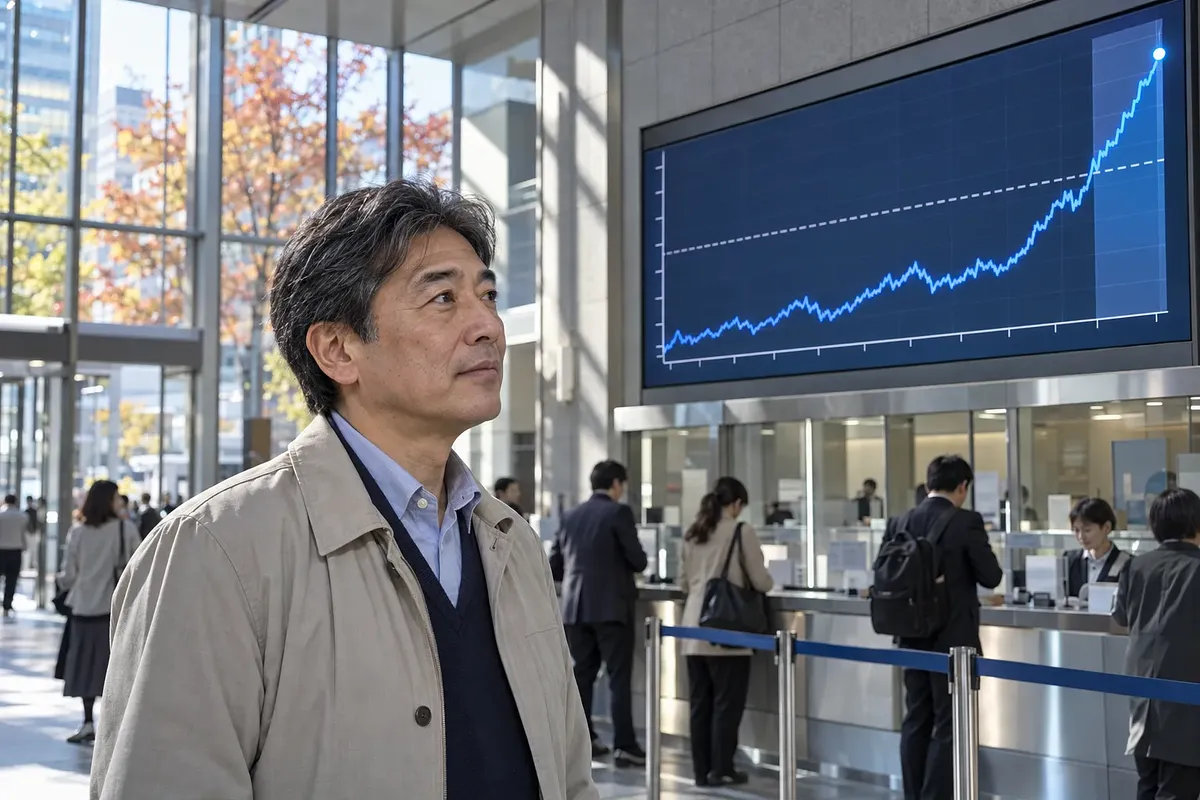
A weak yen can persist even if Japan raises interest rates, as long as a rate gap with the United States remains. Market expectations for interest rates and the flow of overseas investment also matter. When buying yen with Korean won, you need to look at both the dollar-yen and won-dollar exchange rates.
The policy rate figures are based on announcements by the U.S. and Japanese central banks in September 2026.
Which exchange rate defines a weak yen?
A weak yen means the yen has fallen in value against another currency. The dollar-yen exchange rate shows how many yen are needed to buy one dollar. When that number rises, the yen falls against the dollar.
The won-yen exchange rate is usually shown as the won needed to buy 100 yen. When that number falls, you can buy yen more cheaply with won. Because the two rates use different reference currencies, they may not move in the same direction.
| Quotation | When the number rises | When the number falls |
|---|---|---|
| Yen per dollar, yen/dollar | Yen weakens against the dollar | Yen strengthens against the dollar |
| Won per 100 yen, won/100 yen | Yen strengthens against the won | Yen weakens against the won |
Reports of a long-term low in the summer of 2026 concerned the yen against the dollar. In an August 3 report, AP said the dollar-yen rate had briefly exceeded 164 yen in July. The same report described this as the dollar’s strongest level in about 40 years. It should not be read as a historic low in the won-yen exchange rate. AP’s August 3, 2026, exchange rate report

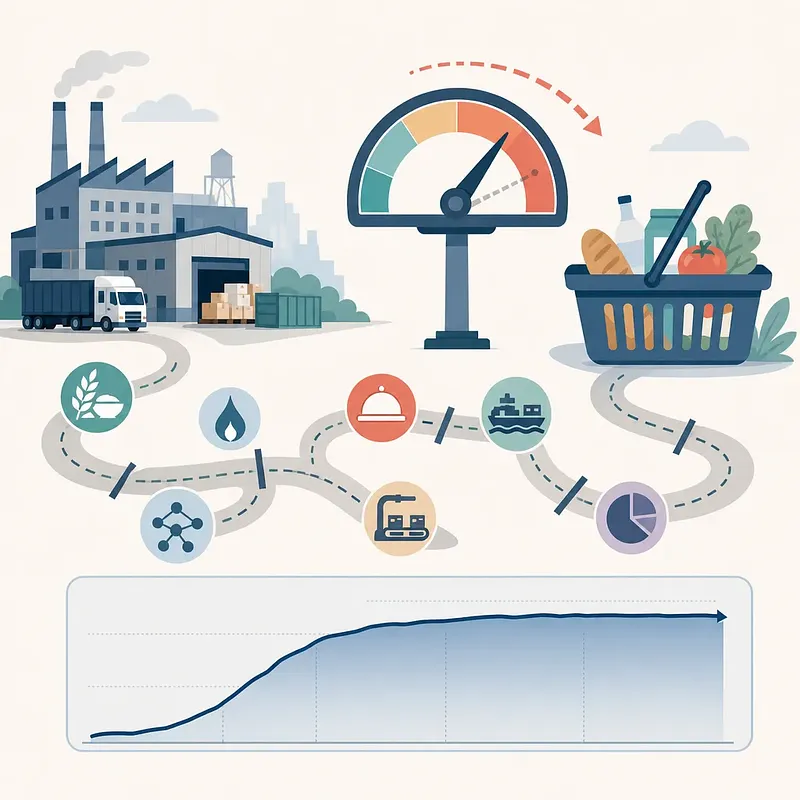
A weaker yen can raise the cost of imported goods for households.
Why is the yen weak even after an interest rate increase?
Exchange rates respond to relative investment conditions, not just the size of Japan’s rate increase. If U.S. rates remain higher, dollar assets retain their interest-rate appeal. Markets also price in expected future rate differences ahead of time.
The Bank of Japan (日本銀行) decided to raise its policy rate on September 18, 2026. Its target for the uncollateralized overnight call rate is around 1.25% per year. The new guideline takes effect on September 24. Bank of Japan announcement of a change in its money market operations guideline
The Bank will encourage the uncollateralized overnight call rate to remain at around 1.25 percent.
Bank of Japan, Change in the Guideline for Money Market Operations, September 18, 2026
This is a target for guiding very short-term interest rates between financial institutions. It does not mean individuals can borrow yen at the same rate. Actual lending rates reflect creditworthiness and the financial institution’s terms.
| Comparison | September 2026 decision | Interpretation |
|---|---|---|
| Japanese policy rate | Around 1.25% per year | Bank of Japan’s short-term rate target |
| U.S. policy rate | 3.75% to 4.00% per year | Target range for the federal funds rate |
| U.S.-Japan policy rate gap | 2.50 to 2.75 percentage points | U.S. target range minus Japan’s target |
The U.S. Federal Reserve also decided to raise its policy rate on September 16. Japan’s increase alone therefore does not show that the rate gap between the two countries narrowed substantially. The gap above is a simple comparison of policy rates. It is not the return on an investment in U.S. Treasury securities. Federal Reserve’s September 2026 FOMC statement
An expected rate increase may be reflected in exchange rates before it is announced. If subsequent increases come more slowly than expected, demand to buy yen may weaken. The yen’s weakness after a rate increase alone does not establish that the policy had no effect.
How does the yen carry trade work?
A yen carry trade involves raising funds in low-interest-rate yen. Investors use the borrowed money to buy assets in other currencies that they expect to yield higher returns. Selling yen in this process can put downward pressure on the currency.
But the interest rate difference is not a guaranteed return. If the yen strengthens, the cost of repaying the borrowed yen rises. A fall in the price of the assets held can also cause losses. BIS analyzed how the unwinding of leveraged investments amplified market volatility in August 2024. BIS analysis of carry trade unwinding
- Funding rate: The interest charged on an actual yen loan.
- Investment return: Interest earned on the investment assets and gains or losses from price changes.
- Foreign exchange gain or loss: The gain or loss when converting funds back into yen.
- Transaction costs: Currency conversion costs, fees, and other expenses.
Currency hedging is a transaction that reduces exchange rate risk. But hedging costs also reflect the interest rate difference between the two countries. It is therefore difficult to eliminate exchange rate risk while still capturing the full rate difference. BIS explanation of currency hedging and interest rate differences
Why is the yen weak despite a current account surplus?
Not all of a current account surplus leads to immediate yen purchases. The current account includes interest and dividends from overseas investments. It also includes some profits that overseas subsidiaries retain locally.
The Bank of Japan’s balance of payments FAQ explains how reinvested earnings are treated. Retained earnings at an overseas subsidiary are recorded as income attributable to its parent company. At the same time, they are recorded as reinvestment in the financial account. They are recorded even if no money is sent to Japan or converted into yen. Bank of Japan balance of payments statistics FAQ
Simply subtracting overseas investment from the current account surplus can therefore be inaccurate. The same reinvestment transaction may have corresponding entries in both statistics. To compare them, first align their periods and coverage.
| Distinction to check | Easy to confuse | Correct interpretation |
|---|---|---|
| Flows and stocks | Annual overseas investment and overseas assets at year-end | Distinguish transactions over a period from holdings at a point in time |
| Gross and net figures | Overseas investment purchases and net investment | Check whether sales, recoveries, and investment in the opposite direction are reflected |
| Income and currency conversion | Profits earned overseas and yen purchases | Distinguish local reinvestment from actual currency conversion |
| Statistical period | Annual and half-year figures | Compare figures for the same period |
NISA is a Japanese account system that provides tax benefits on investment returns. Which assets the money in those accounts is invested in is a separate question. The entire amount invested through NISA cannot be treated as overseas investment or yen sales. Japan Financial Services Agency’s explanation of NISA
Why is foreign exchange intervention unlikely to change the trend?
Intervention to buy yen directly increases demand for the currency. It cannot, however, eliminate the interest rate gap between the two countries or investors’ long-term outlook. Incentives to sell yen may remain after the intervention.
On August 3, 2026, AP reported confirmation of intervention by both the U.S. and Japan. The dollar-yen rate fell to around 155.20 yen during trading that day. But it is difficult to isolate the effect of intervention from the entire exchange rate change over a given period. Economic data and interest rate expectations can change at the same time. AP report on U.S.-Japan foreign exchange intervention
Japan’s Ministry of Finance (財務省) publishes its own intervention amounts separately. The total for July 30 through August 26, 2026, was 15.3993 trillion yen. That is the Japanese amount for the entire reporting period. It should not be read as the total for one day of joint U.S.-Japan intervention. Ministry of Finance announcement of August 28, 2026
When assessing the effect of intervention, make these distinctions:
- Short-term effect: Check whether it eased sharp exchange rate movements.
- Lasting effect: Check whether interest rate expectations and capital flows changed afterward.
- Scope of the figures: Distinguish estimates from official amounts.
- Participants: Look at the Japanese and U.S. amounts separately.
The relationship between fiscal expansion and rising government bond yields
A rise in government bond yields does not always mean a stronger yen. Its effect on the currency depends on why yields rose. Investors may also demand higher interest rates because of concerns about public finances.
| Reason government bond yields rise | Possible market signal | Possible effect on the yen |
|---|---|---|
| Improved growth outlook | Higher expected investment returns and interest rates | May support demand for yen |
| Inflation concerns | Concern about declining purchasing power | Depends on the central bank’s response |
| Increased bond supply | Need to absorb more bonds | Depends on demand and the policy response |
| Weaker confidence in public finances | Demand for extra compensation for risk | May accompany a weaker yen |
Sanae Takaichi’s (高市早苗) government pursued a reduction in the consumption tax on food. A related bill was also mentioned at a September 17, 2026, press conference. The same press conference explained that funding for the entire measure would be considered alongside budget reforms. There is insufficient basis to conclude that the policy would be funded entirely through government bonds. Japanese Prime Minister’s Office press conference of September 17, 2026
Government targets for encouraging investment must also be distinguished from actual government spending. If private investment is included, the entire amount is not a fiscal burden. The confirmed budget and bond issuance plan are needed to determine how much funding the government will actually raise.
There are also limits to calculating costs by multiplying existing government debt by the increase in interest rates. Interest on fixed-rate government bonds does not change immediately when market rates rise. The burden appears through new issuance and refinancing debt as it matures. Refinancing means replacing maturing debt with new debt.