Skip to content
Injoys
Knowledge Base

2026 Chuseok Charye Table: Five-Row Layout and Simplification Guidelines

The date of Chuseok in 2026 should be confirmed using the government's official public holiday calendar. A traditional charye table is commonly described as having five rows, starting from the side nearest the spirit tablet: rice and soup; grilled dishes and jeon; tang; seasoned vegetables and dried foods; and fruit. However, the five-row layout and sayings such as hongdongbaekseo are not absolute rules, so families may reduce the number of dishes and the preparation work according to their traditions and circumstances.

Listen or read this article

15:56

Listen, or read the text only.

2026 Chuseok Charye Table: Five-Row Layout and Simplification Guidelines

Kokoro 82M AI-generated voice 16 min read

0:00 15:56

Advertisement

Download audio

File name
2026-chuseok-charye-table-five-row-simplification-guide-en.mp3
Format
MP3 (audio/mpeg)
Duration
15:56
File size
10.9 MB
Engine
Kokoro 82M

This audio was generated by AI.

You may download and use it freely for personal use.

2026 Chuseok Charye Table: Five-Row Layout and Simplification Guidelines

13 min read

2026 Chuseok Charye Table: Five-Row Layout and Simplification Guidelines
The date of Chuseok in 2026 should be confirmed using the government's official public holiday calendar. A traditional charye table is commonly described as having five rows, starting from the side nearest the spirit tablet: rice and soup; grilled dishes and jeon; tang; seasoned vegetables and dried foods; and fruit. However, the five-row layout and sayings such as hongdongbaekseo are not absolute rules, so families may reduce the number of dishes and the preparation work according to their traditions and circumstances.
The exact dates of Chuseok Day and the statutory holiday period in 2026 should be confirmed using the government's official public holiday calendar.
The five-row charye table is a customary arrangement described as placing rice and soup; grilled dishes and jeon; tang; seasoned vegetables and dried foods; and fruit, starting from the side nearest the spirit tablet.
Hongdongbaekseo, joyulisi, and eodongyukseo are not absolute ancestral rite rules that apply to every household nationwide.
Jeon and fried foods, several types of tang, and numerous varieties of fruit are difficult to regard as mandatory dishes.
When simplifying the rite, it is practical for the family to agree not only on the number of dishes but also on who is responsible, cooking methods, whether to use a paper spirit tablet, the order of the ritual, and how to handle leftovers.
The date and day of the week for Chuseok 2026 should be checked against the government’s official public holiday calendar. Families that hold charye rites can make use of the holiday period, but the actual preparation time will vary depending on work schedules and travel plans.
A charye table is often explained in terms of a five-row arrangement and various placement maxims. However, rather than being a single rule applied uniformly nationwide, this is closer to a model summarizing practices that vary by era, region, and family. To respect tradition while reducing food waste and the burden of preparation, it is necessary to distinguish what is essential from what is optional.
Chuseok 2026 Date and Preparation Schedule
The exact date and day of the week for Chuseok in 2026 should be checked against the government’s official public holiday calendar. Under the regulations governing public holidays for government offices, the day before Chuseok, Chuseok itself, and the following day are public holidays, and the exact dates and days of the week should be checked against the government’s official public holiday calendar.
Date | Day | Scheduling significance September 23 | Wednesday | A weekday well suited to starting shopping and travel early September 24 | Thursday | The day before Chuseok; advance cooking and table-setting preparations are possible September 25 | Friday | Chuseok September 26 | Saturday | The day after Chuseok September 27 | Sunday | Can be combined with weekend travel home and cleanup plans
Even if the holiday appears long on the calendar, preparation time may not be sufficient if travel takes a long time or some family members work shifts. It is reasonable to first confirm the number of attendees and the time of the charye rite, then work backward to determine the scope of shopping and cooking.
How Are Charye and Gijesa Different?
Charye is a rite honoring ancestors on holidays such as Seollal or Chuseok, while gijesa is generally held based on the date an ancestor died. Although the procedures may look similar depending on the household, charye is often observed relatively simply with holiday foods.
Chuseok charye reflects the custom of expressing gratitude by offering newly harvested rice and seasonal produce. Songpyeon is a representative food, but not every household must follow the same menu and sequence. Depending on religion, region, family tradition, and agreement among family members, some households omit charye or replace it with a memorial gathering.
Basic Five-Row Charye Table Arrangement
The five rows are generally described as being counted from the side where the ancestral tablet is placed, rather than from the side of the person facing the table. However, because the number of rows and the positions of foods differ by family, any long-standing family practice should be checked first.
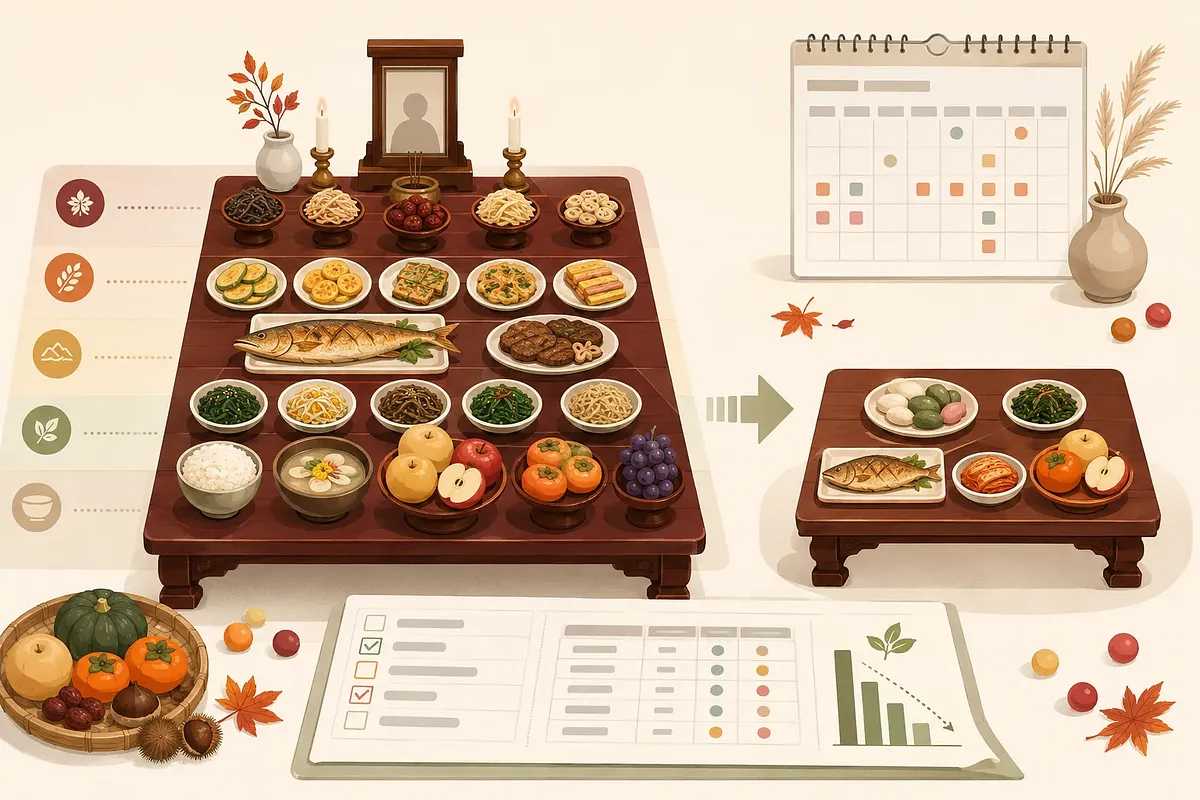
Row | Distance from ancestral tablet | Representative foods | Considerations when simplifying 1st row | Closest | Rice, soup, wine cup, spoon and chopsticks, songpyeon | For Chuseok, some households center the arrangement on songpyeon and omit rice and soup 2nd row | Second | Grilled dishes, skewered dishes, jeon, etc. | The selection may be reduced to one grilled dish, or jeon may be omitted 3rd row | Middle | Meat soup, fish soup, vegetable soup, etc. | Instead of several soups, only one may be prepared, or soup may be omitted 4th row | Fourth | Seasoned vegetables, dried meat or fish, kimchi, sikhye, etc. | The number of seasoned vegetable dishes may be reduced, and everyday side dishes may be used 5th row | Outermost | Fruits such as jujubes, chestnuts, pears, and persimmons | A few seasonal fruits may be selected instead of following a fixed number
This table is a representative model for understanding traditional table arrangements. It does not mean that charye is valid only when every item is included. A table with fewer than five rows may be used, or a simple arrangement may consist only of songpyeon, seasoned vegetables, a grilled dish, kimchi, and fruit.
Whose Perspective Determines the Table’s Left and Right?
Descriptions of charye table arrangements often determine left and right from the perspective of the ancestral tablet facing the food. When the person preparing the table faces it, left and right may appear reversed, causing confusion.
However, standards vary by family, and the placement maxims themselves are not universally mandatory rules. Rather than arguing over positions immediately before the rite, it is practical to check existing photographs or family records and, if no records exist, choose one standard and arrange everything consistently.
Are Hongdongbaekseo, Joyurisii, and Eodongyukseo Absolute Rules?
The following Sino-Korean maxims are often used to explain the placement of foods on a charye table.
· Hongdongbaekseo: Red fruits are placed in the east and white fruits in the west · Joyurisii: Jujubes, chestnuts, pears, and persimmons are placed in that order · Eodongyukseo: Fish is placed in the east and meat in the west · Dudongmiseo: Fish heads point east and tails point west · Jwapouhye: Dried meat or fish is placed on the left and sikhye on the right
These expressions are widely used in modern guides to charye table arrangements, but it is difficult to regard them as a single set of etiquette rules that every family nationwide must follow. Some placement instructions conflict with one another, and practices also vary by region. It has also been noted that universal grounds for these rules are difficult to find in old books on rites, so the simplification guidance issued by the Sungkyunkwan Committee for the Establishment of Ritual Standards does not present these maxims as mandatory rules.
Accordingly, a family may follow its customary placement method, or, if it has no separate tradition, arrange foods attractively and safely by category.
Must Jeon and Oily Foods Be Offered?
Making large quantities of jeon is a major factor increasing the workload of modern holiday preparations. However, there is no universal rule requiring jeon or foods pan-fried in oil to be offered. The simplification approach presented by the Sungkyunkwan Committee for the Establishment of Ritual Standards also does not treat jeon as an essential food.
The following foods may be reduced or omitted by family agreement.
· Multiple types of jeon and fried foods · Several soups separately prepared with meat, fish, and vegetables · Grilled and skewered dishes made using similar cooking methods · Additional seasoned vegetables included to create a color arrangement · Numerous fruits included to follow a prescribed order · Large quantities of food that are difficult to consume after charye
Simplification is not the same as eliminating all traditional foods. One or two dishes that are especially meaningful to the family can be retained, while foods that take a long time to prepare or are not ordinarily eaten can be reduced first.
How Can a Simplified Charye Table Be Arranged?
The widely known Sungkyunkwan example of a simplified arrangement consists of songpyeon, seasoned vegetables, a grilled dish, kimchi, fruit, and similar foods. This is not a new mandatory standard but a proposal intended to show that excessive table arrangements can be reduced.
Households can choose even simpler arrangements as follows.
Example arrangement | Foods Basic | Songpyeon, seasoned vegetables, a grilled dish, kimchi, fruit Minimal cooking | Songpyeon, one seasoned vegetable dish, fruit, and wine or another beverage Family meal combination | Offer songpyeon and seasonal fruit first, then separately prepare a meal to share after the rite
More important than the number of foods is for the family to discuss the meaning and method in advance. No single arrangement is the correct answer for every household.
How Should a Jibang or Photograph Be Prepared?
A jibang is a paper ancestral tablet on which an ancestor’s title is written when a permanent spirit tablet is not enshrined. The wording may vary according to the relationship between the ancestor and the officiant, the ancestor’s sex, and whether an official title is included, making it difficult to apply one example unchanged to every household.
Checking family records or an existing jibang is the most accurate approach. Depending on the household, a photograph of the deceased may be placed instead of a jibang, or a memorial marker bearing only the person’s name may be used. Whether to use a photograph or a jibang is also a matter for family agreement, not a government-mandated requirement.
Even if there is a custom of burning the jibang after the rite, it should not be burned inside an apartment, on a balcony, or in any location where the use of fire is prohibited. It should be disposed of safely in consideration of fire risks and building management regulations.
General Sequence of Chuseok Charye
Specific ancestral rite procedures and the number of bows vary greatly by family. When conducted simply, the rite can follow this sequence.
· Prepare the table and the ancestral tablet or photograph. · Attendees compose themselves and greet the ancestors as a gesture of welcome. · Offer wine or another beverage and bow or observe a moment of silence. · Pause to remember the deceased or allow the family to share their thoughts. · Give a final farewell and clear the table. · Hold eumbok, in which the family shares the food that was offered.
Some households follow traditional procedures such as gangsin, chamsin, heonju, sapsijeongjeo, and sasin. Others may simplify the rite by offering wine once and observing a moment of silence. If changing existing procedures, checking the opinions of elders and attendees before the holiday rather than on the day itself can reduce conflict.
Matters to Decide in Advance Through Family Agreement
Simplification does not end with reducing the number of foods. To reduce the actual workload, the family should also decide together who will prepare what and when the rite will be held.
· Whether to hold charye or replace it with a memorial gathering or a visit to ancestral graves · Whether to use an ancestral tablet, jibang, or photograph · Which foods to retain and which to omit · Which foods to cook at home and which to purchase · Who will handle shopping, cooking, table setting, and dishwashing · The scope of the ritual, including bows, silent remembrance, and wine offerings · Attendees’ dietary requirements, including vegetarian diets, allergies, and medical conditions · How leftover food will be divided and stored · The total budget and how costs will be divided among participants
There is no legal rule requiring charye preparations to be concentrated on a particular gender or one person. As it is a family rite, responsibilities can be divided according to attendees’ available time, health, and cooking ability.
Criteria to Check When Comparing Costs
The cost of a charye table varies greatly depending on the number of items, number of attendees, place of origin, place of purchase, and whether prepared foods are used. A single figure from a particular year cannot easily be applied as the expected cost for every household.
Prices by item, region, and market for agricultural products can be checked through KAMIS, operated by the Korea Agro-Fisheries & Food Trade Corporation. However, KAMIS prices do not represent the total cost of a charye table, including cooking labor, prepared food prices, and delivery charges.
When comparing costs, the following conditions must be kept the same.
· Actual number of attendees and required quantity of each food · Place of purchase, such as a traditional market, large retailer, or online store · Difference between raw ingredients and fully prepared foods · Differences between domestic and imported products and between grades · Delivery and packaging charges, and the amount of leftover food
Simplification That Also Considers Food Safety and Leftovers
Food safety and waste volume are easily overlooked in table-setting guidance. Charye foods are often left at room temperature for long periods after cooking, and cross-contamination may occur as multiple people move and share them.
· Use separate utensils for cooked foods and raw fish or meat ingredients. · Do not leave cooked food at room temperature for long periods, and place only the required amount on the table. · Divide leftovers by type and refrigerate or freeze them promptly. · Do not eat food if its storage conditions are uncertain or its smell or color has changed. · Check in advance for allergenic ingredients and the needs of attendees who cannot drink alcohol.
Preparing only as much as can be eaten from the outset is a form of simplification that simultaneously reduces costs, labor, and food waste.
Key Points
The five-row charye table is a reference model for understanding traditional arrangements, not a rule imposed on every household. Maxims such as hongdongbaekseo and joyurisii also do not need to be treated as absolute standards.
When preparing for Chuseok charye in 2026, first choose items meaningful to the family, such as songpyeon and seasonal foods, and reduce the varieties of jeon, soup, and fruit to match the amount that will actually be eaten. The key to simplification is agreeing before the holiday on the number of foods, ritual sequence, division of responsibilities, and whether to use a jibang.
0:00 0:00
1 / 62

Advertisement

Download text

File name
2026-chuseok-charye-table-five-row-simplification-guide-en.txt
Format
TXT (text/plain)
Paragraphs
62

Downloads exactly what you see as a text file.

Please cite the source when quoting.

Large text

Makes the text larger and the colors clearer. Turn it on if the text feels too small.

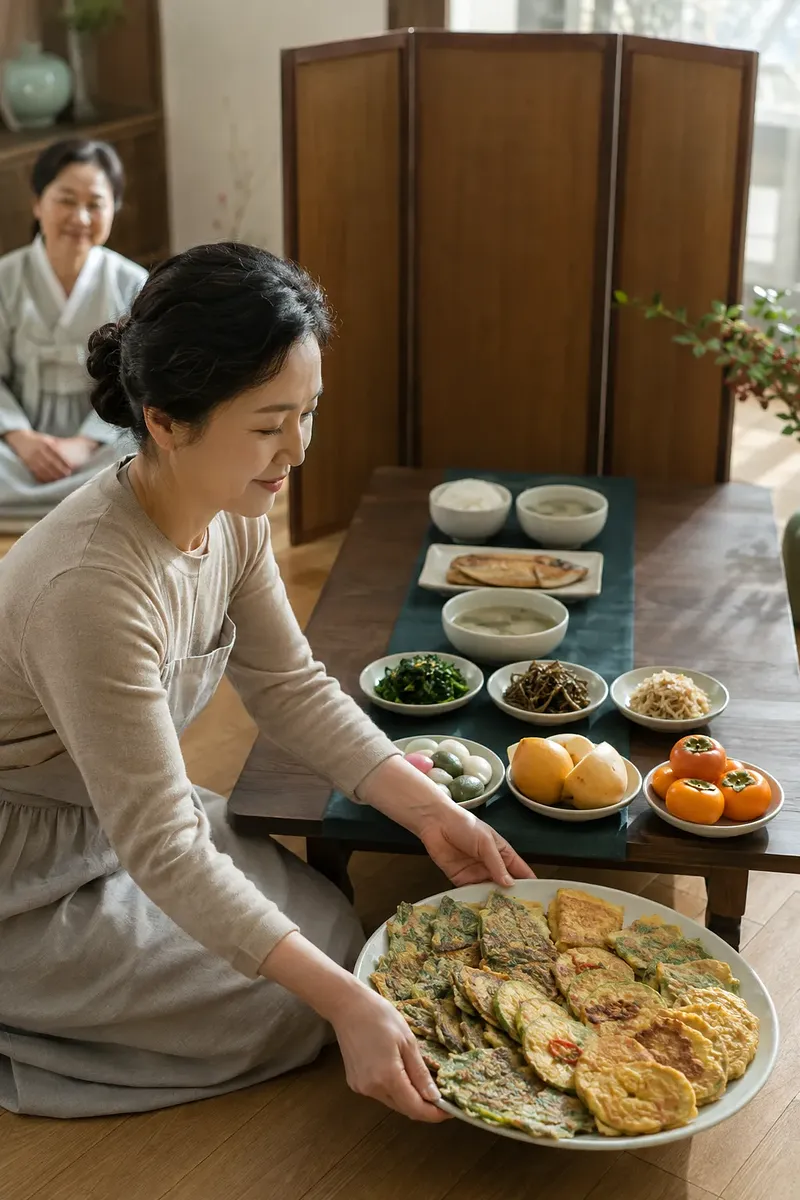
Two women prepare a Chuseok ritual table with jeon, fruit, vegetables, rice, and soup.

Key points

  • The exact dates of Chuseok Day and the statutory holiday period in 2026 should be confirmed using the government's official public holiday calendar.
  • The five-row charye table is a customary arrangement described as placing rice and soup; grilled dishes and jeon; tang; seasoned vegetables and dried foods; and fruit, starting from the side nearest the spirit tablet.
  • Hongdongbaekseo, joyulisi, and eodongyukseo are not absolute ancestral rite rules that apply to every household nationwide.
  • Jeon and fried foods, several types of tang, and numerous varieties of fruit are difficult to regard as mandatory dishes.
  • When simplifying the rite, it is practical for the family to agree not only on the number of dishes but also on who is responsible, cooking methods, whether to use a paper spirit tablet, the order of the ritual, and how to handle leftovers.

The date and day of the week for Chuseok 2026 should be checked against the government’s official public holiday calendar. Families that hold charye rites can make use of the holiday period, but the actual preparation time will vary depending on work schedules and travel plans.

A charye table is often explained in terms of a five-row arrangement and various placement maxims. However, rather than being a single rule applied uniformly nationwide, this is closer to a model summarizing practices that vary by era, region, and family. To respect tradition while reducing food waste and the burden of preparation, it is necessary to distinguish what is essential from what is optional.

Chuseok 2026 Date and Preparation Schedule

The exact date and day of the week for Chuseok in 2026 should be checked against the government’s official public holiday calendar. Under the regulations governing public holidays for government offices, the day before Chuseok, Chuseok itself, and the following day are public holidays, and the exact dates and days of the week should be checked against the government’s official public holiday calendar.

Date Day Scheduling significance
September 23 Wednesday A weekday well suited to starting shopping and travel early
September 24 Thursday The day before Chuseok; advance cooking and table-setting preparations are possible
September 25 Friday Chuseok
September 26 Saturday The day after Chuseok
September 27 Sunday Can be combined with weekend travel home and cleanup plans

Even if the holiday appears long on the calendar, preparation time may not be sufficient if travel takes a long time or some family members work shifts. It is reasonable to first confirm the number of attendees and the time of the charye rite, then work backward to determine the scope of shopping and cooking.

How Are Charye and Gijesa Different?

Charye is a rite honoring ancestors on holidays such as Seollal or Chuseok, while gijesa is generally held based on the date an ancestor died. Although the procedures may look similar depending on the household, charye is often observed relatively simply with holiday foods.

Chuseok charye reflects the custom of expressing gratitude by offering newly harvested rice and seasonal produce. Songpyeon is a representative food, but not every household must follow the same menu and sequence. Depending on religion, region, family tradition, and agreement among family members, some households omit charye or replace it with a memorial gathering.

Basic Five-Row Charye Table Arrangement

The five rows are generally described as being counted from the side where the ancestral tablet is placed, rather than from the side of the person facing the table. However, because the number of rows and the positions of foods differ by family, any long-standing family practice should be checked first.

Row Distance from ancestral tablet Representative foods Considerations when simplifying
1st row Closest Rice, soup, wine cup, spoon and chopsticks, songpyeon For Chuseok, some households center the arrangement on songpyeon and omit rice and soup
2nd row Second Grilled dishes, skewered dishes, jeon, etc. The selection may be reduced to one grilled dish, or jeon may be omitted
3rd row Middle Meat soup, fish soup, vegetable soup, etc. Instead of several soups, only one may be prepared, or soup may be omitted
4th row Fourth Seasoned vegetables, dried meat or fish, kimchi, sikhye, etc. The number of seasoned vegetable dishes may be reduced, and everyday side dishes may be used
5th row Outermost Fruits such as jujubes, chestnuts, pears, and persimmons A few seasonal fruits may be selected instead of following a fixed number

This table is a representative model for understanding traditional table arrangements. It does not mean that charye is valid only when every item is included. A table with fewer than five rows may be used, or a simple arrangement may consist only of songpyeon, seasoned vegetables, a grilled dish, kimchi, and fruit.

Whose Perspective Determines the Table’s Left and Right?

Descriptions of charye table arrangements often determine left and right from the perspective of the ancestral tablet facing the food. When the person preparing the table faces it, left and right may appear reversed, causing confusion.

However, standards vary by family, and the placement maxims themselves are not universally mandatory rules. Rather than arguing over positions immediately before the rite, it is practical to check existing photographs or family records and, if no records exist, choose one standard and arrange everything consistently.

Are Hongdongbaekseo, Joyurisii, and Eodongyukseo Absolute Rules?

The following Sino-Korean maxims are often used to explain the placement of foods on a charye table.

  • Hongdongbaekseo: Red fruits are placed in the east and white fruits in the west
  • Joyurisii: Jujubes, chestnuts, pears, and persimmons are placed in that order
  • Eodongyukseo: Fish is placed in the east and meat in the west
  • Dudongmiseo: Fish heads point east and tails point west
  • Jwapouhye: Dried meat or fish is placed on the left and sikhye on the right

These expressions are widely used in modern guides to charye table arrangements, but it is difficult to regard them as a single set of etiquette rules that every family nationwide must follow. Some placement instructions conflict with one another, and practices also vary by region. It has also been noted that universal grounds for these rules are difficult to find in old books on rites, so the simplification guidance issued by the Sungkyunkwan Committee for the Establishment of Ritual Standards does not present these maxims as mandatory rules.

Accordingly, a family may follow its customary placement method, or, if it has no separate tradition, arrange foods attractively and safely by category.

Must Jeon and Oily Foods Be Offered?

Making large quantities of jeon is a major factor increasing the workload of modern holiday preparations. However, there is no universal rule requiring jeon or foods pan-fried in oil to be offered. The simplification approach presented by the Sungkyunkwan Committee for the Establishment of Ritual Standards also does not treat jeon as an essential food.

The following foods may be reduced or omitted by family agreement.

  • Multiple types of jeon and fried foods
  • Several soups separately prepared with meat, fish, and vegetables
  • Grilled and skewered dishes made using similar cooking methods
  • Additional seasoned vegetables included to create a color arrangement
  • Numerous fruits included to follow a prescribed order
  • Large quantities of food that are difficult to consume after charye

Simplification is not the same as eliminating all traditional foods. One or two dishes that are especially meaningful to the family can be retained, while foods that take a long time to prepare or are not ordinarily eaten can be reduced first.

How Can a Simplified Charye Table Be Arranged?

The widely known Sungkyunkwan example of a simplified arrangement consists of songpyeon, seasoned vegetables, a grilled dish, kimchi, fruit, and similar foods. This is not a new mandatory standard but a proposal intended to show that excessive table arrangements can be reduced.

Households can choose even simpler arrangements as follows.

Example arrangement Foods
Basic Songpyeon, seasoned vegetables, a grilled dish, kimchi, fruit
Minimal cooking Songpyeon, one seasoned vegetable dish, fruit, and wine or another beverage
Family meal combination Offer songpyeon and seasonal fruit first, then separately prepare a meal to share after the rite

More important than the number of foods is for the family to discuss the meaning and method in advance. No single arrangement is the correct answer for every household.

How Should a Jibang or Photograph Be Prepared?

A jibang is a paper ancestral tablet on which an ancestor’s title is written when a permanent spirit tablet is not enshrined. The wording may vary according to the relationship between the ancestor and the officiant, the ancestor’s sex, and whether an official title is included, making it difficult to apply one example unchanged to every household.

Checking family records or an existing jibang is the most accurate approach. Depending on the household, a photograph of the deceased may be placed instead of a jibang, or a memorial marker bearing only the person’s name may be used. Whether to use a photograph or a jibang is also a matter for family agreement, not a government-mandated requirement.

Even if there is a custom of burning the jibang after the rite, it should not be burned inside an apartment, on a balcony, or in any location where the use of fire is prohibited. It should be disposed of safely in consideration of fire risks and building management regulations.

General Sequence of Chuseok Charye

Specific ancestral rite procedures and the number of bows vary greatly by family. When conducted simply, the rite can follow this sequence.

  1. Prepare the table and the ancestral tablet or photograph.
  2. Attendees compose themselves and greet the ancestors as a gesture of welcome.
  3. Offer wine or another beverage and bow or observe a moment of silence.
  4. Pause to remember the deceased or allow the family to share their thoughts.
  5. Give a final farewell and clear the table.
  6. Hold eumbok, in which the family shares the food that was offered.

Some households follow traditional procedures such as gangsin, chamsin, heonju, sapsijeongjeo, and sasin. Others may simplify the rite by offering wine once and observing a moment of silence. If changing existing procedures, checking the opinions of elders and attendees before the holiday rather than on the day itself can reduce conflict.

Matters to Decide in Advance Through Family Agreement

Simplification does not end with reducing the number of foods. To reduce the actual workload, the family should also decide together who will prepare what and when the rite will be held.

  • Whether to hold charye or replace it with a memorial gathering or a visit to ancestral graves
  • Whether to use an ancestral tablet, jibang, or photograph
  • Which foods to retain and which to omit
  • Which foods to cook at home and which to purchase
  • Who will handle shopping, cooking, table setting, and dishwashing
  • The scope of the ritual, including bows, silent remembrance, and wine offerings
  • Attendees’ dietary requirements, including vegetarian diets, allergies, and medical conditions
  • How leftover food will be divided and stored
  • The total budget and how costs will be divided among participants

There is no legal rule requiring charye preparations to be concentrated on a particular gender or one person. As it is a family rite, responsibilities can be divided according to attendees’ available time, health, and cooking ability.

Criteria to Check When Comparing Costs

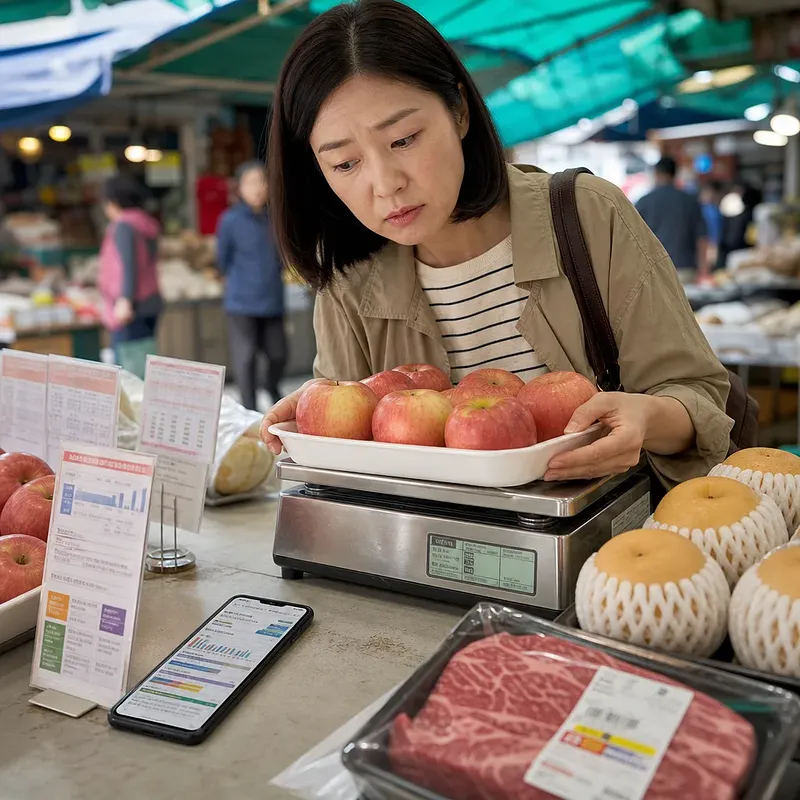
The cost of a charye table varies greatly depending on the number of items, number of attendees, place of origin, place of purchase, and whether prepared foods are used. A single figure from a particular year cannot easily be applied as the expected cost for every household.

Prices by item, region, and market for agricultural products can be checked through KAMIS, operated by the Korea Agro-Fisheries & Food Trade Corporation. However, KAMIS prices do not represent the total cost of a charye table, including cooking labor, prepared food prices, and delivery charges.

When comparing costs, the following conditions must be kept the same.

  • Actual number of attendees and required quantity of each food
  • Place of purchase, such as a traditional market, large retailer, or online store
  • Difference between raw ingredients and fully prepared foods
  • Differences between domestic and imported products and between grades
  • Delivery and packaging charges, and the amount of leftover food

Simplification That Also Considers Food Safety and Leftovers

Food safety and waste volume are easily overlooked in table-setting guidance. Charye foods are often left at room temperature for long periods after cooking, and cross-contamination may occur as multiple people move and share them.

  • Use separate utensils for cooked foods and raw fish or meat ingredients.
  • Do not leave cooked food at room temperature for long periods, and place only the required amount on the table.
  • Divide leftovers by type and refrigerate or freeze them promptly.
  • Do not eat food if its storage conditions are uncertain or its smell or color has changed.
  • Check in advance for allergenic ingredients and the needs of attendees who cannot drink alcohol.

Preparing only as much as can be eaten from the outset is a form of simplification that simultaneously reduces costs, labor, and food waste.

Key Points

The five-row charye table is a reference model for understanding traditional arrangements, not a rule imposed on every household. Maxims such as hongdongbaekseo and joyurisii also do not need to be treated as absolute standards.

When preparing for Chuseok charye in 2026, first choose items meaningful to the family, such as songpyeon and seasonal foods, and reduce the varieties of jeon, soup, and fruit to match the amount that will actually be eaten. The key to simplification is agreeing before the holiday on the number of foods, ritual sequence, division of responsibilities, and whether to use a jibang.

Sign-in required

Sign in with your Google account to like, comment, and save highlights.

Images

Two women prepare a Chuseok ritual table with jeon, fruit, vegetables, rice, and soup.
A full five-row ritual spread is shown alongside a smaller, simplified Chuseok table.

FAQ

When is Chuseok in 2026?

The date and day of the week of Chuseok in 2026 should be checked on the government's official public holiday calendar. The day before and the day after Chuseok are also statutory holiday observances, and the exact dates and days of the week should be checked on the government's official public holiday calendar.

Does a charye table have to be arranged in five rows?

It does not necessarily have to have five rows. Five rows are a common way of explaining how various foods are arranged by type, but the number of rows and dishes can be reduced depending on family traditions, the size of the table, and preparation circumstances.

From which side do you count the first row of a charye table?

In the common five-row arrangement, the row closest to the ancestral spirit tablet is counted as the first row. The outer row of fruit closest to the person preparing the table is the fifth row.

Must hongdongbaekseo and joyulisi be followed?

Hongdongbaekseo and joyulisi are widely used as conventional mnemonics for arranging a charye table, but they are not absolute rules that apply to every household. If there is no established family tradition, the types and placement of fruit can be decided according to the family's circumstances.

Is it acceptable not to place jeon on the Chuseok charye table?

There is no universal rule requiring jeon. Jeon or fried foods can be omitted, and the table can be kept simple with songpyeon, seasoned vegetables, grilled dishes, kimchi, fruit, and other foods.

Do all three types of soup have to be prepared?

There is no obligation to prepare meat soup, fish soup, and vegetable soup. It is also acceptable to prepare only one type or omit soup according to the family's principle of simplification.

Do jujubes, chestnuts, pears, and persimmons all have to be placed on the table?

Jujubes, chestnuts, pears, and persimmons are often mentioned in the arrangement mnemonic joyulisi, but they are not a mandatory list. You can place only an amount of readily available seasonal fruit that can actually be eaten.

Can a photo of the deceased be used instead of a paper ancestral tablet?

Depending on the household, a photo or a memorial marker bearing the person's name may be used instead of a paper ancestral tablet. Since there is no single national rule on this matter, it can be decided according to existing family traditions and agreement among the attendees.

Should only women prepare the charye?

There is no legal rule requiring a particular gender to prepare the charye. Shopping, cooking, setting the table, conducting the ceremony, and cleaning up can be divided among the attendees according to their time, health, and abilities.

Where can I check the cost of preparing a charye table?

Retail prices for agricultural products can be checked by item and region through KAMIS, operated by the Korea Agro-Fisheries & Food Trade Corporation. However, the total cost, including prepared food costs, delivery fees, and packaging costs, must be checked separately with the actual place of purchase.

Sources

Also available as video and a short read

Videos and a short write-up made from this content. Watch instead of reading, or skim the gist first.

Short version

Loading…

Data formats

This content is available in several machine-friendly formats.

Data-only languages (machine translated, files only)

Indonesian JSON MD Portuguese JSON MD Chinese (Traditional) JSON MD Deutsch JSON MD

Verification

Reviewed by 신익희 · 편집장 · 2026-09-04

Figures in this article were checked against the source material during generation. 8 correction(s) applied. · 2026-09-04

This translation has been cross-checked by AI. · 2026-09-04

Reuse & AI usage

Search indexing and AI citation with attribution are welcome. See the license policy for details.

CC BY · License

Loading…

Loading…

Related content

From Injoys

Request the content you want and take 70% of what it earns

Just leave the subject. We handle production, review, translation and distribution.

See how revenue sharing works

Comments