COVID-19 Vaccination 2026: Flu Coadministration and Errors
Coadministration of COVID-19 and flu vaccines is recommended, but it must be distinguished from unnecessary duplicate vaccination. For the 2026~2027 season, the points to check are eligibility and schedules, vaccination history, same-day registration, and the response to vaccination errors.
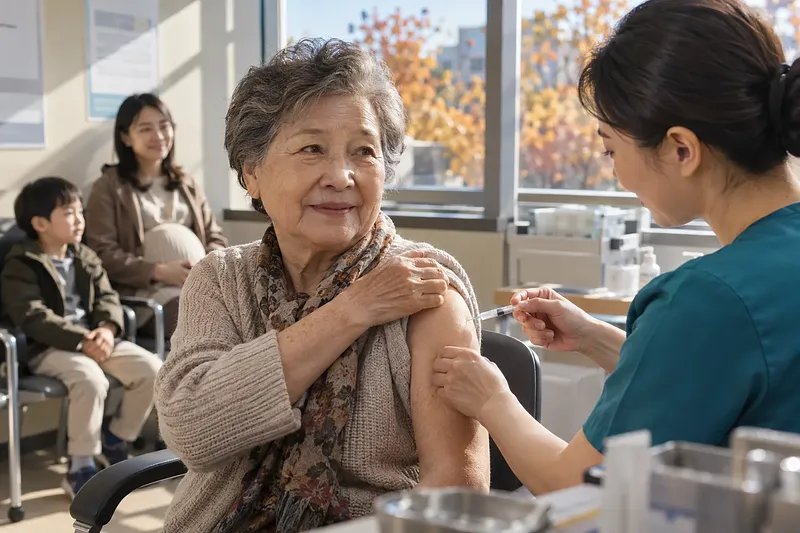
COVID-19 and influenza vaccines can be administered at the same time at different injection sites.
National COVID-19 vaccination for the 2026~2027 season is for people aged 65 and older, immunocompromised people, and inpatients and residents of facilities vulnerable to infection.
Vaccination schedules for high-risk children under 12 will be announced separately as vaccines are introduced.
Medical institutions must check vaccination history before vaccination and record the vaccination in the system on the day it is administered.
Vaccination errors must be reported to the public health center, and the affected person must be informed. Whether to revaccinate depends on the type of error.
Receiving COVID-19 and flu vaccines at the same visit is recommended. This differs from unnecessary duplicate vaccination, which means receiving the same vaccine again without a need. Healthcare providers must check vaccination histories before administering vaccines. After vaccination, they must register the records that same day.
Eligibility and schedules are based on the Korea Disease Control and Prevention Agency's program guidance dated October 19, 2026.
The difference between flu coadministration and duplicate vaccination
Coadministration means receiving vaccines that prevent different infectious diseases on the same day. The official name for flu is influenza. The Korea Disease Control and Prevention Agency recommends coadministration of COVID-19 and influenza vaccines. They must be given at different injection sites.
Category | Meaning | What to check
COVID-19 and flu coadministration | Receiving different vaccines on the same day | Check the vaccination requirements for each vaccine and administer them at different sites
Unnecessary duplicate vaccination | Receiving another dose after completing the required vaccinations | Check previous vaccination dates, vaccines received, and whether vaccination for this season has been completed
Additional vaccination according to guidelines | Giving additional doses required for specific groups | Check immune status and the applicable vaccination schedule
A second dose alone does not establish that a vaccination error has occurred. Separate dose requirements apply to immunocompromised people. The recommendation for coadministration also does not mean that individual contraindication checks can be skipped. The source is the Korea Disease Control and Prevention Agency's COVID-19 National Immunization Program Guidelines.
Eligibility and vaccination schedules for the 2026~2027 season
People aged 65 or older and designated high-risk groups are eligible for government-funded vaccination. This season, COVID-19 vaccination was designated an essential immunization. This change does not mean that vaccination is free for all ages.
Eligible group | Birth date or age criteria | Start date | End date
People aged 70 or older | Born on or before December 31, 1956 | October 12, 2026 | June 30, 2027
People aged 65~69 | Born from January 1, 1957, through December 31, 1961 | October 15, 2026 | June 30, 2027
Immunocompromised people, inpatients and residents of facilities vulnerable to infection | Aged at least 12 at the time of vaccination | October 12, 2026 | June 30, 2027
Immunocompromised people under 12, inpatients and residents under 12 of facilities vulnerable to infection | Detailed eligibility recommendations must be checked | Separate announcement after vaccines become available | Separate schedule must be checked
This table shows the COVID-19 vaccination schedule. It must not be treated as the full schedule for the flu vaccination program. High-risk groups under 12 must be distinguished from the schedule above for those aged 12 or older. Being eligible and the actual start of vaccination are separate matters.
The vaccines covered this season are Pfizer's and Moderna's XFG vaccines. The standard schedule is 1 dose per year. Immunocompromised people receive 2 doses per year. Hematopoietic stem cell transplant patients require a clinical assessment under separate criteria.
Immunocompromised status is not determined solely by a disease name. Treatment details and age-specific criteria are checked together. Facilities vulnerable to infection must also fall within the categories specified in the guidelines. The detailed source is the Korea Disease Control and Prevention Agency's Implementation Plan for the 2026~2027 Season.
Findings from the October request to prevent vaccination errors
The recent request for cooperation focused on checks before vaccination and same-day registration. The Korean Hospital Association posted the request on October 19, 2026. The supporting document is an official notice from the Korea Disease Control and Prevention Agency dated October 16, 2026.
The Korean Hospital Association's “Request for Cooperation Regarding the Influenza and COVID-19 National Immunization Programs” requested the following checks and actions.
Checking vaccine expiration dates and condition, and registering vaccination details in the system on the day of vaccination, among other measures
The numbers of reported vaccination errors listed in the posting are below. These figures reflect reports received as of the request for cooperation. They must not be read as cumulative totals through October 27, 2026.
Vaccine | Reports for the 2026~2027 season | Previous season's reports listed in the posting
Influenza | 57 | 5
COVID-19 | 8 | 5
Report counts alone cannot be used to calculate an individual's risk of a vaccination error. The posting does not include the total number of vaccinations needed to calculate an incidence rate. The text also does not specify the exact periods being compared. The figures come from the Korean Hospital Association's request for cooperation.
Checks before and after vaccination
Preventing vaccination errors extends from identifying the recipient to registering the vaccination afterward. Completing a pre-vaccination screening questionnaire is one step in this process. Completing the questionnaire alone does not mean that the vaccine and vaccination history have been checked.
· Verify the person's identity using at least two pieces of information, such as their name and date of birth.
· Look up previous vaccination records in the system.
· Check contraindications and precautions through the screening questionnaire and a medical examination.
· Cross-check the recipient and vaccine again immediately before administration.
· Check the vaccine's type, dose, expiration date, and condition.
· Register the vaccination in the system immediately afterward.
· Explain precautions and monitor for adverse events.
The 2026 National Immunization Guidelines also require similar vaccines to be stored separately. Refrigerator temperature and expiration date checks are part of routine management. These requirements apply alongside visual checks on the day of vaccination. The source is the vaccination safety section of the 2026 National Immunization Guidelines.
Screening questionnaires and limits on vaccination numbers
Screening questionnaires and limits on vaccination numbers are safeguards to prevent verification steps from being skipped. Whether vaccines are coadministered and how forms are managed must be understood separately. The latest screening questionnaire is available in the vaccination guidelines on Immunization Assistant.
The 2026 guidelines set a maximum of 100 people per day for each physician conducting pre-vaccination examinations. Influenza and COVID-19 vaccinations are counted separately. Because some categories, such as paid vaccinations, are excluded, this differs from the total number of visitors. Details on how the limit applies must be checked in the section on vaccination number limits in the National Immunization Guidelines.
Managing vaccine storage, transfers, and disposal
Vaccine management involves checking both inventory and storage conditions. Redistribution means transferring surplus vaccines to another institution for allocation. Redistribution, returns, and disposal must follow the guidelines for each vaccine.
The Korea Disease Control and Prevention Agency also announced improvements to procedures for responding to temperature excursions. These were included in the measures to strengthen vaccination safety announced on September 30, 2026. The announced improvement plans must not all be interpreted as procedures already in place. The source is the Measures to Strengthen Vaccine Quality Control and Vaccination Safety in the National Immunization Program.
Can someone be considered unvaccinated if there is no record?
The absence of a record on the search screen alone is not enough to conclude that someone is unvaccinated. There may be a delay between vaccination and registration in the system. The request for same-day registration can be understood as a measure to reduce this gap.
Situation identified | Interpretation | Necessary checks
A vaccination record exists for this season | A completed vaccination is confirmed | Check whether the person is eligible for an additional dose
No record exists, but the person says they were vaccinated | There is a discrepancy in the vaccination history | Cross-check the vaccination provider and date
The person cannot remember the vaccine name | They may have confused flu and COVID-19 vaccines | Check records for each vaccine
Vaccination is also being provided at another institution | Information must be checked between institutions | Check vaccination and registration records at each institution
This table is a verification framework that connects vaccination history checks with the principle of same-day registration. It is not an analysis establishing the causes of actual incidents. A guardian's recollection or appointment records must also be distinguished from actual vaccination records.
Responding to a vaccination error
Healthcare providers must disclose the vaccination error and report it to the public health center. The absence of symptoms does not justify withholding this information. Monitoring for adverse events and deciding whether revaccination is needed are handled separately.
· Inform the vaccine recipient or guardian of the vaccination error.
· Report the incident to the local public health center.
· Check the vaccine and vaccination details to classify the type of error.
· Determine whether revaccination is needed according to the guidelines for that error type.
· Monitor for adverse events and document follow-up actions.
Duplicate vaccination and administration of an expired vaccine are different errors. Even with the same vaccine, the response may differ depending on the type of error. No blanket conclusion should be made about whether an individual needs revaccination. The latest response table is available in the Notice of Revisions to the 2026 National Immunization Guidelines.
Common misconceptions and frequently asked questions
Dose requirements, eligibility for government funding, and vaccination records must be considered separately. The questions below address misconceptions that arise when these criteria overlap. Whether an individual should be vaccinated is determined through a healthcare professional's pre-vaccination assessment.
Is receiving flu and COVID-19 vaccines on the same day a vaccination error?
Receiving the two vaccines on the same day is not itself a vaccination error. The Korea Disease Control and Prevention Agency recommends coadministration. Each vaccine must be given at a different site.
Is a second dose for an immunocompromised person also duplicate vaccination?
A second dose given according to the guidelines differs from unnecessary duplicate vaccination. This season, immunocompromised people receive 2 doses per year. The specific schedule is determined after checking their previous vaccination history and condition.
Has vaccination already started for high-risk groups under 12?
The October 19, 2026 guidance states that their schedule will be announced separately. It specifies that emergency vaccine procurement procedures are underway. Subsequent schedules must be checked through Immunization Assistant or a public health center.
Can I go home immediately after vaccination?
The Korea Disease Control and Prevention Agency advises observation at the vaccination provider for 20~30 minutes. This time is intended to check for adverse events after vaccination. Observation is not skipped because vaccines were coadministered.
Are reported vaccination errors the same as cases of side effects?
The number of reported vaccination errors and the number of adverse events are not the same measure. A vaccination error refers to an error in vaccination criteria or administration methods. Adverse events require separate verification and assessment.
Can I receive government-funded vaccination outside my area of residence?
Vaccination is available at designated healthcare providers or public health centers regardless of your address. Check whether the institution can provide the vaccination before visiting. You can check through the designated healthcare provider search on Immunization Assistant.
 Injoys