Korean Chili Powder: Fridge, Freezer and Mold Prevention
For Korean chili powder, follow the storage conditions on the product label first. After opening, limit moisture exposure. Refrigeration or freezing alone cannot determine how long it can be stored.
Before opening, check the storage instructions and use-by date, as well as the packaging for damage.
When choosing between refrigeration and freezing, consider both the product label and how often you use it.
The Rural Development Administration's 2019 storage experiment results do not indicate how long every product can be stored.
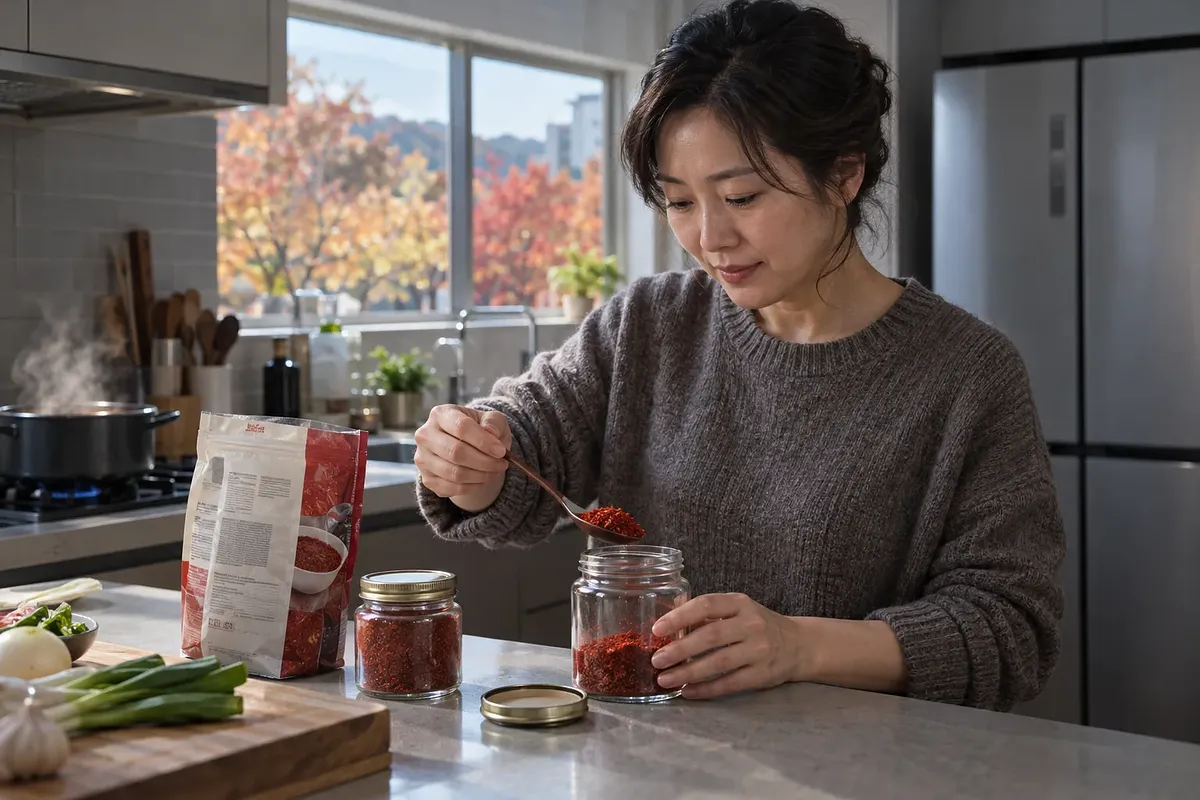
Portioning reduces repeated exposure of all the remaining powder to humid air.
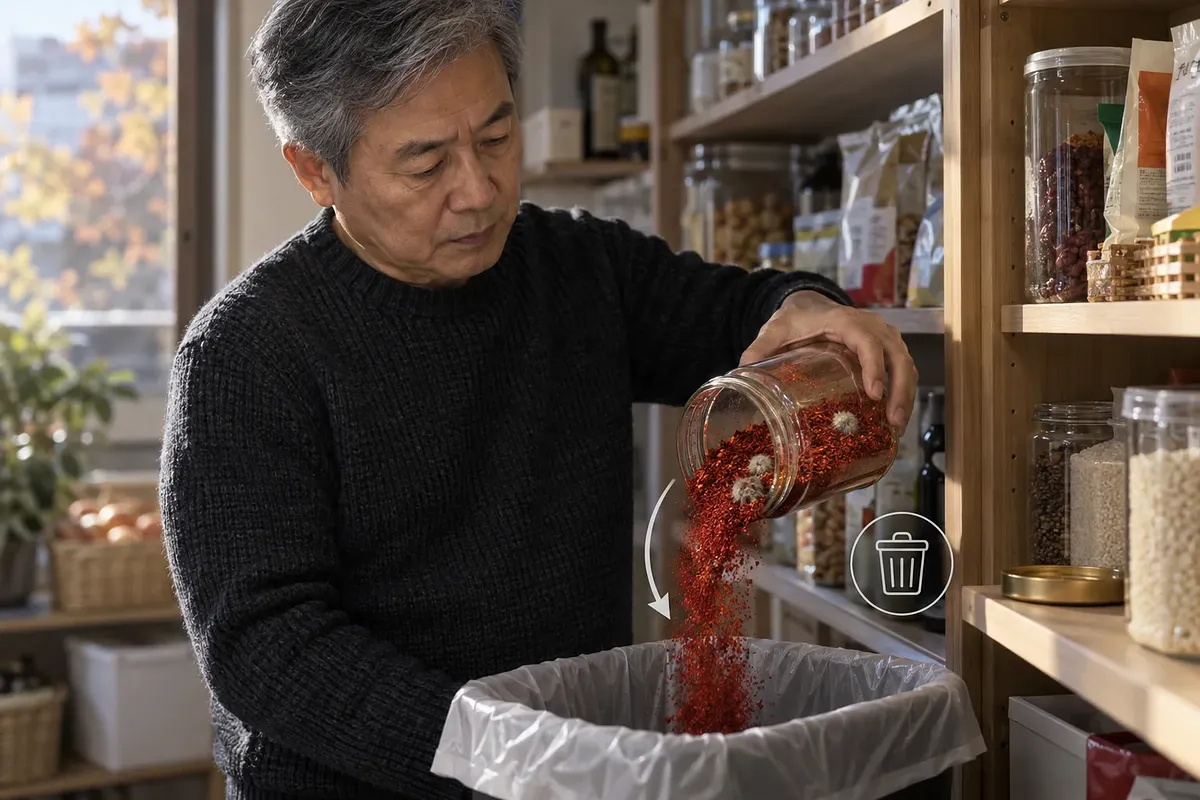
If mold or insects are found in the contents, do not pick out the affected parts and reuse the rest.
Follow the storage conditions on the chili powder label first. When choosing between refrigeration and freezing after opening, also consider moisture and how well the container is sealed. A low temperature alone does not guarantee safety. If you find mold or insects, do not eat the affected contents.
The storage figures are based on guidance from the Rural Development Administration in July 2019 and the Ministry of Food and Drug Safety in November 2024.
What chili powder is and how products differ
Chili powder is a seasoning made by drying and grinding chili peppers. The coarseness of the powder mainly relates to how it is used in cooking. The National Agricultural Products Quality Management Service’s traditional food standards describe fine powder as suitable for making gochujang.
Product characteristics vary with the ingredients and processing method. You can check the product description for its heat level and particle size. These characteristics alone cannot tell you how long it can be stored.
What to check on the product | What it tells you | What to check separately
Coarseness and cooking use | Particle size suited to the dish | Storage instructions after opening
Heat level label | How hot the product is described as being | Ingredient composition
Origin of ingredients | Where the chili peppers were grown | Processor and storage conditions
Net weight | Weight of the powder in the package | How much you use and plans for dividing it into smaller portions
Even domestically produced chili powder can develop storage problems if exposed to moisture. Origin tells you about the ingredients. It does not tell you how well the product is managed after opening.
Label information and package condition before opening
Before opening, read both the storage instructions and the date labels. The use-by date assumes that the stated storage conditions are followed. Check separately for package damage, even if the bag has not been opened.
· Storage instructions: room temperature, refrigeration or freezing guidance, and specified temperature
· Date labels: whether a date is a use-by date, manufacturing date or another date
· After-opening guidance: separate storage conditions or instructions for consumption
· Package condition: tears, holes or gaps in sealed areas
· Product information: manufacturer and contact details
You cannot assume that a product remains safe until the printed date after opening. The Ministry of Food and Drug Safety advises consuming opened food as soon as possible. If the period after opening is unclear, it is better to check with the manufacturer. Ministry of Food and Drug Safety Q&A on use-by date labeling
Choosing between refrigeration and freezing
Choose refrigeration or freezing based on the product label. Separating the amount you use often from the amount you plan to keep longer makes storage easier to manage. If it is unclear whether a product can be frozen, check the manufacturer’s guidance.
Situation | How to choose | What else to manage
Unopened product | Follow the storage instructions on the package first | Package damage and dates
Small amount used frequently | For products that can be refrigerated, use a small airtight container | Keep out moisture from wet tools and cooking steam
Extra powder you will not use soon | For products with freezing instructions, divide into smaller portions before freezing | Avoid repeatedly opening a large bag
Product without storage instructions | Ask the manufacturer or seller about storage conditions | Do not set your own long-term storage period
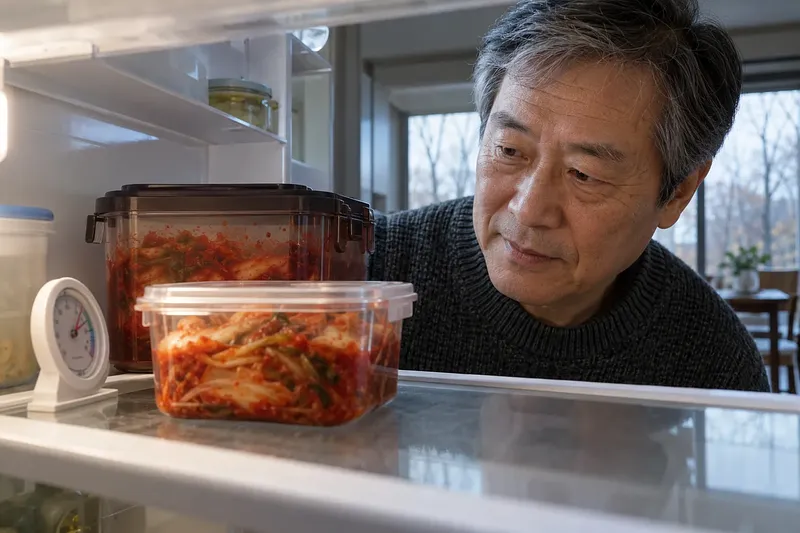
Even when refrigerating chili powder, you need to manage moisture inside the container. The Ministry of Food and Drug Safety explains that mold can grow even inside a refrigerator. Putting the powder in the freezer does not undo contamination that has already occurred.
If you plan to store chili powder for a long time, you can divide it into portions and freeze them. However, the public guidance reviewed does not give a storage period in months that applies to every product. Do not treat the day you freeze it as the start of a new use-by period.
What do 10℃ and 69% humidity mean?
The Rural Development Administration’s figures came from a specific storage experiment. In its 2019 announcement, it reported observing the product for at least 10 months at different temperatures and humidity levels. The temperature at which chili powder had the least mold growth was 10℃.
The Rural Development Administration’s “Managing ‘Temperature’ and ‘Humidity’ Is Essential When Storing Chili Powder” explains:
The temperatures with the least mold growth were 0℃ for dried chili peppers and 10℃ for chili powder, and humidity of 69% or less was found to be appropriate.
The original text describes the humidity as “less than 69%.” This figure refers to humidity in the storage environment. It does not mean the moisture content of the powder itself. Rural Development Administration press release, July 11, 2019
This result alone is not a reason to set a home refrigerator to 10℃. Other foods stored alongside it have different requirements. The length of the experiment also does not indicate how long the powder is safe to eat.
How to reduce condensation and moisture exposure
Condensation occurs when water vapor in the air turns into droplets on a cold surface. Exposing cold powder to humid air can cause moisture to collect on it. The Ministry of Food and Drug Safety also warns that powdered foods can absorb moisture when temperatures change. Ministry of Food and Drug Safety Open Maru, November 2024 issue
The following steps apply this principle to reduce moisture exposure. They do not indicate a fixed storage period set by an agency. Divide the powder into amounts that match how much you actually use in cooking.
· Completely dry a container after washing it thoroughly.
· Separate the amount you will use often from the amount you will keep.
· Keep the product name and date information from the original package.
· Take out only the portion you will use from the freezer.
· Keep the portion you will use at room temperature sealed while reducing the temperature difference.
· Wipe moisture off the outside of the container, then use a dry tool to scoop out the powder.
· Seal the remaining powder immediately and store it under the specified conditions.
It is better not to open a storage bag directly over a boiling pot. Steam could enter the bag. Scoop the amount you need into a separate bowl away from the pot.
Dates and product details easily overlooked when dividing into portions
Keep the original product information on containers used for smaller portions. If you throw away the packaging, it becomes harder to check the storage conditions again. Powders that look alike may have been bought at different times or made from different ingredients.
Information to keep | Why it matters
Product name and manufacturer | Identifies the product when you ask about storage instructions
Original use-by date | Prevents mistaking the date you divided it into portions for a new deadline
Opening date and date divided into portions | Helps manage the order of use
Photo of the original package | Lets you check the ingredients, storage instructions and manufacturing number
Continually topping up old powder with a new product mixes their histories. It is better to use the previous contents first and wash the container. Dry it completely before refilling it.
What to do if you find mold or insects
If you find mold in chili powder, do not eat the contents of the affected bag or container. Removing only the visible part does not tell you how far the contamination has spread. Some mycotoxins are not sufficiently removed by ordinary heating. Policy weekly Gonggam, featuring Ministry of Food and Drug Safety materials
What you find | What it means and what to do
Fuzz or spreading spots that look like mold | Stop using it and discard the affected contents
Insects, larvae or threadlike traces | Discard the affected contents and check nearby foods
An unusual smell or clear signs of spoilage | Stop using it without tasting it to check
Only clumps or a color change | Do not conclude from appearance alone that it is moldy or safe
If insects are found in the food, also inspect the surrounding storage area. The University of Minnesota’s guidance on stored-food pests likewise recommends discarding infested food. Clean gaps in shelves and any powder scattered nearby. University of Minnesota guidance on stored-food pests
Common mistakes
A common mistake is judging safety by storage temperature or appearance alone. A low temperature does not replace proper sealing and moisture control. Avoid memorizing a storage period without considering the conditions for the specific product.
· Treating an experimental observation period as the period during which the powder is safe to eat
· Assuming freezing also eliminates mycotoxins
· Taking out a large bag and opening it in a humid kitchen every time
· Resealing the container after putting in a wet spoon
· Judging safety by origin or red color alone
Frequently asked questions
Can an unopened product be kept at room temperature?
If the product says to store it at room temperature, follow those conditions. If it says to refrigerate or freeze it, follow those instructions first. Even before opening, check the product’s condition again if the package is damaged.
How many years can I keep it in the freezer and still eat it?
No number of years that applies to every product has been confirmed. Storage conditions vary with the packaging and the condition of the ingredients. Check the product label and the manufacturer’s guidance for after opening.
Should I set my refrigerator’s humidity to 69%?
You cannot use the study’s figure as a setting for a home refrigerator. Humidity in a storage space is not the same as conditions inside a sealed container. At home, focus on reducing the ways moisture can reach the powder.
Are all clumps mold?
Clumping alone does not confirm mold. Check whether moisture may have entered and look for other unusual signs. If you suspect spoilage, do not taste the powder to find out.
Can I discard the moldy part and roast the rest?
Do not reuse the rest, because you cannot confirm that it is safe. Heating does not sufficiently eliminate some mycotoxins. It is safer to discard the contaminated contents.
Can I just sift out the insects?
Do not use powder in which insects have been found. Eggs or other contamination may also be present. Check nearby dry foods and storage containers too.
 Injoys