The Difference Between Contract Renewal and the Right to Request Renewal: Does the Right Resurface with a New Contract?
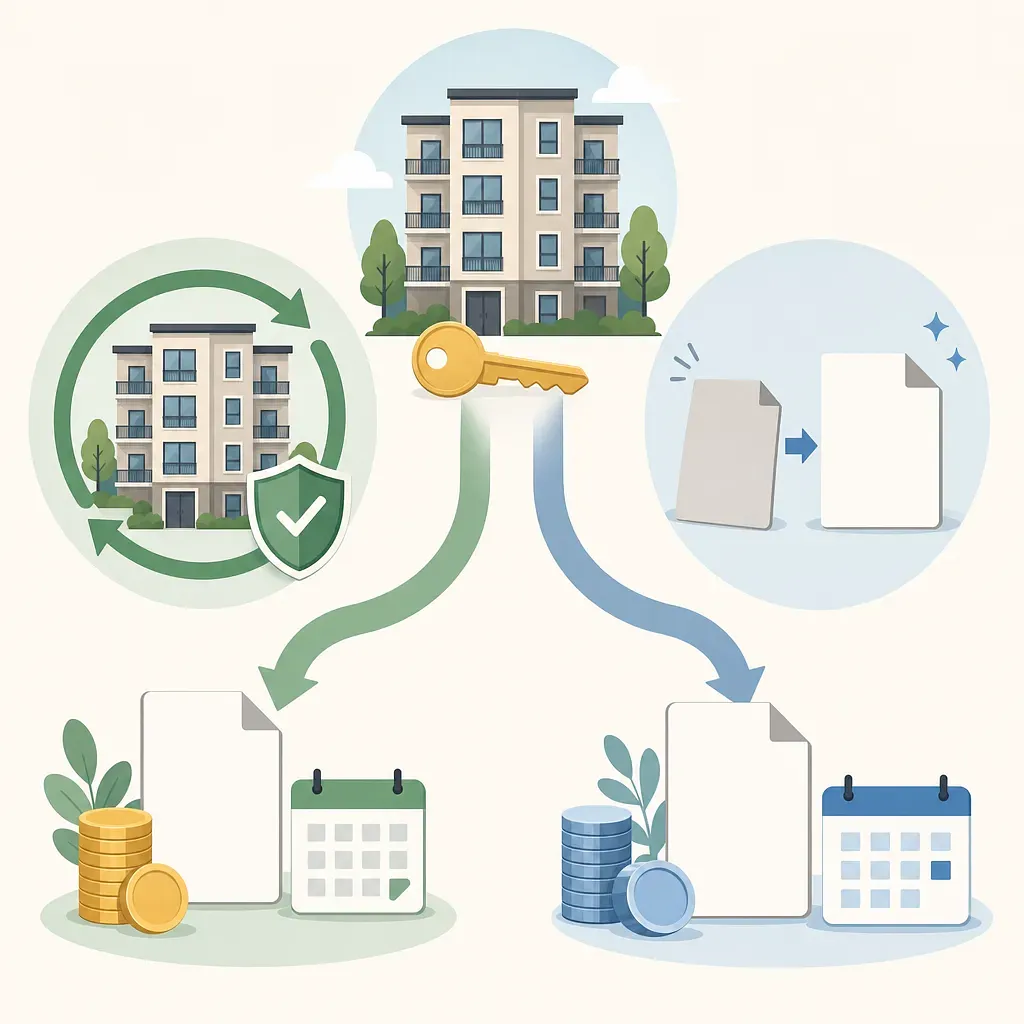
In residential lease agreements, “renewal” and the “right to demand contract renewal” are not the same thing. If a genuine new contract is entered into, the existing contract terminates, and the issue of the right to demand contract renewal may be reassessed based on the new contract.
The right to request contract renewal is a statutory right that a tenant may exercise once under the Residential Lease Protection Act.
As a general rule, exercising the right to renew a lease extends the existing lease under the same terms, and any increase in rent or security deposit is permitted only within the limits set by law.
A lease renewal refers to a situation in which the landlord and tenant mutually agree to terminate the existing lease and enter into a new lease under different terms.
Simply because a contract has been rewritten does not necessarily mean it is a new contract; what matters is whether it is, in substance, an extension of the existing contract.
To minimize disputes, the contract must clearly specify whether the right to renew will be exercised, whether the existing contract will be terminated, and the reasons for any changes to the security deposit or term.
Key Conclusion
In residential lease agreements, re-signing the lease and exercising the right to request renewal must be legally distinguished. The mere fact that a tenant has rewritten the lease agreement does not automatically mean that the tenant has exercised the right to request renewal; conversely, even if a new lease agreement exists, it may be deemed a renewal if it is substantively an extension of the existing lease.
The two most important criteria for determination are as follows:
· Did the tenant express an intention to exercise the statutory right to request renewal?
· Can it be deemed that the existing lease has clearly terminated and a new lease has been established?
If a new lease agreement in the true sense has been concluded, the legal relationship regarding the existing contract terminates, and the issue of the right to demand contract renewal can be reassessed based on the new contract. However, in actual disputes, specific circumstances—such as the wording of the contract, the settlement of the security deposit, the lease term, the extent of changes in rent, and records of communications between the parties—are reviewed together.
Glossary
Category | Meaning | Key Effect
Right to Request Contract Renewal | The tenant’s right to request renewal of the existing lease once in accordance with the law | In principle, the landlord cannot refuse unless there are statutory grounds for refusal
Renewal | The extension of an existing lease relationship | In principle, existing terms are maintained, and rent increases are limited to statutory caps
Re-contracting | Terminating the existing contract by mutual agreement and entering into a new contract under new terms | Key terms such as the security deposit, rent, and term may be redefined
Implicit Renewal | The legal renewal of a lease upon the expiration of the term without specific notice prior to the contract’s expiration | This is a separate system from the right to request contract renewal
What Is the Right to Request Contract Renewal?
The right to request contract renewal is a right granted to tenants under the Housing Lease Protection Act. Tenants may request the renewal of a lease agreement from the landlord within a specified period, and the landlord cannot easily refuse this request unless there are grounds for refusal specified by law.
The key points to remember are as follows:
· A tenant may exercise the right to demand contract renewal once.
· The period for exercising this right is, in principle, from 6 months to 2 months before the lease term ends.
· The term of the renewed lease is generally considered to be 2 years.
· In principle, the terms after renewal are the same as those of the existing contract.
· However, increases in the security deposit or monthly rent are subject to the limits set by the Residential Lease Protection Act, which are generally within a 5% range.
An important point here is that exercising the right to request contract renewal is not so much “entering into a new contract” as it is legally extending the existing contractual relationship.
What Is a Renewal Contract?
A renewal contract refers to the landlord and tenant mutually agreeing to terminate the existing contract and enter into a new lease agreement. In practice, it is common to draw up a “renewal contract” upon the expiration of a global lease agreement, often involving a significant increase in the security deposit, a switch to monthly rent, or the establishment of new terms regarding the lease term and special provisions.
The characteristics of a renewal are as follows:
· It requires mutual agreement between the parties.
· It is not merely a simple extension of the existing contract; there must be circumstances that allow it to be considered a new contract.
· Key terms—such as the security deposit, monthly rent, contract term, and special provisions—may change significantly.
· Unlike the exercise of the statutory right to request renewal, the terms are not restricted to an unconditional 5% increase limit.
However, if the arrangement is merely labeled a “renewal” to circumvent the Lease Protection Act but is, in substance, a renewal of the existing contract, it may not be recognized as a renewal in the event of a dispute.
The Main Difference Between a Renewal Agreement and Exercising the Right to Request Contract Renewal
Comparison Item | Exercising the Right to Request Contract Renewal | Renewal Agreement
Legal Nature | Exercise of the tenant’s statutory right | New contract based on mutual agreement between landlord and tenant
Relationship to the Existing Contract | An extension of the existing contract | A new contract following the termination of the existing contract
Landlord’s Consent | Refusal is restricted unless there are statutory grounds for refusal | In principle, agreement between the parties is required
Changes to Security Deposit and Monthly Rent | Generally subject to a 5% cap | If recognized as a new contract, terms may be renegotiated
Exhaustion of the Right to Request Renewal | Exercising this right counts as one use | May be assessed separately if it is a genuine new contract
Key Points of Dispute | Timing of exercise and grounds for refusal | Whether it is a new contract or a simple renewal
Does Rewriting the Contract Automatically Constitute a Renewal?
No. Simply drafting a new contract is not sufficient. In legal terms, the substance of the contract is more important than its name.
For example, in the following cases, the agreement is more likely to be viewed as a renewal of the existing lease rather than a new contract:
· The existing security deposit and monthly rent remained virtually unchanged.
· The leased property and the parties involved are the same.
· The term was simply extended upon the contract’s expiration.
· The tenant stated they would exercise their right to request renewal, and the landlord accepted this.
· The new contract contains a clause stating that the renewal is “based on the exercise of the right to request renewal.”
Conversely, the likelihood of it being considered a genuine renewal increases if the following circumstances exist:
· There is clear language stating that the existing contract is being terminated or ended by mutual agreement.
· Key terms—such as the security deposit, monthly rent, term, or special provisions—have been significantly altered.
· Settlement procedures, such as the return and re-payment of the security deposit, were actually carried out.
· The new lease agreement clearly states that it constitutes a new lease agreement separate from the existing one.
· The parties’ intent to enter into a new lease agreement is confirmed through text messages, emails, audio recordings, etc.
However, since the return and re-payment of the security deposit may be linked to other legal issues—such as the right of opposition, priority of repayment, and the date of registration—caution is advised before proceeding.
Does the Right to Request Contract Renewal Expire Upon Signing a New Lease?
It cannot be stated categorically that “it expires.” Whether the right to request contract renewal is exhausted depends not on the label “renewal contract”, but on whether the tenant exercised the right to request contract renewal and whether a new contract was substantively established.
1. When the tenant extends the lease by exercising the right to request contract renewal
If the tenant notified the landlord that they would “exercise the right to request contract renewal” and the contract was extended accordingly, it is generally considered that the right to request renewal has been used. In this case, even if a new lease agreement is drawn up, if that document merely confirms the renewal terms, it may be deemed that the right has been exercised once.
2. When the parties mutually agree to terminate the existing contract and enter into a new one
If the landlord and tenant clearly terminate the existing contract and enter into a new lease agreement under new terms, this is distinct from the exercise of the statutory right to request renewal. In this case, the tenant’s right to request renewal may be reassessed based on the new contract.
3. Cases where the form is a “renewal agreement” but the substance is an extension
Even if the title of the contract is “Renewal Agreement,” if the actual content is merely an extension of the existing contract, it may be viewed as a renewal. In particular, if the rent increase is within 5%, there is a record that the tenant exercised the right to request renewal, and there is no procedure to terminate the existing contract, it is likely to be assessed as a simple renewal.
Documents and Evidence to Verify in Practice
When it is unclear whether the agreement is a renewal or the exercise of the right to request renewal, the following materials are important.
Document | Items to Verify
Existing Lease Agreement | Expiration date, security deposit, monthly rent, special provisions, clauses related to renewal
New Lease Agreement | Whether it is a new lease or a renewal, and whether it contains language terminating the existing lease
Text Messages, KakaoTalk, Email | Whether the right to request renewal was exercised, intent to terminate by mutual agreement, and the negotiation process regarding terms
Security Deposit Transfer Records | Whether the deposit was returned and repaid, or only the increased amount was paid
Documents Related to the Date of Confirmation | Whether procedures to preserve rights were completed after signing the new contract
Property Verification and Explanation Document | Whether there is evidence that the new contract was concluded through a broker
To prevent disputes, it is advisable to clearly state in the contract whether it is a “renewal resulting from the exercise of the right to renew” or a “new lease agreement following the termination of the existing contract.”
Suggested Wording for the Contract
The wording below is provided for illustrative purposes only; actual contracts require consideration of individual circumstances and legal review.
To clearly state that the contract is a renewal resulting from the exercise of the right to request renewal
· “This agreement renews the existing lease agreement pursuant to the tenant’s exercise of the right to request renewal under the Residential Lease Protection Act.”
· “The lease term following renewal shall be two years, and the security deposit and rent shall be adjusted within the limits set by law.”
To clarify that this is a new lease agreement
· “The parties hereby terminate the previous lease agreement by mutual consent and enter into this agreement as a separate, new lease agreement.”
· “The parties confirm that this agreement is not a renewal agreement resulting from the tenant’s exercise of the right to request contract renewal.”
However, the mere inclusion of such wording does not always guarantee that it will be recognized as legally valid. In practice, all relevant circumstances—including the extent of the changes to the terms, the settlement of the security deposit, and the details of the parties’ negotiations—are taken into consideration.
Commonly Confusing Cases
Case 1: The jeonse deposit was increased by 5%, and the tenant agreed to stay for two more years
If the tenant exercised their right to request renewal and the increase in the jeonse deposit is within 5%, it is generally likely to be viewed as a renewal resulting from the exercise of that right. In this case, the right to request renewal may be deemed to have been exercised.
Case 2: The jeonse deposit increased significantly, and a new contract was signed
If there is a clear intention to terminate the existing contract and enter into a new one, and the deposit has changed significantly, there is room to view this as a new contract. In this case, it may be distinguished from the exercise of the right to renew.
Case 3: The contract is titled “Renewal Agreement,” but the content is nearly identical
Substance is more important than the title. If the terms are largely maintained and only the term is extended, it is likely to be viewed as a renewal.
Case 4: The tenant signed the new lease agreement without objection
If the tenant’s intention to exercise the right to renewal is not clearly expressed, it is difficult to immediately conclude that the right was exercised. However, if the intent to exercise the right to renewal is confirmed during the negotiation process, the situation may be judged differently.
Checklist for Tenants and Landlords
Tenant Checklist
· First, decide whether to exercise the right to renewal or to enter into a mutually agreed-upon new lease.
· If exercising the right to renewal, provide notice via a method that leaves a record, such as text message or email.
· Verify that the new lease agreement includes the phrase “Exercise of the Right to Renew.”
· If the security deposit increases significantly, clarify whether it is a new lease or a renewal.
· Double-check procedures for protecting your rights, such as obtaining a certified date and registering your change of address.
Landlord Checklist
· Distinguish whether the tenant’s notice constitutes the exercise of the right to renewal or a simple negotiation.
· If there are grounds for refusing renewal, verify the statutory requirements and the timing of notification.
· If you wish to renew the lease, clearly document your intention to terminate the existing lease and enter into a new one.
· Keep in mind that changes to the security deposit or monthly rent may be evaluated differently depending on whether the renewal is statutory or based on mutual agreement.
· Since grounds for refusing renewal—such as the landlord’s actual occupancy or rent delinquency—are likely to lead to disputes later, organize your evidence.
Summary in One Sentence
A lease renewal is the creation of a new lease agreement through mutual consent between the parties, whereas exercising the right to renewal is the tenant’s one-time right to extend the lease, guaranteed by law. Therefore, you should not only check whether a new lease agreement was drafted but also verify whether the existing lease has actually expired and whether the tenant has exercised their right to renewal.
 Injoys