Injoys
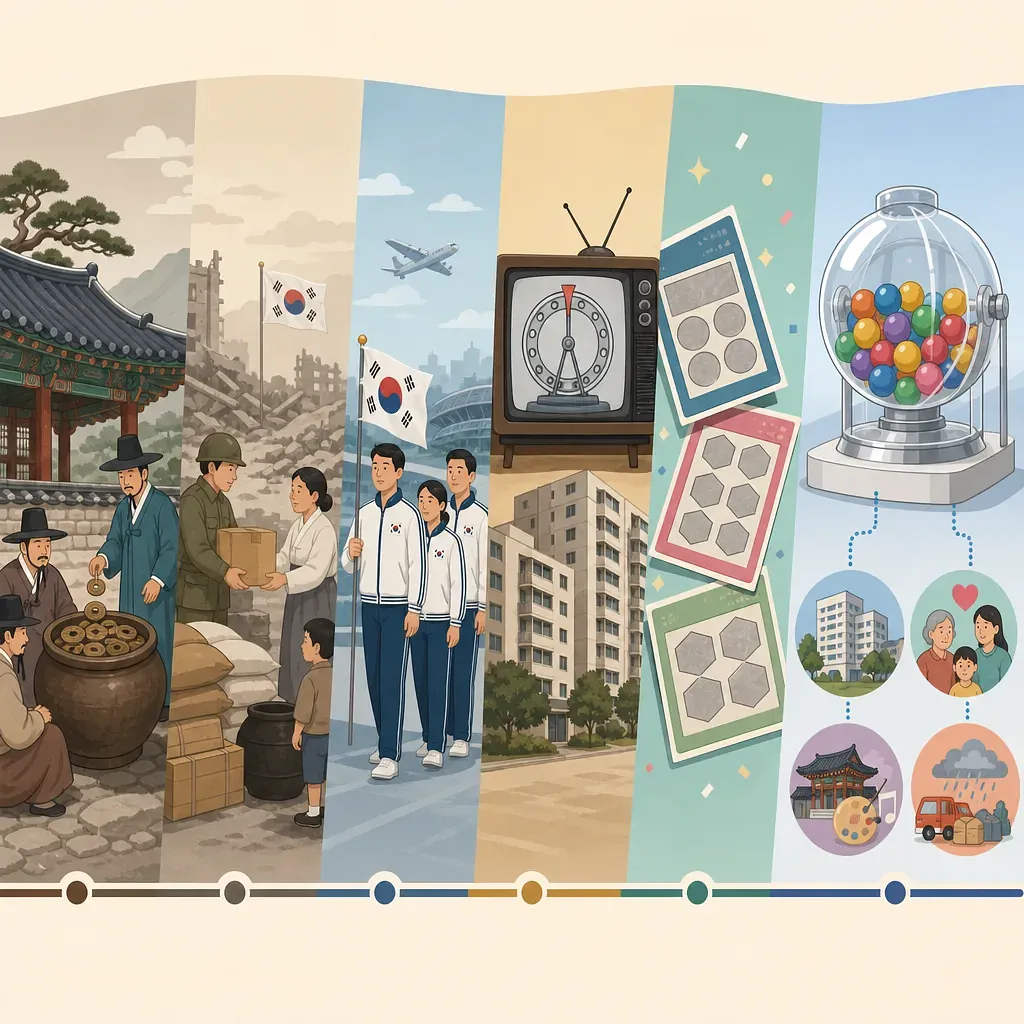
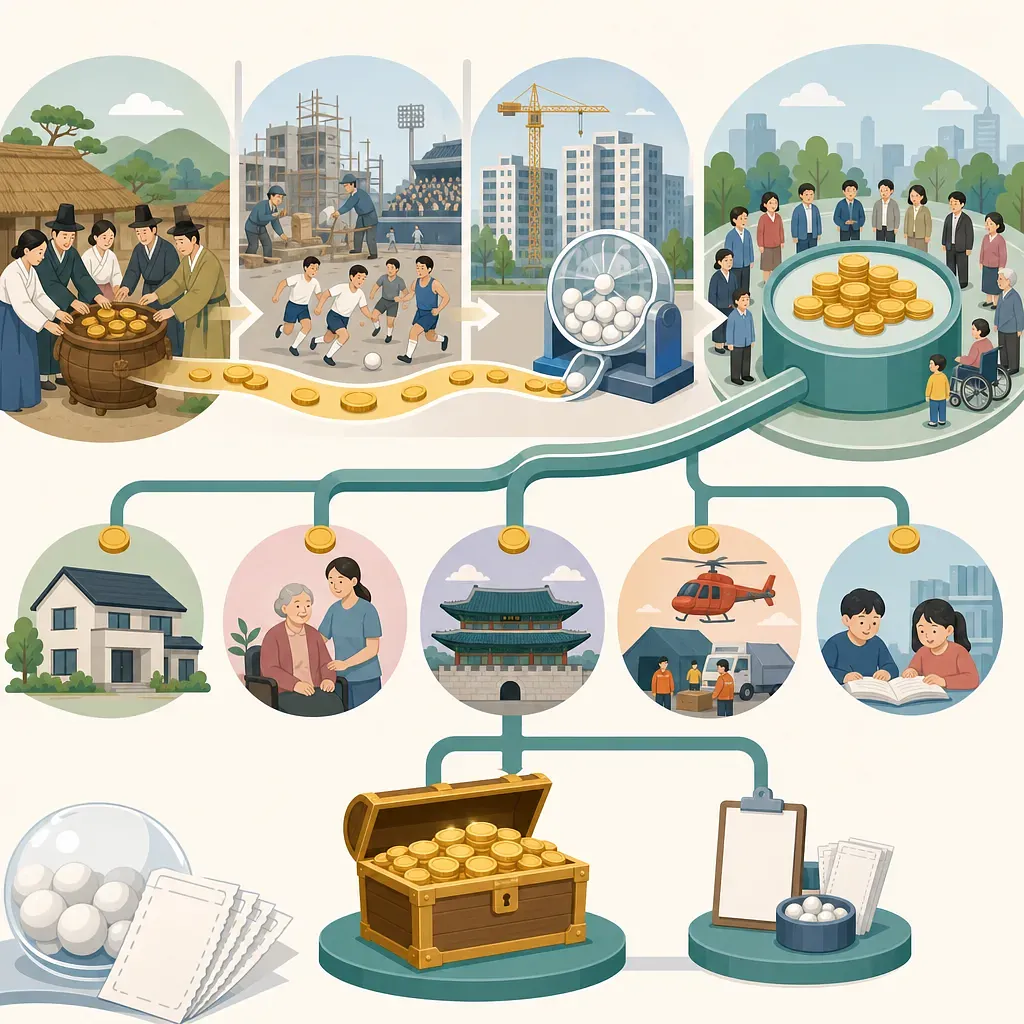
A lottery is not simply a product for buying and selling luck. The history of Korean lotteries extends from the late Joseon-era gye, in which people pooled funds, to public financing for national reconstruction, housing provision, international events, and support for vulnerable groups.
However, old gye and modern lotteries differ in their operators and legal character, and converting historical amounts into present-day values also requires caution. This article outlines the development of Korean lotteries, focusing on verifiable institutional changes and major events.
Key Timeline by Period
| Period | Lottery or Similar System | Key Features | Representative Purpose of Funds |
|---|---|---|---|
| Late Joseon period | Jakbaek-gye, Cheonin-gye, Manin-gye, and others | Many people pooled money, and recipients were selected by drawing lots | Circulation of funds among members; public expenses in some cases |
| 1947–1948 | Olympic Support Tickets | Purpose-specific lottery supporting the delegation sent to the London Olympics | Funding delegation expenses |
| From 1949 | Welfare Lottery Tickets, Patriotic Lottery, and others | Temporary issues for relief and postwar reconstruction | Social relief and national reconstruction |
| 1969 | Housing Lottery | Korea’s first regularly issued lottery | Housing construction and residential support for low-income households |
| 1980s | Olympic Lottery | Linked to preparations for an international sporting event | Olympics-related projects |
| 1990 | Expo Lottery | Instant lottery revealing results when scratched | Support for the 1993 Daejeon Expo |
| 1990s | Numerous institution-specific lotteries | Issued by government ministries and local governments for specific purposes | Housing, science and technology, welfare, tourism, and others |
| 2002 | Lotto 6/45 | Buyers selected numbers, and prizes were tied to sales | Creation of the Lottery Fund |
| 2004 | Launch of the Lottery Commission | Integrated management of lottery policy and funds | Statutory allocations and support for public-interest projects |
Was the Late Joseon Manin-gye an Ancestor of the Modern Lottery?
In the late Joseon period, large-scale gye known as Jakbaek-gye, Cheonin-gye, and Manin-gye, depending on the number of participants, are said to have operated. Members paid a set amount of money, after which recipients were selected through a drawing. Manin-gye, as its name suggests, referred to a lottery-style gye involving a very large number of people.
Similarities to Modern Lotteries
- Many people contributed small amounts to create a large pool of funds.
- Recipients were selected by drawing lots according to predetermined procedures.
- The pooled money was paid out after operating expenses or a designated share was deducted.
- Some records explain that money paid to government offices was used for local projects.
However, Manin-gye should not be regarded as exactly the same system as today’s lotto. Modern lotteries are issued or authorized by the state under law, with sales, prizes, and the use of funds subject to management. Manin-gye, by contrast, operated on the basis of private gye organizations and local practices of the time. It is also difficult to conclude that the same prize ratios or methods of public payment applied to every Manin-gye.
The Story of An Jung-geun and the Lottery Company
An Jung-geun’s autobiographical account describes his experience managing a business related to chaepyo in Jinnampo during his youth. Chaepyo was a lottery-style product in which numbered tickets were sold and money was paid according to the drawing results.
One anecdote says that all the tickets spilled out at once during a drawing, prompting protests from the crowd, and that An Jung-geun calmed the agitated participants. The story shows that large-scale lottery operations at the time attracted sizable crowds and that fairness in the drawing and trust in its management were central concerns. However, the specific dialogue and descriptions of the scene should be read with the autobiographical nature of the account in mind.
What Were Lotteries Issued for Around the Time of Liberation?
Immediately after liberation, the Korean Peninsula faced the challenges of resettling returning populations, addressing material shortages, and rebuilding its administrative system. After the Korean War, enormous funds were needed for relief and the restoration of facilities. Lotteries during this period were closer to temporary financing tools for specific projects than permanent entertainment products.
Olympic Support Tickets That Helped the London Olympic Delegation
The Korean Olympic Committee issued Olympic Support Tickets to raise the cost of sending a delegation to the 1948 London Olympics. At the time, even securing travel and accommodation expenses for the delegation was difficult.
The South Korean delegation participated in the London Olympics as the representative of an independent nation and won bronze medals in weightlifting and boxing. These support tickets remain a representative example of a lottery supporting national athletics and participation on the international stage.
Jeon Gyeong-mu, whose portrait appeared on the ticket, was an independence activist and sports administrator. He worked to secure South Korea’s participation in the Olympics but died in an aircraft accident while traveling on business involving the International Olympic Committee.
Welfare Lottery Tickets and Postwar Lotteries
The Welfare Lottery Tickets issued beginning in 1949 were purpose-specific lotteries intended to raise funds for social relief. Later, lotteries connected to national reconstruction or specific public-interest projects, including the Patriotic Lottery, also appeared.
The sales prices and prizes of the time should not be converted directly into today’s money. After liberation, there were significant fluctuations in prices and changes in currency units, while consumption patterns also differed greatly from those of today. Purchasing power can be assessed more accurately by comparing the nominal amounts with wages, rice prices, and housing prices at the time.
How the 1969 Housing Lottery Changed Everyday Life
The Housing Lottery, first issued on September 15, 1969, is regarded as Korea’s first regularly issued lottery. Unlike earlier lotteries issued briefly for specific projects, it continued to be sold on a fixed schedule.
The first Housing Lottery was issued by the Korea Housing Bank. Each ticket cost 100 won, and the first prize was 3 million won. Housing Lottery proceeds were used for residential support projects, including housing for low-income households and rental housing.
“Ready, Aim, Shoot” and Public Drawings
Housing Lottery drawings were broadcast on television. A widely known method involved spinning a disc displaying numbers and then shooting an arrow to determine the winning number, accompanied by the host’s phrase, “Ready, aim, shoot.”
The broadcast brought about three changes.
- It opened the drawing process to the public, allowing viewers to see that it was fair.
- It turned lottery drawings into regularly scheduled broadcast content.
- It encouraged people to view the lottery as both a public financing product and everyday entertainment.
The Housing Lottery was initially issued monthly, but in 1972 it was expanded to once a week. The first prize also rose substantially from 3 million won in 1969 through the 1970s and 1980s. This resulted from the combined effects of economic growth, inflation, changes in housing prices, and the need to promote sales.
According to official lottery history materials, the Housing Lottery was issued 574 times before the Olympic Lottery was introduced in 1983 and supported housing projects totaling approximately 45,000 homes, including flood-relief housing, rental housing, and housing for persons of national merit.