Jang Bogo: Cheonghaejin's 828 Founding and Achievements
Jang Bogo established Cheonghaejin in 828 to combat piracy and the trafficking of Silla people. Historical sources document his achievements in leading trade among Silla, Tang and Japan, but the historical record must be distinguished from interpretation regarding how troops were raised and the year of his death.
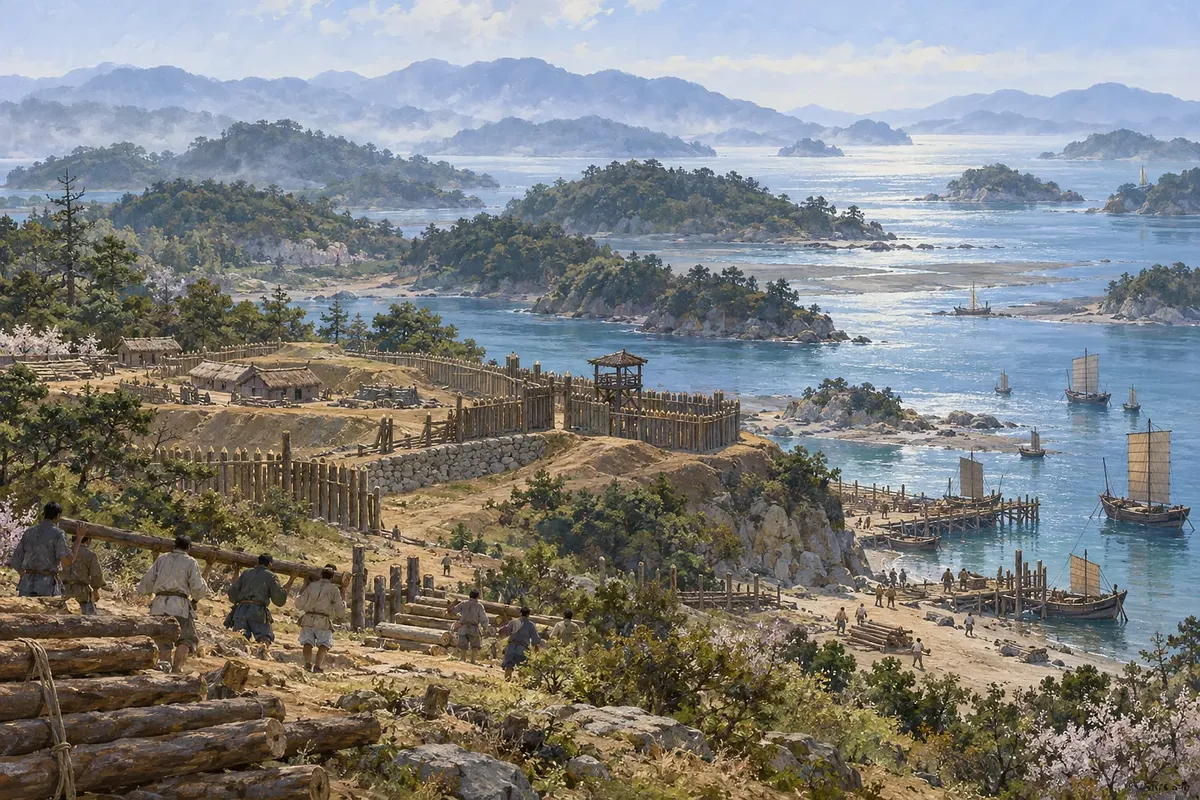
Cheonghaejin was a maritime military base established in 828 in present-day Wando with King Heungdeok's permission.
Piracy threatened not only international trade but also grain transport and the daily lives of coastal residents.
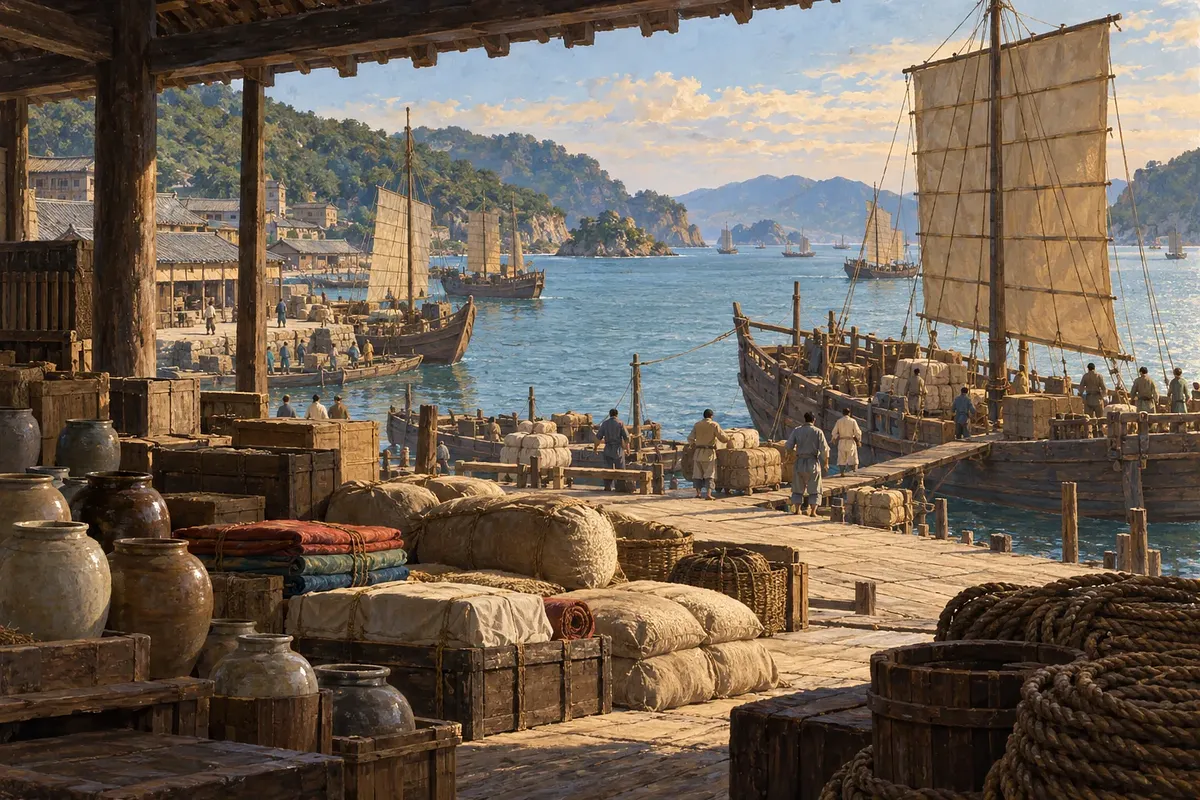
Jang Bogo led international trade by connecting Cheonghaejin with Silla communities living in Tang.
It is difficult to determine whether all 10,000 troops were dispatched by the central government.
Historical sources differ on the year of Jang Bogo's death, and Cheonghaejin was abolished in 851.
Jang Bogo was a Silla military officer and merchant who established Cheonghaejin in 828 in response to piracy and the trafficking of Silla people. He used this base to protect sea routes. He is remembered for leading a trade network linking Silla, Tang, and Japan.
This article was written after consulting the National Institute of Korean History's records and commentary on the Samguk sagi in October 2026.
Jang Bogo's Life and Origins
Jang Bogo rose to prominence through military power and trade in the first half of the 9th century. The Samguk sagi also records his name as Gungbok. His birth year and family background are unclear.
The biographies in the Samguk sagi state that his hometown and ancestors were unknown. This must be distinguished from claims that he came from Wando, which have a different level of supporting evidence. The fact that Wando was his base of operations does not establish it as his birthplace.
Jang Bogo traveled to Tang with Jeong Nyeon and served in the Wuning Army. He held the military post of junior commander in this army. The exact date of his departure for Tang has not been established.
Silla's bone-rank system at the time restricted status according to lineage. Our History Net describes this as part of the background to his rise and political setbacks. His exact status within that system, however, has not been established.
Why Cheonghaejin Was Established
Cheonghaejin was established to protect sea routes threatened by pirates. In the early 9th century, pirates plundered merchant ships. They also captured coastal residents and sold them in Tang.
The damage was not limited to overseas trade. Our History Net explains that maritime grain shipments to Gyeongju were also threatened. This transport system involved shipping grain collected as taxes and other payments.
Target under threat | Impact of pirate activity
Merchant ships and traders | Trade disrupted by plundering during voyages
Coastal residents | Risk of property theft and abduction
Grain transport | Insecurity along transport routes to the capital
Silla court | Burdens on provincial control and financial administration
It was not that the state took no action. Our History Net explains that weakened control over the provinces made suppression difficult. Cheonghaejin was a regional military base established under these circumstances.
The Establishment of Cheonghaejin in 828 and Wando's Location
The turning point came when King Heungdeok authorized the establishment of Cheonghaejin. The Silla Annals in the Samguk sagi record this in the 4th lunar month of 828. Jang Bogo became the commissioner in charge of Cheonghaejin.
His biography includes a proposal to stop the abduction and sale of Silla people. These remarks are conveyed by a historical work compiled later. They cannot be treated as a verbatim record of the conversation at the time.
Wando stood along maritime routes connecting China and Japan. Knowledge of the surrounding waterways helped with operating the base. Cheonghaejin used this location for military activity and trade.
Foundation | Connection to Cheonghaejin's operations
Royal authorization | Authority to carry out missions against pirates
Military service in Tang | Experience useful for commanding troops
Wando's geographical location | A base with access to southwestern sea routes
Silla communities living in Tang | Personal connections linking navigation and trade
Key Dates in Jang Bogo's Life and Cheonghaejin's History
The years of Cheonghaejin's establishment and abolition are confirmed, but records differ on the year of Jang Bogo's death. The timeline below presents events alongside their supporting sources. Months recorded in the lunar calendar have not been converted to the solar calendar.
Year or period | Event | Supporting record or commentary
Birth date unknown | Birth year and family background are unclear | Samguk sagi, volume 44, biographies of Jang Bogo and Jeong Nyeon
Before 828 | Served as a soldier in Tang's Wuning Army | Samguk sagi, volumes 10 and 44
4th lunar month of 828 | Establishment of Cheonghaejin under Jang Bogo's command | Samguk sagi, volume 10, entry for the 3rd year of King Heungdeok's reign
839 | Provided military support for Kim Ujing's accession as King Sinmu | Annotations on Jang Bogo in the Korean History Database
839 | Ennin recorded the relationship between Chishan Fahua Temple and Jang Bogo | Record of a Pilgrimage to China in Search of the Law, volume 2
841 or 846 | Killed by Yeom Jang; records differ on the year of death | Commentary on the Shoku Nihon Kōki; Silla Annals in the Samguk sagi
851 | Abolition of Cheonghaejin and relocation of its residents to Byeokgol County | Our History Net, “Cheonghaejin”
Jang Bogo's Achievements and the Structure of International Trade
His main achievements were protecting Silla people and expanding international trade networks. The Fanchuan wenji states that the buying and selling of Silla people disappeared after Cheonghaejin was established. This record describes his success in curbing human trafficking.
However, that wording cannot be read as a statistical account of victims. Detailed operational records of campaigns against pirates have not been identified. There is also insufficient evidence to calculate the number of battles or the rate of decline in losses.
Trade took place through connections between Cheonghaejin and Silla people living abroad. Silla settlements, such as Sillabang, existed along the Tang coast. Their merchants and sailors formed the foundation of maritime exchange.
Region or base | Role in exchange
Cheonghaejin on Wando | Base directing military activity and trade
Tang's Shandong Peninsula and eastern coast | Base for Silla communities and trading activity
Japan's Kyushu region | Region trading with Jang Bogo's fleet in Japan
Chishan Fahua Temple | Temple illustrating Silla community life and Buddhist exchange
Trade missions sent to Japan were called hoeyeoksa. Our History Net lists ceramics, silk, and aromatics among the goods traded. However, it is difficult to give figures for the fleet's total trade volume or profits.
People and news traveled by sea along with goods. The Japanese monk Ennin (圓仁) left the Record of a Pilgrimage to China in Search of the Law. It describes the operation of Chishan Fahua Temple, which Jang Bogo founded.
Intervention in the Royal Succession and the Abolition of Cheonghaejin
The power Jang Bogo secured at sea also influenced Silla's central politics. His support contributed to King Sinmu's accession in 839. Cheonghaejin was a force capable of intervening militarily in the royal succession.
A later attempt to arrange a marriage with the royal family met opposition from aristocrats. The Samguk sagi links the failure of his daughter's marriage plans to rebellion. Jang Bogo was eventually killed by Yeom Jang.
The status hierarchy and power struggles were intertwined in these events. The historical work's characterization of the events as a rebellion also reflects its perspective. It is difficult to explain them solely in terms of either personal ambition or status discrimination.
Cheonghaejin was not abolished immediately after Jang Bogo's death. The court abolished it in 851. Its residents were relocated to Byeokgol County, in what is now the Gimje area.
The abolition of Cheonghaejin meant that operations at that base had ended. It did not mean the end of maritime trade by Silla people as a whole. Our History Net describes the subsequent activities of maritime forces in other regions.
Records and Interpretations
When discussing Jang Bogo, the wording of the records must be distinguished from researchers' judgments. Sources can differ on the dates or details of the same event. The distinctions below separate established facts from unresolved issues.
What the Records State Directly
The Samguk sagi records 10,000 troops and the establishment of Cheonghaejin. The biography states that the buying and selling of Silla people ceased after its establishment. The Silla Annals place Jang Bogo's death among the events of 846.
The Record of a Pilgrimage to China in Search of the Law preserves observations about Chishan Fahua Temple. This account reveals Silla community life beyond Cheonghaejin. It helps identify the foundations of exchange that military activities alone do not reveal.
Interpretations Commonly Discussed in Research Commentary
Commentaries by the National Institute of Korean History discuss Jang Bogo as both a military officer and a maritime trader. They also explain Cheonghaejin's growth through the combination of military power and international trade. They discuss his characteristics as a member of the powerful local elite whose influence rested on regional wealth and armed strength.
The term “King of the Seas” is a nickname summarizing this influence. It does not mean that he became the king of a separate state. Claims that he directly ruled all Silla people abroad also require caution.
Issues That Are Difficult to Resolve
The records alone do not establish how the 10,000 troops were actually raised. Our History Net's “Cheonghaejin” interprets this figure as the upper limit on the number he could command. This differs from the explanation that all the troops were dispatched by the central government.
Issue | Differences between records and commentary | Limits when describing it
10,000 troops | A troop count in the historical work versus an interpretation focused on command authority | Difficult to treat as an actual deployment roster
Year of death | 846 in the Samguk sagi versus 841 based on Japanese records | The source being followed must be identified
Birthplace | An unknown hometown in the biography versus claims of origin in Wando | His base of operations must be distinguished from his birthplace
Suppression of pirates | Records describing success versus the absence of operational records | Difficult to give the scale of battles or a suppression rate
Our History Net's “Cheonghaejin” adopts 841 as the year of his death. The biographical heading in its “Jang Bogo” entry uses 846. This shows that commentaries from the same institution can select different dates.
Does Agreement Across Sources Mean Independent Testimony?
Even when there are many sources, they do not all constitute independent evidence. Jang Bogo's biography in the Samguk sagi draws extensively on a text by Du Mu. Du Mu's text appears in the Fanchuan wenji.
It is therefore necessary to establish how the same information came to be repeated. An account copied from an earlier source differs from a separate firsthand observation. This issue can easily be overlooked when citing Jang Bogo's achievements.
Type of source | What it can establish | Limitations to consider
Biography drawing on an earlier text | Assessments of a person and the transmission of accounts of events | Possible reliance on the same original source
Traveler's account | Observations of places visited and exchanges witnessed | Difference between direct observation and information heard from others
Excavated sites and artifacts | Locations of facilities and material traces | Difficult to prove the actions of a particular person
Ennin did not personally witness every event he recorded either. For example, he received news of the royal succession from others. When citing historical sources, observations must be distinguished from secondhand reports.
The Wando Site and Its Meaning Today
Archaeological remains on Jangdo in Wando offer evidence of Cheonghaejin's activities. Excavations have identified fortifications and building sites, among other remains. Wando County's site guide introduces traces of wooden palisades, roof tiles, and pottery.
This site provides material evidence that can be compared with written sources. However, the presence of facilities does not substantiate every account of a battle. It is difficult to link excavation findings directly to individual stories about Jang Bogo.
This case illustrates the relationship between safe sea routes and trade. Connecting the facts discussed above also brings the protection of residents into that relationship. This is an analysis intended to help explain Cheonghaejin's functions together.
The political conditions that sustained trade also need separate examination. Cheonghaejin achieved results, but it was abolished after conflict with the royal family. This shows that the security of sea routes and the continued existence of the base were separate matters.
Frequently Asked Questions
Was Cheonghaejin a Military Base or a Trading Port?
Cheonghaejin was a maritime military base established to counter pirates. It later also served as a hub for international trade. It can be understood as a place that combined both functions.
Did Jang Bogo Eliminate All Pirates?
Some records state that the buying and selling of Silla people ceased. However, it is difficult to establish whether he eliminated all pirates throughout the waters concerned. This is because detailed operational records and statistics on losses have not survived.
Was Jang Bogo a King?
Jang Bogo was a Silla figure who served as commissioner of Cheonghaejin. “King of the Seas” is a later nickname emphasizing his influence. It should not be used to mean that he was the monarch of an independent state.
Was Cheonghaejin Abolished in the Year Jang Bogo Died?
Cheonghaejin was abolished after Jang Bogo's death. The year of its abolition was 851. Whether his death is dated to 841 or 846, the two events remain distinct.