Skip to content
Injoys
Knowledge Base

Cheugugi: Standardizing Rainfall Observation in 1442

Joseon developed Cheugugi to improve on the practice of estimating rainfall from the depth to which rainwater soaked into the ground. In 1442, it formalized a nationwide observation system by setting instrument specifications, measurement units, responsible officials, and items to record.

Read text only

11 min read

Just the words, no images.

Cheugugi: Standardizing Rainfall Observation in 1442

11 min read

Cheugugi: Standardizing Rainfall Observation in 1442
Joseon developed Cheugugi to improve on the practice of estimating rainfall from the depth to which rainwater soaked into the ground. In 1442, it formalized a nationwide observation system by setting instrument specifications, measurement units, responsible officials, and items to record.
Cheugugi is an instrument that measures rainfall by the depth of rainwater collected in a cylindrical container.
Discussions about making it in 1441 began with the problem that rainwater soaked to different depths depending on soil conditions.
The 1442 regulations specified a length of 1 cheok 5 chon and a diameter of 7 chon, using the jucheok standard.
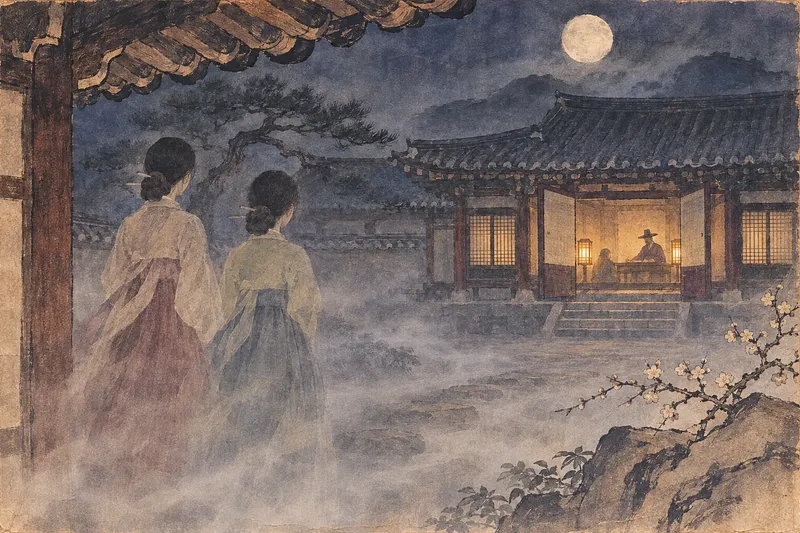
Responsibility for direct observation was assigned to Seoun-gwan officials in Seoul and local magistrates elsewhere.
The system recorded the dates and times of rainfall and clearing skies, along with water depth, providing a basis for comparing observations.
Joseon struggled to measure rainfall accurately, which was necessary for responding to drought. It developed the Cheugugi in 1441 and refined its measurement and reporting standards in 1442. This system is remembered for establishing a basis for comparing observations across regions.
This article follows the records in the National Institute of Korean History's Annals of King Sejong, checked in November 2026.
Why the Cheugugi Was Developed and the Limits of Earlier Observations
The instrument was developed because rainfall was difficult to determine from the depth of rainwater that had seeped into the ground alone. Joseon was already receiving reports on rainfall in the provinces. But the ability to submit reports and the accuracy of the measurements were separate matters.
The way rainwater seeped into the soil varied depending on how dry or wet it was. The depth of wet soil therefore could not be equated directly with rainfall. A 1441 memorial from the Ministry of Taxation pointed out this limitation in measurement.
Determining how much rain had fallen for agriculture was fundamental to responding to drought. The aim was not to improve the natural phenomenon of rainfall itself. It was to improve the method used to observe and measure it.
Category | Examining the depth of seepage into the ground | Measuring rainwater collected in a vessel What was measured | Depth of soil penetrated by rainwater | Depth of water collected in the vessel Effect of soil conditions | Dryness or wetness affected the assessment | No seepage into soil was involved How standards were aligned | Differences in soil conditions made comparisons difficult | Instrument specifications and ruler standards were set Nature of the record | Observations of how wet the soil was | Rainfall measured with a standardized instrument
This shift is also explained in Uriyeoksanet's “Making the Cheugugi” commentary.
Timeline from Development in 1441 to Refinement of the System in 1442
In 1441, instrument-based observation was pursued, and in 1442, specifications and operating standards were detailed. Combining the two years into a single event obscures the process by which the system was refined. All dates from the annals below use the lunar calendar.
Date | Recorded details | Source 18th day of the 8th lunar month, 1441 | The Ministry of Taxation identified the limitations of existing measurements and proposed observations using an iron vessel | Annals of King Sejong, volume 93, entry 4 18th day of the 8th lunar month, 1441 | Proposed placing a vessel 2 cheok long and 8 chon in diameter on a platform at Seoun-gwan | The same Ministry of Taxation memorial 8th day of the 5th lunar month, 1442 | Revised the specifications to a length of 1 cheok 5 chon and a diameter of 7 chon, explicitly naming the jucheok as the standard | Annals of King Sejong, volume 96, entry 1 8th day of the 5th lunar month, 1442 | Defined observation responsibilities in the capital and provinces, the information to be recorded, and how records were to be kept | The same Ministry of Taxation memorial
The key historical source is the Ministry of Taxation memorial dated the 8th day of the 5th lunar month, 1442. A memorial is a report submitted by an official to the king. This entry also records that the king accepted the ministry's proposal.
How the Cheugugi Worked and the Role of Each Part
The measurement principle was to use a ruler to read the depth of rainwater collected in a cylindrical vessel. The volume of water entering the vessel was not itself reported. The observed value was a length indicating how high the collected water stood.
This principle is easy to understand when the area receiving the rainwater equals the cross-sectional area in which the water collects. Dividing the volume of collected water by the receiving area gives the water depth. In a straight-sided cylinder, therefore, the water depth represents the amount of rain that fell at that location.
Component | Role | Distinguishing feature Cheugugi body | Received and collected rainwater | A cylindrical vessel for measuring rainfall Cheugudae | Supported the body | A structure separate from the vessel holding rainwater Jucheok | Measured the depth of collected water | A ruler based on the length standard designated for common use in observations
Cheok, chon, and bun are the units of length used in the records. Converting them into modern millimeters requires a conversion standard for the jucheok. This article retains the specifications and recording units used in the annals.
Observation Standards for the Capital and Provinces in 1442
The 1442 rules allowed materials to vary by region while requiring consistent measurement standards. The instrument specified for use in the capital was made of iron. Local districts were allowed to use porcelain or earthenware vessels made to the same specifications.
Item | Capital | Provinces Reference instruments | An iron Cheugugi | One set consisting of an iron Cheugugi and a jucheok sent to each province Actual construction | Length of 1 cheok 5 chon and diameter of 7 chon, based on the jucheok | Each district to make a porcelain or earthenware vessel according to the standard Installation site | On a platform at Seoun-gwan | On a platform built in the courtyard of the guesthouse Measuring tool | Jucheok | A bamboo or wooden ruler made in advance to the same standard Responsibility for observations | Seoun-gwan officials | Local magistrates Recorded information | Dates and times when rain began and cleared, and water depth in chon and bun | Dates and times when rain began and cleared, and water depth in cheok, chon, and bun Handling of records | Report immediately and enter in a ledger | Report immediately and enter in a ledger as a reference for the future
Seoun-gwan was the government office responsible for astronomy, weather, and related matters at the time. Guesthouses were facilities for receiving visitors at local government offices. The rules explicitly made the responsible officials accountable for examining rainfall conditions themselves.
The observation duties described in the memorial can be organized in the following sequence.
· Prepare an instrument and ruler that meet the specified standards. · Install the instrument on a platform at the designated location. · After rainfall, have the responsible official personally examine rainfall conditions. · Measure the water depth with the jucheok and record the dates and times when rain began and cleared. · Report the measurements and preserve them in a ledger.
The standardization of specifications and observation procedures stands out more than uniformity of materials. Construction methods were left open so that local districts could also obtain instruments meeting the standard. At the same time, responsibility for records was assigned, making the system part of administrative work.
Achievements of Institutionalization and the Surviving Artifact
The achievement of institutionalization was the creation of a framework for measuring and recording rainfall according to consistent standards. If instruments alone had been distributed, observation times and recording methods could have varied. The 1442 rules addressed these matters together.
However, these rules alone do not show how much drought damage was reduced. The memorial also does not state how much agricultural production increased. The achievement that can be confirmed is the development of a detailed observation and reporting system.
The system established under Sejong did not continue without interruption thereafter. The National Meteorological Museum explains that the system was interrupted by war and revived under Yeongjo. This history can be traced in the National Meteorological Museum's Cheugugi guide.
The only known surviving Cheugugi from the Joseon period is the Rain Gauge of Chungcheong Provincial Office, Gongju. This artifact was made in 1837. It is not an original instrument made under Sejong.
According to Korea Heritage Service records, the artifact was returned from Japan in 1971. It is currently managed by the National Meteorological Museum. Its designation as a National Treasure on February 27, 2020, is also documented. The source is the artifact record in the National Heritage Digital Service.
Records and Interpretation
The rules recorded in the annals should be distinguished from later historical assessments. The rules show what people were instructed to do at the time. They do not prove every aspect of actual operation and results.
What the Records State Directly
The 1442 memorial specified instrument dimensions and observation duties in detail. It also explicitly required the use of the jucheok and personal observation by the responsible officials. The dates and times when rain began and cleared were to be recorded alongside the water depth.
The king's acceptance of the proposal is also recorded. However, this entry does not say when every district completed installation. How many local observation ledgers survive must also be checked separately.
Significance Assigned in Historical Commentary
Uriyeoksanet's commentary emphasizes the nationwide implementation of a system for measuring rainfall quantitatively. This assessment highlights the combination of an invented instrument with administrative recordkeeping. It interprets the system as an attempt to record natural phenomena in comparable numerical terms.
The Korea Heritage Service presents the Cheugugi as the world's first scientific rainfall-measuring instrument. This is that institution's assessment of its significance in the history of science. This article focuses on the development and refinement of the system that can be confirmed through the annals.
What Can Be Confirmed About the Inventor and Detailed Circumstances
Uriyeoksanet's commentary explains that the crown prince, who later became Munjong, was involved in the invention. However, the 1442 memorial itself is not an account of an individual's development process. This entry alone cannot establish that a particular person was the sole inventor.
No basis is therefore established here for describing it as Jang Yeong-sil's sole invention. The memorial also does not describe the specific experiments involved in reducing the instrument's size. Unverified details should not be filled in with dialogue or anecdotes about historical figures.
Distinctions Needed When Reading Observation Records as Data
The date when an observation system began and the extent of the material available today are different matters. The 1442 rules provide evidence that records were required. They do not mean that observations from every region have been preserved without gaps from that year onward.
This is an interpretation of the rules in the annals from a modern data perspective. An isolated water-depth value makes it difficult to identify the location and time of observation. To compare records, the conditions attached to the figures must also be preserved.
Information to transfer into data | Why the distinction matters Observation region and location | Prevents measurements from different sites from being mixed together Dates and times when rain began and cleared | Identifies the rainfall event to which the water depth belongs Water depth and original units | Prevents the distinctions among cheok, chon, and bun from being lost by retaining numbers alone Instrument specifications and measurement standards | Provides a basis for checking whether values were obtained in the same way Whether a record exists | Prevents the absence of an observation from being treated as an absence of rain
In particular, the absence of a record is different from a conclusion that rainfall was 0. Filling gaps in the material with arbitrary figures can distort past weather. This is why the existence of a system, the performance of observations, and the preservation of records must be considered separately.
What This Means for Understanding Rainfall Observation Today
Even today, the meaning of an observation depends on measurement standards and recording conditions. Figures with the same name still require care in comparison if their units or observation periods differ. The 1442 rules offer a historical example for understanding these issues.
The significance of this example lies not only in the form of the invention. It also lies in the decision to specify who would measure and what would be recorded. Both instruments and recording procedures must be in place for observations to serve as evidence in the future.
0:00 0:00
1 / 56

Advertisement

Download text

File name
cheugugi-1442-rainfall-measurement-system-en.txt
Format
TXT (text/plain)
Paragraphs
56

Downloads exactly what you see as a text file.

Please cite the source when quoting.

Advertisement

Large text

Makes the text larger and the colors clearer. Turn it on if the text feels too small.

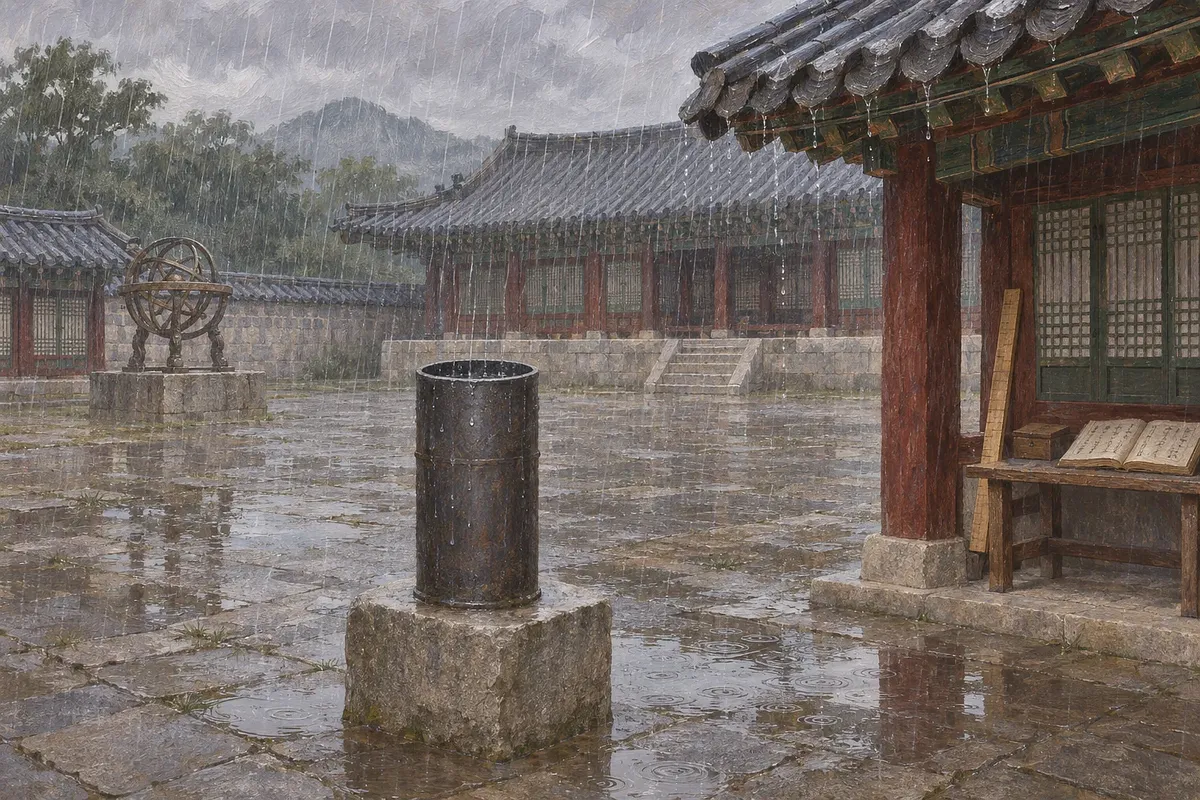
Rainfall came to be measured by the depth of collected rainwater rather than how deeply it soaked into the soil.AI-generated image

Key points

  • Cheugugi is an instrument that measures rainfall by the depth of rainwater collected in a cylindrical container.
  • Discussions about making it in 1441 began with the problem that rainwater soaked to different depths depending on soil conditions.
  • The 1442 regulations specified a length of 1 cheok 5 chon and a diameter of 7 chon, using the jucheok standard.
  • Responsibility for direct observation was assigned to Seoun-gwan officials in Seoul and local magistrates elsewhere.
  • The system recorded the dates and times of rainfall and clearing skies, along with water depth, providing a basis for comparing observations.

Joseon struggled to measure rainfall accurately, which was necessary for responding to drought. It developed the Cheugugi in 1441 and refined its measurement and reporting standards in 1442. This system is remembered for establishing a basis for comparing observations across regions.

This article follows the records in the National Institute of Korean History's Annals of King Sejong, checked in November 2026.

Why the Cheugugi Was Developed and the Limits of Earlier Observations

The instrument was developed because rainfall was difficult to determine from the depth of rainwater that had seeped into the ground alone. Joseon was already receiving reports on rainfall in the provinces. But the ability to submit reports and the accuracy of the measurements were separate matters.

The way rainwater seeped into the soil varied depending on how dry or wet it was. The depth of wet soil therefore could not be equated directly with rainfall. A 1441 memorial from the Ministry of Taxation pointed out this limitation in measurement.

Determining how much rain had fallen for agriculture was fundamental to responding to drought. The aim was not to improve the natural phenomenon of rainfall itself. It was to improve the method used to observe and measure it.

Category Examining the depth of seepage into the ground Measuring rainwater collected in a vessel
What was measured Depth of soil penetrated by rainwater Depth of water collected in the vessel
Effect of soil conditions Dryness or wetness affected the assessment No seepage into soil was involved
How standards were aligned Differences in soil conditions made comparisons difficult Instrument specifications and ruler standards were set
Nature of the record Observations of how wet the soil was Rainfall measured with a standardized instrument

This shift is also explained in Uriyeoksanet's “Making the Cheugugi” commentary.

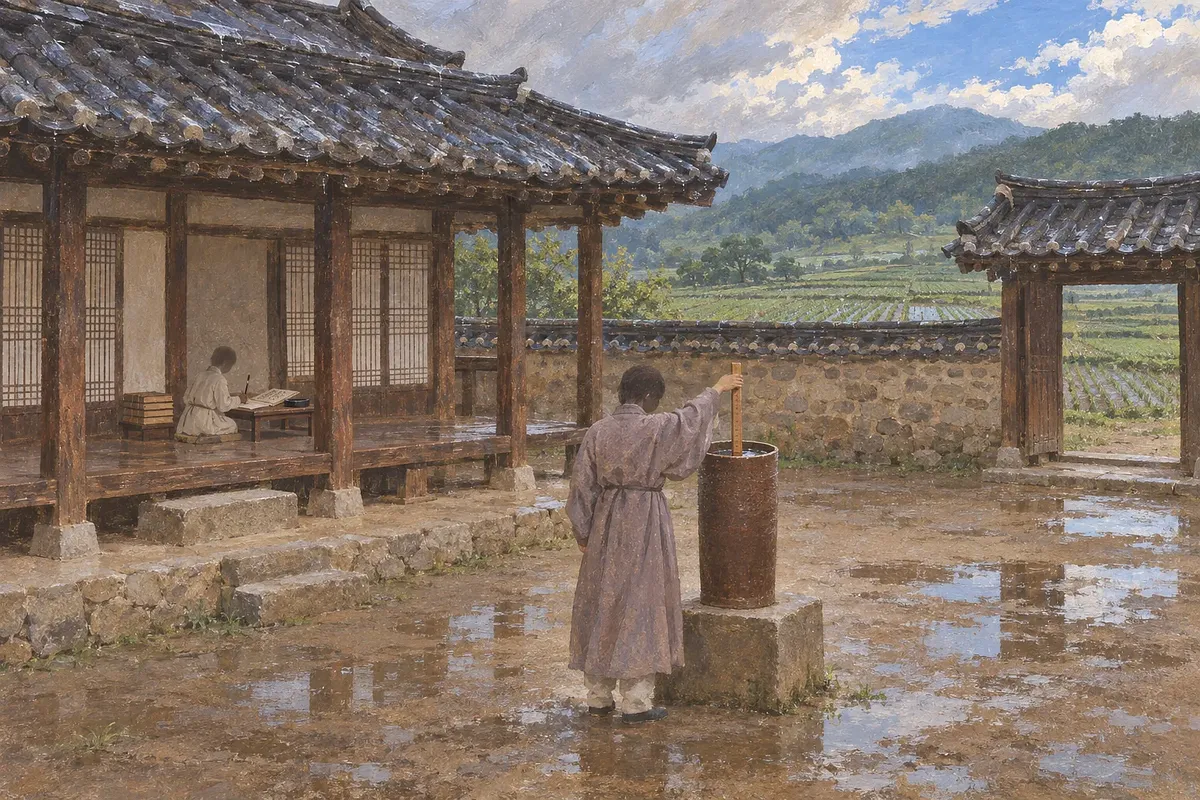
The 1442 regulations made local magistrates personally responsible for measuring rainfall.AI-generated image

Timeline from Development in 1441 to Refinement of the System in 1442

In 1441, instrument-based observation was pursued, and in 1442, specifications and operating standards were detailed. Combining the two years into a single event obscures the process by which the system was refined. All dates from the annals below use the lunar calendar.

Date Recorded details Source
18th day of the 8th lunar month, 1441 The Ministry of Taxation identified the limitations of existing measurements and proposed observations using an iron vessel Annals of King Sejong, volume 93, entry 4
18th day of the 8th lunar month, 1441 Proposed placing a vessel 2 cheok long and 8 chon in diameter on a platform at Seoun-gwan The same Ministry of Taxation memorial
8th day of the 5th lunar month, 1442 Revised the specifications to a length of 1 cheok 5 chon and a diameter of 7 chon, explicitly naming the jucheok as the standard Annals of King Sejong, volume 96, entry 1
8th day of the 5th lunar month, 1442 Defined observation responsibilities in the capital and provinces, the information to be recorded, and how records were to be kept The same Ministry of Taxation memorial

The key historical source is the Ministry of Taxation memorial dated the 8th day of the 5th lunar month, 1442. A memorial is a report submitted by an official to the king. This entry also records that the king accepted the ministry's proposal.

How the Cheugugi Worked and the Role of Each Part

The measurement principle was to use a ruler to read the depth of rainwater collected in a cylindrical vessel. The volume of water entering the vessel was not itself reported. The observed value was a length indicating how high the collected water stood.

This principle is easy to understand when the area receiving the rainwater equals the cross-sectional area in which the water collects. Dividing the volume of collected water by the receiving area gives the water depth. In a straight-sided cylinder, therefore, the water depth represents the amount of rain that fell at that location.

Component Role Distinguishing feature
Cheugugi body Received and collected rainwater A cylindrical vessel for measuring rainfall
Cheugudae Supported the body A structure separate from the vessel holding rainwater
Jucheok Measured the depth of collected water A ruler based on the length standard designated for common use in observations

Cheok, chon, and bun are the units of length used in the records. Converting them into modern millimeters requires a conversion standard for the jucheok. This article retains the specifications and recording units used in the annals.

Observation Standards for the Capital and Provinces in 1442

The 1442 rules allowed materials to vary by region while requiring consistent measurement standards. The instrument specified for use in the capital was made of iron. Local districts were allowed to use porcelain or earthenware vessels made to the same specifications.

Item Capital Provinces
Reference instruments An iron Cheugugi One set consisting of an iron Cheugugi and a jucheok sent to each province
Actual construction Length of 1 cheok 5 chon and diameter of 7 chon, based on the jucheok Each district to make a porcelain or earthenware vessel according to the standard
Installation site On a platform at Seoun-gwan On a platform built in the courtyard of the guesthouse
Measuring tool Jucheok A bamboo or wooden ruler made in advance to the same standard
Responsibility for observations Seoun-gwan officials Local magistrates
Recorded information Dates and times when rain began and cleared, and water depth in chon and bun Dates and times when rain began and cleared, and water depth in cheok, chon, and bun
Handling of records Report immediately and enter in a ledger Report immediately and enter in a ledger as a reference for the future

Seoun-gwan was the government office responsible for astronomy, weather, and related matters at the time. Guesthouses were facilities for receiving visitors at local government offices. The rules explicitly made the responsible officials accountable for examining rainfall conditions themselves.

The observation duties described in the memorial can be organized in the following sequence.

  1. Prepare an instrument and ruler that meet the specified standards.
  2. Install the instrument on a platform at the designated location.
  3. After rainfall, have the responsible official personally examine rainfall conditions.
  4. Measure the water depth with the jucheok and record the dates and times when rain began and cleared.
  5. Report the measurements and preserve them in a ledger.

The standardization of specifications and observation procedures stands out more than uniformity of materials. Construction methods were left open so that local districts could also obtain instruments meeting the standard. At the same time, responsibility for records was assigned, making the system part of administrative work.


Achievements of Institutionalization and the Surviving Artifact

The achievement of institutionalization was the creation of a framework for measuring and recording rainfall according to consistent standards. If instruments alone had been distributed, observation times and recording methods could have varied. The 1442 rules addressed these matters together.

However, these rules alone do not show how much drought damage was reduced. The memorial also does not state how much agricultural production increased. The achievement that can be confirmed is the development of a detailed observation and reporting system.

The system established under Sejong did not continue without interruption thereafter. The National Meteorological Museum explains that the system was interrupted by war and revived under Yeongjo. This history can be traced in the National Meteorological Museum's Cheugugi guide.

The only known surviving Cheugugi from the Joseon period is the Rain Gauge of Chungcheong Provincial Office, Gongju. This artifact was made in 1837. It is not an original instrument made under Sejong.

According to Korea Heritage Service records, the artifact was returned from Japan in 1971. It is currently managed by the National Meteorological Museum. Its designation as a National Treasure on February 27, 2020, is also documented. The source is the artifact record in the National Heritage Digital Service.

Records and Interpretation

The rules recorded in the annals should be distinguished from later historical assessments. The rules show what people were instructed to do at the time. They do not prove every aspect of actual operation and results.

What the Records State Directly

The 1442 memorial specified instrument dimensions and observation duties in detail. It also explicitly required the use of the jucheok and personal observation by the responsible officials. The dates and times when rain began and cleared were to be recorded alongside the water depth.

The king's acceptance of the proposal is also recorded. However, this entry does not say when every district completed installation. How many local observation ledgers survive must also be checked separately.

Significance Assigned in Historical Commentary

Uriyeoksanet's commentary emphasizes the nationwide implementation of a system for measuring rainfall quantitatively. This assessment highlights the combination of an invented instrument with administrative recordkeeping. It interprets the system as an attempt to record natural phenomena in comparable numerical terms.

The Korea Heritage Service presents the Cheugugi as the world's first scientific rainfall-measuring instrument. This is that institution's assessment of its significance in the history of science. This article focuses on the development and refinement of the system that can be confirmed through the annals.

What Can Be Confirmed About the Inventor and Detailed Circumstances

Uriyeoksanet's commentary explains that the crown prince, who later became Munjong, was involved in the invention. However, the 1442 memorial itself is not an account of an individual's development process. This entry alone cannot establish that a particular person was the sole inventor.

No basis is therefore established here for describing it as Jang Yeong-sil's sole invention. The memorial also does not describe the specific experiments involved in reducing the instrument's size. Unverified details should not be filled in with dialogue or anecdotes about historical figures.

Distinctions Needed When Reading Observation Records as Data

The date when an observation system began and the extent of the material available today are different matters. The 1442 rules provide evidence that records were required. They do not mean that observations from every region have been preserved without gaps from that year onward.

This is an interpretation of the rules in the annals from a modern data perspective. An isolated water-depth value makes it difficult to identify the location and time of observation. To compare records, the conditions attached to the figures must also be preserved.

Information to transfer into data Why the distinction matters
Observation region and location Prevents measurements from different sites from being mixed together
Dates and times when rain began and cleared Identifies the rainfall event to which the water depth belongs
Water depth and original units Prevents the distinctions among cheok, chon, and bun from being lost by retaining numbers alone
Instrument specifications and measurement standards Provides a basis for checking whether values were obtained in the same way
Whether a record exists Prevents the absence of an observation from being treated as an absence of rain

In particular, the absence of a record is different from a conclusion that rainfall was 0. Filling gaps in the material with arbitrary figures can distort past weather. This is why the existence of a system, the performance of observations, and the preservation of records must be considered separately.

What This Means for Understanding Rainfall Observation Today

Even today, the meaning of an observation depends on measurement standards and recording conditions. Figures with the same name still require care in comparison if their units or observation periods differ. The 1442 rules offer a historical example for understanding these issues.

The significance of this example lies not only in the form of the invention. It also lies in the decision to specify who would measure and what would be recorded. Both instruments and recording procedures must be in place for observations to serve as evidence in the future.

Open the link

Opens in a new window.

Advertisement

Sign-in required

Sign in with your Google account to like, comment, and save highlights.

FAQ

What does a cheugugi measure?

A cheugugi is an instrument that measures rainfall by the depth of rainwater collected in a cylindrical vessel. This differs from measuring the depth to which water has seeped into the ground.

Why was the cheugugi created?

Because the depth to which rainwater seeped into the soil varied depending on how dry or wet the soil was. Joseon sought to use a more consistent standard to obtain the rainfall data needed to respond to drought.

What is the significance of 1441 and 1442, respectively?

In 1441, efforts were made to measure rainfall using iron vessels. In 1442, the instrument's specifications, measurement units, responsibilities for observation, and recording procedures were defined in detail.

What dimensions were set for the cheugugi in 1442?

The specifications in the Sejong Sillok are a length of 1 cheok 5 chon and a diameter of 7 chon, based on the jucheok standard. When converting these dimensions into modern units of length, the conversion standard used for the jucheok must also be stated.

Were all cheugugi in the provinces also made of iron?

Local towns could use porcelain or earthenware vessels of the same specifications. Each province was to receive one iron cheugugi and one jucheok ruler to serve as standards for production.

Who measured rainfall?

In Seoul, officials of the Seoun-gwan were instructed to conduct observations themselves. In the provinces, local magistrates were assigned responsibility for personally observing rainfall conditions and measuring the water depth.

What was entered in the observation ledgers?

They recorded the dates and times when it rained and when the weather cleared, along with the depth of the collected water. After the measurements were reported, they were to be entered in ledgers for future reference.

How does a cheugugi differ from a cheugudae?

A cheugugi is a vessel that collects rainwater. A cheugudae is the supporting structure on which the instrument is placed. A separate ruler called a jucheok was used to read the water depth.

Can the cheugugi be considered the invention of Jang Yeong-sil alone?

The 1442 memorial submitted by the Hojo does not support the claim that Jang Yeong-sil invented it alone. The commentary on Uriyeoksanet explains the involvement of the crown prince, who later became Munjong. An individual's role in making the instrument must be distinguished from the state's development of an observation system.

Did the invention of the cheugugi solve drought?

The cheugugi was a tool for determining the amount of rainfall. It was not a device that made rain fall or supplied water for agriculture. The extent of any reduction in drought damage cannot be determined from that memorial alone.

Was the surviving cheugugi made during Sejong's reign?

The surviving cheugugi from the Chungcheong Provincial Office in Gongju was made in 1837. It is not an instrument made during Sejong's reign. The Korea Heritage Service describes this artifact as the only currently known cheugugi from the Joseon period.

Do all nationwide rainfall records survive from 1442 onward?

The fact that observation rules were established does not mean that all records have been preserved. The periods covered by surviving records and the gaps in those records must be checked separately for each region.

Sources

Data formats

This content is available in several machine-friendly formats.

Data-only languages (machine translated, files only)

Indonesian JSON MD Portuguese JSON MD Chinese (Traditional) JSON MD Deutsch JSON MD

Verification

This article was drafted with AI and then reviewed and edited by a person.

Reviewed by 신익희 · 편집장 · 2026-11-11

Figures in this article were checked against the source material during generation. · 2026-11-11

This translation has been cross-checked by AI. · 2026-11-11

Reuse & AI usage

Search indexing and AI citation with attribution are welcome. See the license policy for details.

CC BY · License

Loading…

Loading…

Loading…

Where this content lives

Related content

From Injoys

Request the content you want and take 70% of what it earns

Just leave the subject. We handle production, review, translation and distribution.

See how revenue sharing works

Comments