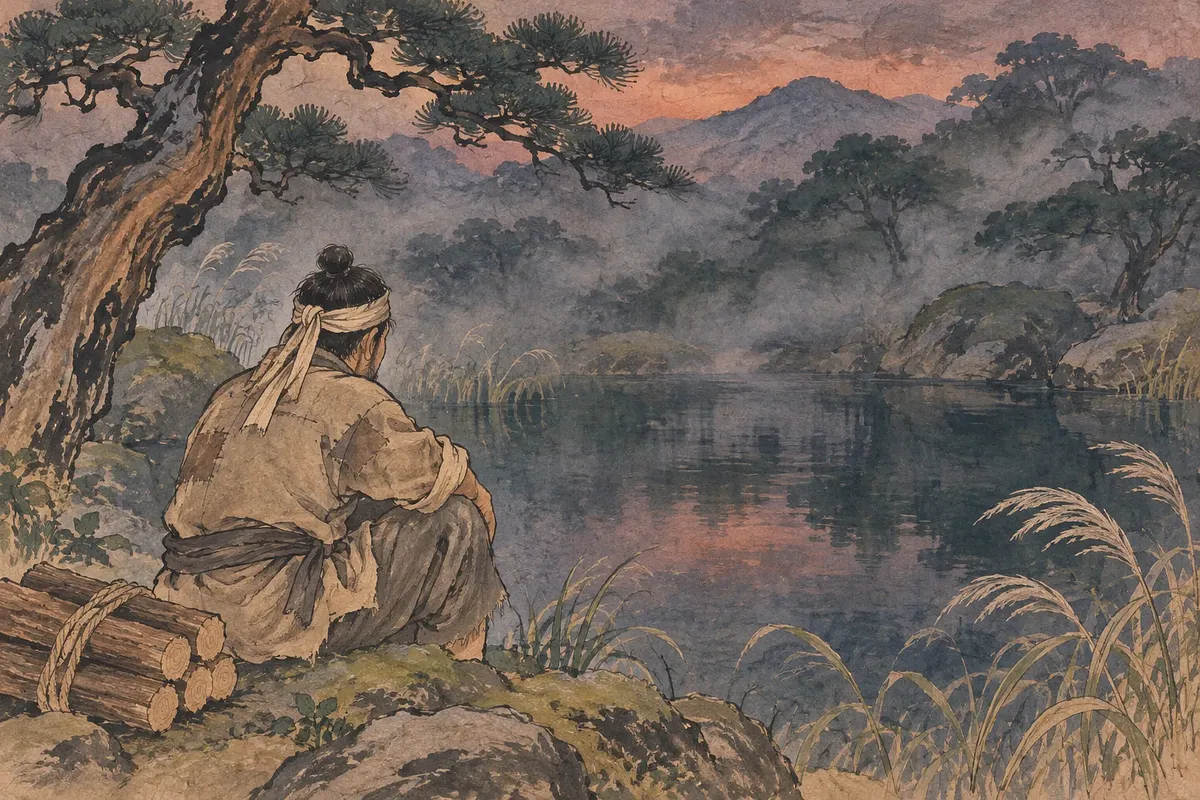
“The Gold Axe and the Silver Axe” is a traditional folktale about a lost axe and the reward for honesty. This article retells a story recorded in Daejeo-dong, Busan, in 2014. In this oral account, the woodcutter says that the silver axe is his.
This article follows Folktales of the Western Busan Cultural Region Ⅰ: Gangseo-gu Volume and was prepared as of November 2026.
The Story
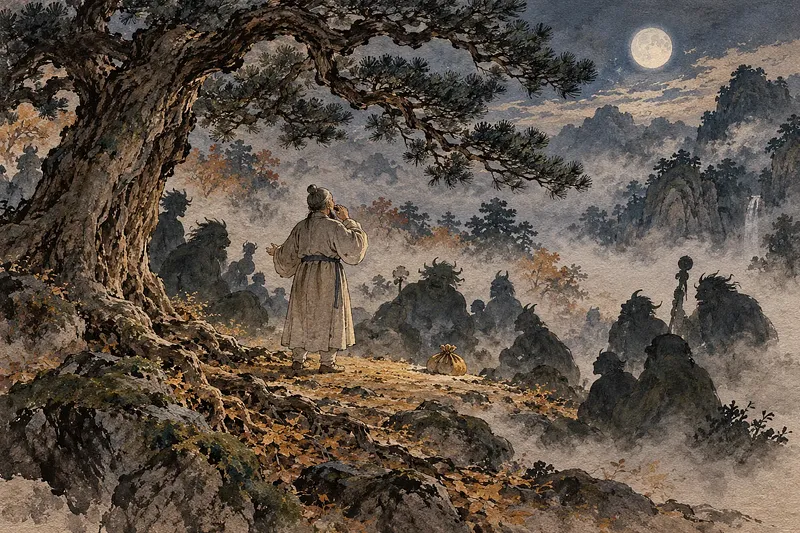
This oral account begins with a poor woodcutter losing his axe. He was cutting wood near a pond. In the middle of chopping, the axe slipped from his hands. It sank into the water and disappeared from view.
The axe was not even made of good iron. Still, the woodcutter could not afford to buy another. Without an axe, he could not cut wood. He sank to the ground beside the pond and wept.
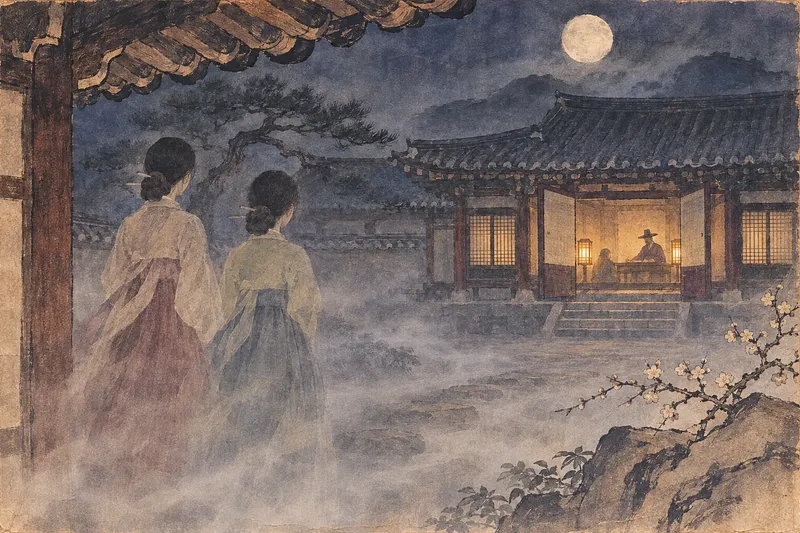
Then an unfamiliar being appeared, holding an axe. The being, who seemed to be a heavenly maiden, approached in the form of a white-haired old man. The old man first showed him a gold axe. He asked whether this was what the woodcutter had lost.
The woodcutter replied that the gold axe was not his. Next, the old man held out a silver axe. This time, the woodcutter said it was his. He received the gold axe as well, and the story ends by praising him as a good person.
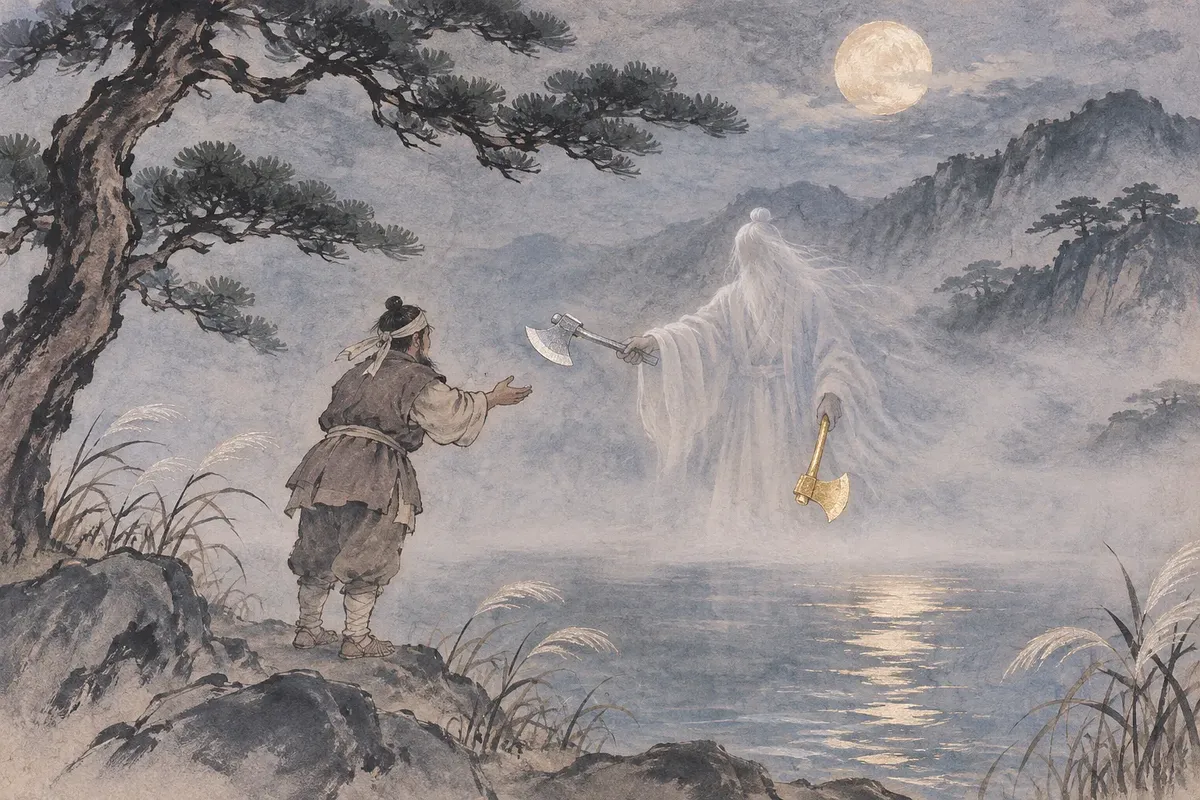
In the Daejeo-dong telling, the gold axe is refused, but the silver axe is claimed as his own.AI-generated image
Source and Origins
The source text for this article is an oral folktale recorded in Daejeo-dong, Busan. “Source text” means the record used as the basis for the retelling. Here, “source” does not mean the oldest written account of this story.
The full oral account appears in a folktale collection published by the Busan Metropolitan City History Compilation Committee. It is listed as Daejeo-dong Folktale 34, on printed page 151. The story, told by Mun Pil-sun, was recorded on February 12, 2014. The original text is available in the public PDF of Folktales of the Western Busan Cultural Region Ⅰ: Gangseo-gu Volume.
| Item | Recorded details |
|---|---|
| Publication | Folktales of the Western Busan Cultural Region Ⅰ: Gangseo-gu Volume |
| Location in the publication | Daejeo-dong Folktale 34, printed page 151 |
| Narrator | Mun Pil-sun |
| Recording date | February 12, 2014 |
| Recording location | Sinchon Grandmothers’ Senior Center, Daejeo 1-dong |
| Nature of the material | A record of an orally transmitted folktale of unknown authorship |
The recording date is the day the story was documented. It is not the date when the folktale first arose or when its events occurred. The place name Daejeo-dong likewise identifies the area where this account was passed down. It cannot be read as evidence that someone actually received an axe there.
Why He Said the Silver Axe Was His
This recorded account alone does not establish why he answered that the silver axe was his. The opening describes the woodcutter’s axe as an iron axe of poor quality. Later, however, he says that the silver axe is his. The record offers no explanation for this discrepancy.
There is also no basis for concluding that it was a lapse in memory or a deliberate alteration. This retelling leaves his answer about the silver axe unchanged. Replacing it with the familiar iron-axe scene would erase a distinctive feature of this oral account. Inconsistencies in the telling also offer clues when reading the recorded account.
Other Versions and Similar Stories
The name and appearance of the being who offers the axes vary across versions. Han Myeong-suk’s 2024 study introduces versions featuring a mountain spirit, an elder sister, an old man, and others. These distinctions appear in the abstract of “Transmission Patterns and Implications of ‘The Gold Axe and the Silver Axe’”.
| Version or comparison | Helper’s appearance | Distinction to note |
|---|---|---|
| Account recorded in Daejeo-dong, Busan | Mentioned as if a heavenly maiden, then described as a white-haired old man | The description changes within a single oral account |
| Korean versions introduced in the study | Mountain spirit | Cases where the helper is called a mountain spirit |
| Korean versions introduced in the study | Elder sister | Cases where the helper is addressed differently |
| Korean versions introduced in the study | Old man | Cases passed down with the helper appearing as an old man |
| Aesop’s fable “Hermes and the Woodcutter” | Hermes | A comparison involving a similar axe story |
What Role Does the Mountain Spirit Play?
The mountain spirit is not a fixed character in every version of this folktale. Reading several versions together reveals the role of a helper who tests honesty. Appearance and forms of address can be distinguished as different ways of expressing that role.
In the Daejeo-dong oral account, a reference to a heavenly maiden is followed by a description of an old man. It does not, however, explain that a heavenly maiden transformed into an old man. This retelling likewise adds no separate transformation scene. It preserves the oral account’s distinctive lack of a single, clearly defined identity for the helper.
Differences in the Ending of “The Gold Axe and the Silver Axe”
In the Daejeo-dong recorded account, the woodcutter is rewarded after saying that the silver axe is his. The part where he does not insist that the gold axe is his remains. The narrator describes the woodcutter as good.
| Point of comparison in the ending | Familiar iron-axe ending | Daejeo-dong recorded account |
|---|---|---|
| Axe he identifies as his own | Iron axe | Silver axe |
| Answer about the silver axe | Says it is not his | Says it is his |
| Treatment in this article | A comparison used to explain the difference | The actual basis for the retelling |
This recorded account contains no follow-up story about a greedy neighbor. Nor does it describe the woodcutter selling the axes he received and becoming rich. Those events have therefore not been added to the ending of this oral account.
Did It Originate in Aesop’s Fables?
A similar plot alone does not establish that the story originated in Aesop’s fables. Han Myeong-suk’s study examines differences between Korean versions and Aesop’s fable. The study also suggests the possibility that the two traditions arose independently. This is the researcher’s interpretation, not a confirmation of the story’s origin.
Folk Culture in the Story
This folktale can be read as a moral tale linking honest behavior with reward. The National Folk Museum of Korea classifies it as a moral tale in the Folktales section of the Encyclopedia of Korean Folk Literature. A moral tale centers on the principles people should follow.
What Does the Axe Mean?
In the Daejeo-dong oral account, the axe is a tool that sustains the woodcutter’s livelihood. He cries because he cannot afford a new axe. The narrator describes his inability to cut wood as a serious problem. His livelihood is thus already in danger before he receives a reward.
According to this description, the axe’s value is not determined solely by the price of its material. Even an iron axe of poor quality enables its owner to work. On that basis, this article interprets the axe as the foundation of his livelihood.
How Is the Reward for Honesty Expressed?
The reward for honesty is reflected in the scene where the woodcutter does not claim that the gold axe is his. Although poor, he does not pretend to own the gold axe. The narrator connects that behavior with a good heart.
His answer about the silver axe, however, departs from the familiar course of the moral lesson. This difference does not have to be erased to explain the meaning of honesty. The narrator’s judgment and the answer actually recorded need to be read together. The former shows the story’s lesson; the latter shows what distinguishes this version.
A Supernatural Being and Hopes for Everyday Life
The supernatural helper steps in when the woodcutter faces a difficulty he cannot resolve alone. This can be interpreted as a story expressing the hope that people who live honestly will receive help. It also imagines a being who recognizes the actions of a poor person.
However, this recorded account contains no description of any particular offering or ritual. It should therefore not be treated as a record of a specific mountain-spirit worship practice. Supernatural beings in stories and actual religious practices must be considered on separate evidence.
Key questions in this article
Did This Really Happen?
It is a traditional folktale, not a story verified as a historical event. The recording location and date document when and where the oral account was recorded. They do not establish where or when the events in the story occurred.
Where Can I Read the Original Oral Account?
It appears in the public PDF of Folktales of the Western Busan Cultural Region Ⅰ: Gangseo-gu Volume. Look for Daejeo-dong Folktale 34. The printed page number is 151.
Which Axe Does the Woodcutter Say Is His in the Daejeo-dong Account?
The woodcutter says that the silver axe is his. Earlier, he says that the gold axe is not his. This retelling follows the principle of preserving that difference in his answers rather than replacing it with an iron-axe scene.
Is the Being Who Gives Him the Axes Always a Mountain Spirit?
The being is not always described as a mountain spirit. The study also introduces versions in which the helper appears as an elder sister or an old man. The Daejeo-dong oral account itself retains both a reference to a heavenly maiden and a description of an old man.
Does a Greedy Woodcutter Also Appear?
No such character appears in the Daejeo-dong recorded account on which this article is based. The oral account ends when the first woodcutter receives his reward. A follow-up story remembered from another tale should not be treated as part of this record.
What Is the Lesson of This Story?
The lesson is not to covet valuable things that do not belong to you. The Daejeo-dong oral account describes the woodcutter who refuses the gold axe as good. It also conveys that losing his axe leaves him unable to earn a living.
Is the Recording Date the Day the Folktale Was Created?
The recording date is the date when the oral account was documented. It does not mean the day the folktale was first created. This record alone cannot establish when the story originated.