During the Qing invasion of Joseon, as the defenders held out at Namhansanseong, Qing troops fired cannons from Hanbong, a peak overlooking the inside of the fortress. After the war, Joseon built an outer fortress on Hanbong. A Qing envoy came and tore down part of the wall, but Jo Hyeon-myeong rebuilt it in 1739. What remains of Hanbongseong shows that Joseon tried to defend even the peak outside the main fortress.
The years of the original construction and the rebuilding were verified in November 2026 by comparing the Annals of King Sukjong with the Annals of King Jeongjo.
Why Hanbong was a weak point during the Qing invasion of Joseon
Hanbong, east of Namhansanseong, stood higher than the section of the main fortress wall facing it. The main fortress is the central fortification that encloses the temporary royal palace and the village. According to the Records of the Border Defense Council, O Si-bok explained that anyone standing on Hanbong could see inside the fortress. Mok Rae-seon, who had accompanied King Injo when he fled, recalled that Qing troops had fired cannons from the peak.
In 1636, when Qing troops blocked the road to Ganghwado, Injo took refuge at Namhansanseong. During the siege, Qing cannon fire brought down part of the main fortress wall. After holding out for 47 days in the mountain fortress, Injo surrendered at Samjeondo on the 30th day of the 1st lunar month the following year.
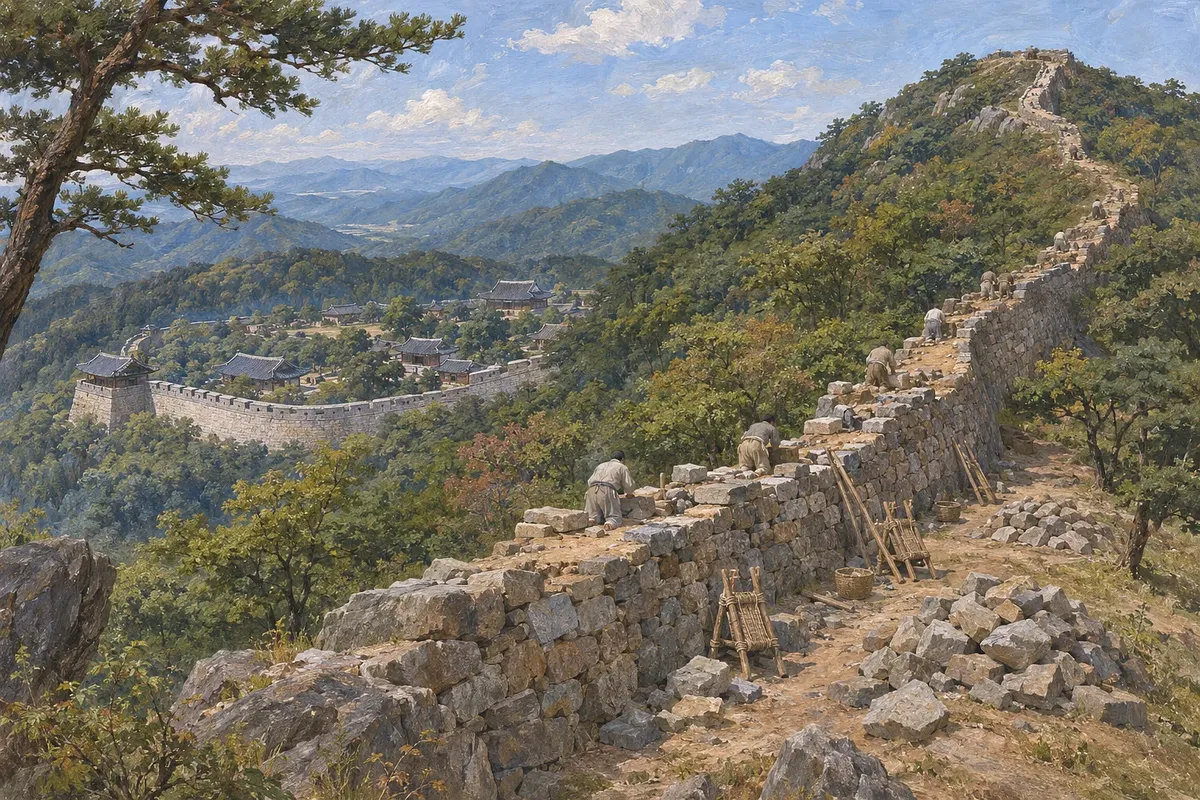
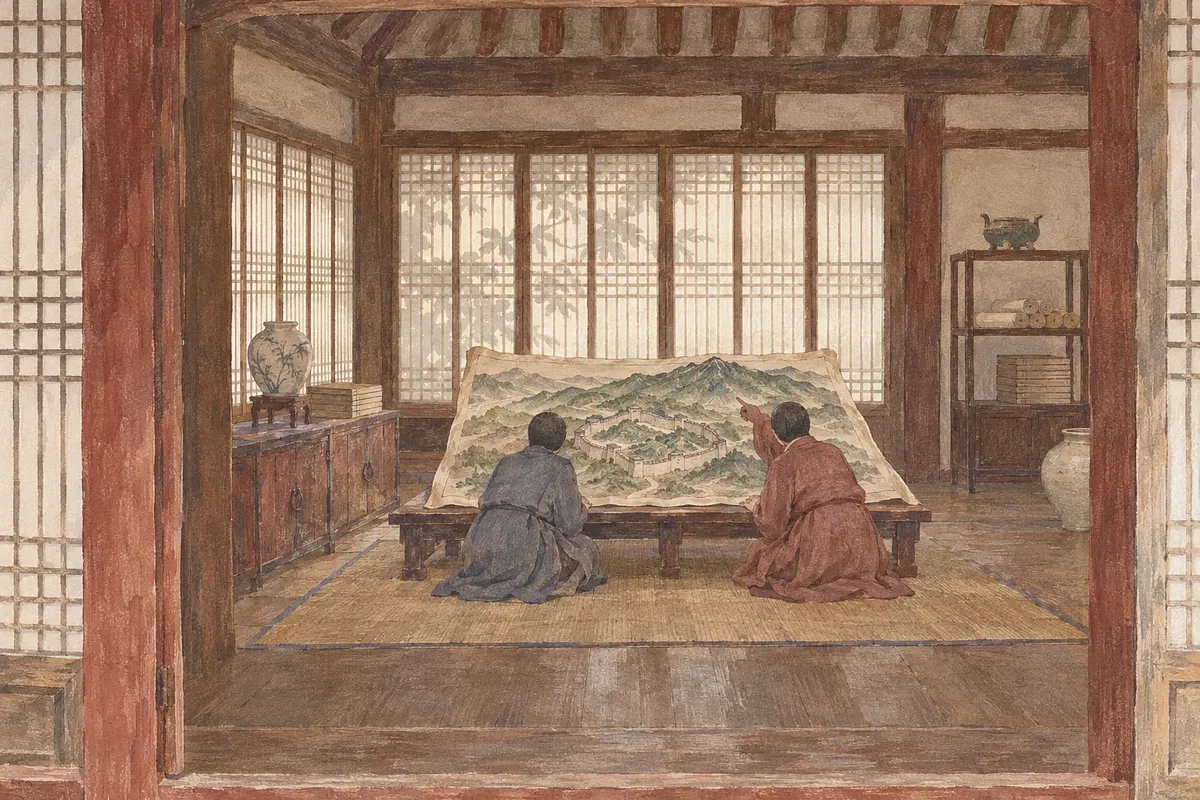
In 1739, Jo Hyeon-myeong led the rebuilding of Hanbong’s outer wall.AI-generated image
Why Hanbongseong was built and partly torn down
Joseon needed to defend Hanbong, but the agreement that ended the war prevented work on the fortifications. One of the terms imposed by the Qing barred Joseon from repairing existing fortresses or building new ones. The restriction also applied to work to address weaknesses exposed during the war.
In 1693, O Si-bok, the defense commander in charge of Namhansanseong, began building a fortress on Hanbong. A fortification added outside the main fortress in this way is called an outer fortress. In 1705, a Qing envoy came and tore down part of Hanbongseong.
Timeline of the rebuilding of Hanbong Outer Fortress
The defense of Hanbong came before the royal court again in 1707, and the fortress was rebuilt in 1739. The months and days in the timeline follow the lunar calendar used in the records of the time.
| Year or date of record | What happened | Source |
|---|---|---|
| 1636 to 1637 | During the Qing invasion of Joseon, Qing troops besieged Namhansanseong, and cannon fire brought down part of the fortress wall. | Our History Net, “Namhansanseong” |
| 1692, 4th day of the 10th lunar month | Mok Rae-seon recalled the cannon fire during the war, and O Si-bok described the terrain at Hanbong. | Records of the Border Defense Council, vol. 46 |
| 1693 | O Si-bok began building Hanbong Outer Fortress. | Annals of King Jeongjo, year 3 of Jeongjo’s reign, 7th day of the 8th month, entry 3 |
| 1705 | While Min Jin-hu was serving as defense commander, a Qing envoy came and tore down part of the wall. | Annals of King Jeongjo, same entry; Our History Net, “Namhansanseong” |
| 1707, 15th day of the 5th lunar month | Jo Tae-chae raised the issue of Hanbong’s defenses, and Yi I-myeong proposed inspecting the site. | Annals of King Sukjong, vol. 45, entry 1 |
| 1738, 20th day of the 12th lunar month | Jo Hyeon-myeong proposed rebuilding the fortress on Hanbong. | Diaries of the Royal Secretariat, year 14 of Yeongjo’s reign, entry for the 20th day of the 12th month |
| 1739 | Jo Hyeon-myeong rebuilt Hanbong Outer Fortress. | Annals of King Jeongjo, year 3 of Jeongjo’s reign, 7th day of the 8th month, entry 3 |
| 1779, 7th day of the 8th lunar month | Seo Myeong-eung reported to Jeongjo on the history of construction at Hanbongseong. | Annals of King Jeongjo, vol. 8, entry 3 |