Skip to content
Tales & Laughs Tales

Yongjae Chonghwa Ghost Lights: How Prefect An's Story Ends

Listen or read this article

11:50

Listen, or read the text only.

Yongjae Chonghwa Ghost Lights: How Prefect An's Story Ends

Kokoro 82M AI-generated voice 12 min read

0:00 11:50

Advertisement

Download audio

File name
yongjaechonghwa-dokkaebi-fire-an-buyun-ending-en.mp3
Format
MP3 (audio/mpeg)
Duration
11:50
File size
8.13 MB
Engine
Kokoro 82M

This audio was generated by AI.

You may download and use it freely for personal use.

Yongjae Chonghwa Ghost Lights: How Prefect An's Story Ends

10 min read

Yongjae Chonghwa Ghost Lights: How Prefect An's Story Ends
The anecdote about Prefect An in volume 3 of Yongjae Chonghwa tells how, after encountering ghost lights on a road at night, he mistakes even a pine torch for a ghost. It retells the Classical Chinese account in fresh language and distinguishes the humor of the ending from interpretations in later studies of ghost lights.
The ghost light anecdote about Prefect An appears in volume 3 of Yongjae Chonghwa by Seong Hyeon of the early Joseon period.
The story moves from clusters of lights on a road at night to the reappearance of ghost lights, then to confusion over a pine torch at a villa.
The ending reveals a twist: the man who thought he had driven away the ghost lights is still afraid.
Summaries of the mountain-road scene in later studies do not describe a separate variant, but present part of the same anecdote.
This anecdote alone cannot establish the origins of ghost light traditions or the natural cause of the lights.
The account of An Buyun in volume 3 of Yongjae chonghwa is a strange tale recorded by Seong Hyeon in the early Joseon period. A man who encounters ghost lights on a nighttime road later mistakes even the pine-knot fire at his country house for a ghost. This article retells that traditional story.
This article follows the story in volume 3 of Yongjae chonghwa and was prepared as of October 2026.
The Story
The lights An Buyun encounters on a nighttime road lead him to cause a commotion even after reaching his country house. The following retelling follows the sequence of events in the Classical Chinese account. The transitions between scenes are newly written.
Lights Surrounding the Nighttime Road
When An Buyun was young, he was traveling to his country house in Seowon. He was riding a thin horse. A single page accompanied him.
Night was falling, and no one was in sight. Lights resembling torches appeared in the direction of the town to the east. Noisy voices could also be heard. It looked like a hunting party.
The lights drew closer. Before long, they surrounded the travelers on both sides. Even after they had traveled some distance, the lights would not leave them. These were what the story calls ghost lights.
An Buyun could find nowhere to retreat. He simply urged his horse onward. As he continued along the road, the lights scattered.
Ghost Lights Reappearing Beyond the Pass
After he crossed a mountain pass, the lights that had disappeared blocked the road again. The sky was overcast, and the rain-soaked road was difficult to travel. Until moments before, An Buyun had been relieved to think he had escaped the ghost lights.
The lights from earlier were gathered in layers before his eyes. He could think of no other way out. He drew his sword, shouted loudly, and charged into the lights.
The lights scattered all at once. The swarm moved into the woods and underbrush. There followed even the sounds of clapping and loud laughter.
The Pine-Knot Fire at the Country House
Even after reaching his country house, An Buyun could not calm his nerves. He leaned against a window and dozed briefly. Inside, the servants were spinning thread by the light of a pine-knot fire.
The light grew brighter, then dimmer. Seeing it, An Buyun thought the ghost lights had followed him again. He sprang up and caused a commotion. Dishes around him broke, and the household was startled.
The man who thought he had driven off the ghost lights on the nighttime road had not yet escaped his fear. What frightened him again at the country house was a fire lit for household work. The story ends with this mistake.
The Original Source and Its Background
This account comes from volume 3 of Seong Hyeon's Yongjae chonghwa. Seong Hyeon was a figure of the early Joseon period, born in 1439 and deceased in 1504. Kyujanggak describes the book as a collection of essays covering institutions, customs, people, and other subjects. Bibliographic information is available on the detailed page for the copy held by Kyujanggak.
At the beginning of the story, An Buyun is introduced as Seong Hyeon's maternal uncle. A maternal uncle is a brother of one's mother. Here, “An” is the surname, and “Buyun” is an official title. “An Buyun” should therefore not be read as a person's full name.
The Classical Chinese text can also be found in a quotation included in the Korean Modern Historical Materials Database. Son Jin-tae quoted it in issue 15 of Donggwang, published on July 5, 1927. The article is titled “A Study of Early Korean Culture, A Religious and Folk Study of Ancient Korean Religion (4).” The article includes the Classical Chinese text through the commotion at the country house.
The dates associated with these sources should be distinguished as follows.
Category | Confirmed information | Points to keep in mind when reading Source of the story | Volume 3 of Yongjae chonghwa | This does not prove that the events actually happened Author | Seong Hyeon, born in 1439 and deceased in 1504 | His birth and death dates do not date the events of the story The linked copy held by Kyujanggak | A lithographic edition listed as published in the 20th century | The date this copy was printed differs from the date the work was written Classical Chinese quotation in Donggwang | Published on July 5, 1927 | This is a later source quoting the original text
The relevant Kyujanggak page was used to check the bibliographic details of its copy. This retelling is based on the Classical Chinese passage quoted in Donggwang. No sentences from modern translations were used.
Other Versions and Similar Stories
The differences among the sources consulted concern the scope of quotation and summary rather than distinct versions. Kim Jong-dae's 2004 study focuses on the encounter with ghost lights on a mountain road. The paper is titled “A Preliminary Comparative Study of Korean Dokkaebi and Japanese Yōkai (妖怪).” The relevant material can be found in the paper made available by the National Folk Museum of Korea.
Source or tradition | Content presented | Relationship to this account Classical Chinese quotation from volume 3 of Yongjae chonghwa | Runs from the ghost lights on the nighttime road through the mistaken perception at the country house | Provides the sequence of events on which this retelling is based Kim Jong-dae's 2004 study | Ghost lights gather in a group and tease a traveler on a mountain road | Focuses on part of the same account Oral traditions of dokkaebi fire compared in the study | Groups of lights appear on nighttime roads in bad weather | Allow comparison of shared motifs
The absence of the country-house scene from a summary does not mean it has a different ending. Nor does a resemblance to motifs in oral traditions make them the same story. To discuss distinct versions, records with different characters and sequences of events must be identified.
Folklore in the Story
The ghost lights in this account can be read in connection with traditions of dokkaebi fire. “Ghost lights” refers to strange lights regarded as the fire of ghosts. Kim Jong-dae's study also interprets this record as an example of dokkaebi fire.
The comparison rests on the shared motifs of nighttime roads, bad weather, and gathering in groups. Here, the weather is a condition under which the lights appear in the tradition. It is not observational evidence establishing what actually caused the lights.
Does This Account Explain the Origin of Dokkaebi Fire?
This account does not explain how the tradition of dokkaebi fire began. It unfolds as the personal account of someone who encounters strange lights. The origin of Korean dokkaebi as a whole therefore cannot be found in this single story.
The following distinctions should be kept in mind when reading.
· Distinguish the expression “ghost lights” in the record from the later interpretation of them as dokkaebi fire. · Do not assume that ghosts and dokkaebi are always the same beings. · Do not conclude that a particular natural phenomenon caused the events in this account. · The setting of the story does not indicate a present-day haunted location.
The Ending and Meaning of the An Buyun Story
The key to the ending is the twist in which a pine-knot fire is mistaken for a ghost. A pine-knot fire burns pieces of resin-rich pine. For the household, it provided light for work. For An Buyun, it became a light that revived his fear from the nighttime road.
This structure can be read as showing how fear changes even the way ordinary things are interpreted. On the mountain road, unidentified lights frighten a person. At the country house, that person misidentifies a familiar light. The contrast between the two scenes creates humor.
Scene | An Buyun's judgment | Meaning revealed by the ending After the ghost lights first scatter | He thinks he has escaped danger | His relief does not last long After he charges into the ghost lights | He clears a path again | His fear has not disappeared as well After he sees the light at the country house | He thinks the ghost lights have returned | He mistakes the pine-knot fire for them and causes a commotion
This interpretation is a reading drawn from the story's structure. It is not a separate moral explicitly stated by Seong Hyeon. Nor is there a basis for assigning An Buyun a modern medical diagnosis.
Frequently Asked Questions
Is the Story of An Buyun True?
It is a strange tale recorded in a classical work, not an event verified as true. The mere presence of a person in the story does not prove that ghost lights exist. This article retells a traditional story.
Where Can I Read the Original Text?
The Classical Chinese text is quoted in an article in issue 15 of Donggwang in the Korean Modern Historical Materials Database. It runs from the introduction of An Buyun through the commotion at the country house. The linked Kyujanggak page provides bibliographic details for its copy.
Is An Buyun a Person's Name?
“An Buyun” is a form of address combining a surname and an official title. “An” is the surname, and “Buyun” is the official title. The text introduces him as Seong Hyeon's maternal uncle.
Is the Fire That Appears at the End Also a Ghost Light?
The final fire at the country house is a pine-knot fire the servants have lit for their work. An Buyun mistakes it for ghost lights. This mistake creates the twist in the ending.
Is a Summary That Ends on the Mountain Road a Different Version?
There is no basis for treating the summary in the study consulted as a distinct version. The study presents the mountain-road scene with a focus on the characteristics of dokkaebi fire. The Classical Chinese quotation continues through the commotion at the country house.
What Does the Story Mean?
One possible reading is that lingering fear can make even an ordinary light seem threatening. Placing a mistake after the scene in which the ghost lights appear to have been driven away creates humor. This is an interpretation of the story's structure.
Is This a Tradition Connected to Halloween?
There is no evidence that this account originated with Halloween. It can be included among classical ghost stories to read in the lead-up to Halloween. The original source and the meaning of its ending remain the same when read in summer or any other season.
0:00 0:00
1 / 62

Advertisement

Download text

File name
yongjaechonghwa-dokkaebi-fire-an-buyun-ending-en.txt
Format
TXT (text/plain)
Paragraphs
62

Downloads exactly what you see as a text file.

Please cite the source when quoting.

Large text

Makes the text larger and the colors clearer. Turn it on if the text feels too small.

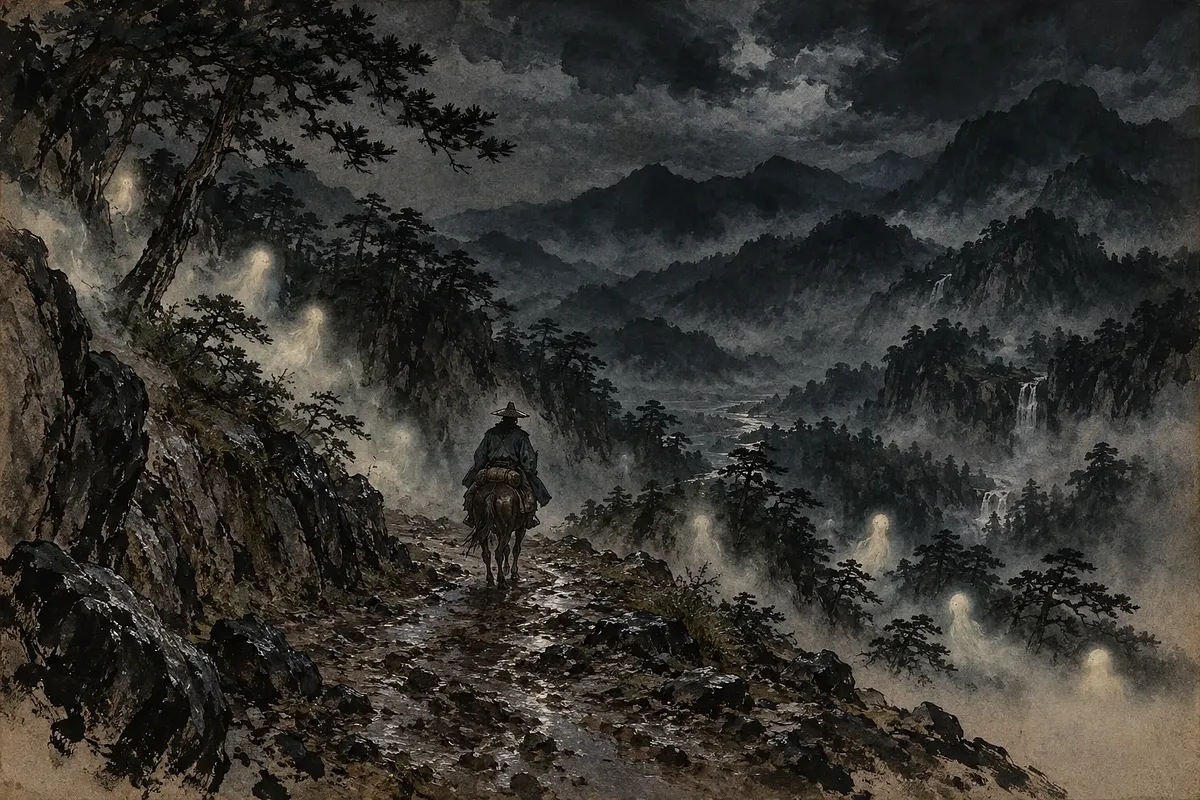
Prefect An’s encounter with ghost lights sets up the later misunderstanding.AI-generated image

Key points

  • The ghost light anecdote about Prefect An appears in volume 3 of Yongjae Chonghwa by Seong Hyeon of the early Joseon period.
  • The story moves from clusters of lights on a road at night to the reappearance of ghost lights, then to confusion over a pine torch at a villa.
  • The ending reveals a twist: the man who thought he had driven away the ghost lights is still afraid.
  • Summaries of the mountain-road scene in later studies do not describe a separate variant, but present part of the same anecdote.
  • This anecdote alone cannot establish the origins of ghost light traditions or the natural cause of the lights.

The account of An Buyun in volume 3 of Yongjae chonghwa is a strange tale recorded by Seong Hyeon in the early Joseon period. A man who encounters ghost lights on a nighttime road later mistakes even the pine-knot fire at his country house for a ghost. This article retells that traditional story.

This article follows the story in volume 3 of Yongjae chonghwa and was prepared as of October 2026.

The Story

The lights An Buyun encounters on a nighttime road lead him to cause a commotion even after reaching his country house. The following retelling follows the sequence of events in the Classical Chinese account. The transitions between scenes are newly written.

Lights Surrounding the Nighttime Road

When An Buyun was young, he was traveling to his country house in Seowon. He was riding a thin horse. A single page accompanied him.

Night was falling, and no one was in sight. Lights resembling torches appeared in the direction of the town to the east. Noisy voices could also be heard. It looked like a hunting party.

The lights drew closer. Before long, they surrounded the travelers on both sides. Even after they had traveled some distance, the lights would not leave them. These were what the story calls ghost lights.

An Buyun could find nowhere to retreat. He simply urged his horse onward. As he continued along the road, the lights scattered.

Ghost Lights Reappearing Beyond the Pass

After he crossed a mountain pass, the lights that had disappeared blocked the road again. The sky was overcast, and the rain-soaked road was difficult to travel. Until moments before, An Buyun had been relieved to think he had escaped the ghost lights.

The lights from earlier were gathered in layers before his eyes. He could think of no other way out. He drew his sword, shouted loudly, and charged into the lights.

The lights scattered all at once. The swarm moved into the woods and underbrush. There followed even the sounds of clapping and loud laughter.

The Pine-Knot Fire at the Country House

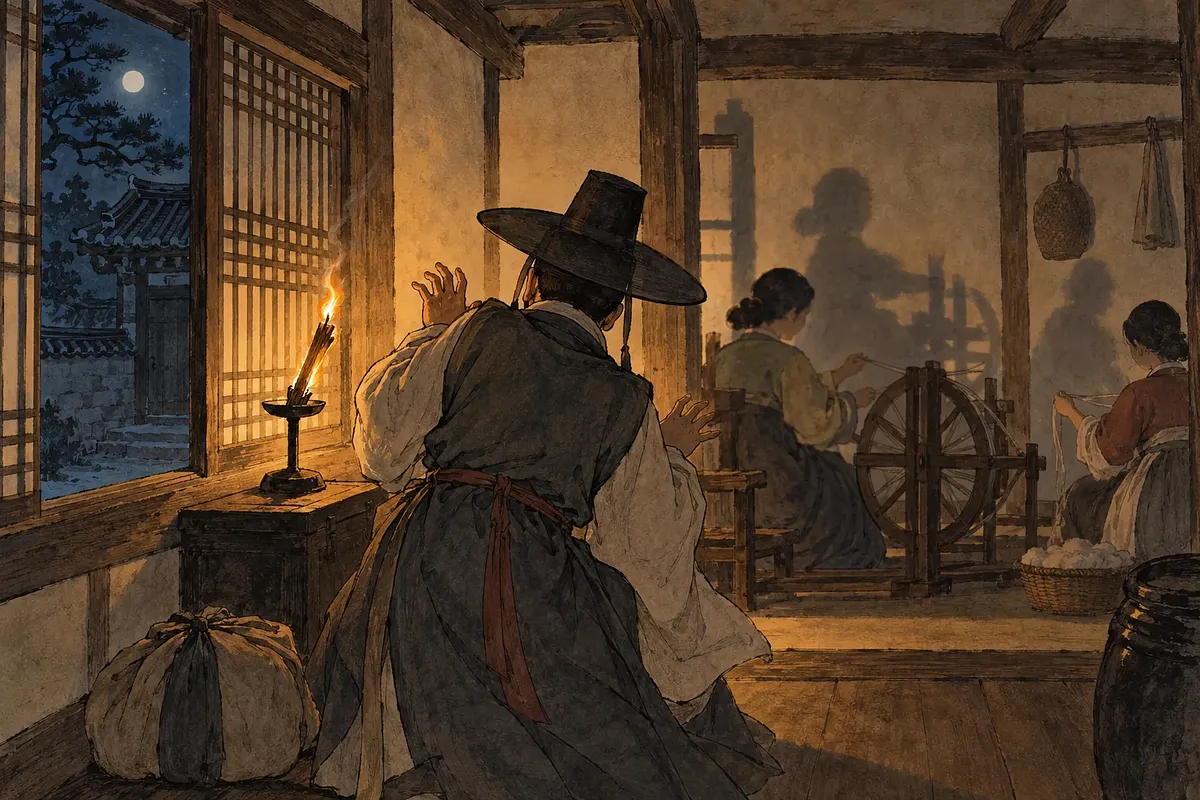
Even after reaching his country house, An Buyun could not calm his nerves. He leaned against a window and dozed briefly. Inside, the servants were spinning thread by the light of a pine-knot fire.

The light grew brighter, then dimmer. Seeing it, An Buyun thought the ghost lights had followed him again. He sprang up and caused a commotion. Dishes around him broke, and the household was startled.

The man who thought he had driven off the ghost lights on the nighttime road had not yet escaped his fear. What frightened him again at the country house was a fire lit for household work. The story ends with this mistake.

The comic ending reveals that fear lingers even after he believes he has driven the spirits away.AI-generated image

The Original Source and Its Background

This account comes from volume 3 of Seong Hyeon's Yongjae chonghwa. Seong Hyeon was a figure of the early Joseon period, born in 1439 and deceased in 1504. Kyujanggak describes the book as a collection of essays covering institutions, customs, people, and other subjects. Bibliographic information is available on the detailed page for the copy held by Kyujanggak.

At the beginning of the story, An Buyun is introduced as Seong Hyeon's maternal uncle. A maternal uncle is a brother of one's mother. Here, “An” is the surname, and “Buyun” is an official title. “An Buyun” should therefore not be read as a person's full name.

The Classical Chinese text can also be found in a quotation included in the Korean Modern Historical Materials Database. Son Jin-tae quoted it in issue 15 of Donggwang, published on July 5, 1927. The article is titled “A Study of Early Korean Culture, A Religious and Folk Study of Ancient Korean Religion (4).” The article includes the Classical Chinese text through the commotion at the country house.

The dates associated with these sources should be distinguished as follows.

Category Confirmed information Points to keep in mind when reading
Source of the story Volume 3 of Yongjae chonghwa This does not prove that the events actually happened
Author Seong Hyeon, born in 1439 and deceased in 1504 His birth and death dates do not date the events of the story
The linked copy held by Kyujanggak A lithographic edition listed as published in the 20th century The date this copy was printed differs from the date the work was written
Classical Chinese quotation in Donggwang Published on July 5, 1927 This is a later source quoting the original text

The relevant Kyujanggak page was used to check the bibliographic details of its copy. This retelling is based on the Classical Chinese passage quoted in Donggwang. No sentences from modern translations were used.

Other Versions and Similar Stories

The differences among the sources consulted concern the scope of quotation and summary rather than distinct versions. Kim Jong-dae's 2004 study focuses on the encounter with ghost lights on a mountain road. The paper is titled “A Preliminary Comparative Study of Korean Dokkaebi and Japanese Yōkai (妖怪).” The relevant material can be found in the paper made available by the National Folk Museum of Korea.

Source or tradition Content presented Relationship to this account
Classical Chinese quotation from volume 3 of Yongjae chonghwa Runs from the ghost lights on the nighttime road through the mistaken perception at the country house Provides the sequence of events on which this retelling is based
Kim Jong-dae's 2004 study Ghost lights gather in a group and tease a traveler on a mountain road Focuses on part of the same account
Oral traditions of dokkaebi fire compared in the study Groups of lights appear on nighttime roads in bad weather Allow comparison of shared motifs

The absence of the country-house scene from a summary does not mean it has a different ending. Nor does a resemblance to motifs in oral traditions make them the same story. To discuss distinct versions, records with different characters and sequences of events must be identified.

Folklore in the Story

The ghost lights in this account can be read in connection with traditions of dokkaebi fire. “Ghost lights” refers to strange lights regarded as the fire of ghosts. Kim Jong-dae's study also interprets this record as an example of dokkaebi fire.

The comparison rests on the shared motifs of nighttime roads, bad weather, and gathering in groups. Here, the weather is a condition under which the lights appear in the tradition. It is not observational evidence establishing what actually caused the lights.

Does This Account Explain the Origin of Dokkaebi Fire?

This account does not explain how the tradition of dokkaebi fire began. It unfolds as the personal account of someone who encounters strange lights. The origin of Korean dokkaebi as a whole therefore cannot be found in this single story.

The following distinctions should be kept in mind when reading.

  • Distinguish the expression “ghost lights” in the record from the later interpretation of them as dokkaebi fire.
  • Do not assume that ghosts and dokkaebi are always the same beings.
  • Do not conclude that a particular natural phenomenon caused the events in this account.
  • The setting of the story does not indicate a present-day haunted location.

The Ending and Meaning of the An Buyun Story

The key to the ending is the twist in which a pine-knot fire is mistaken for a ghost. A pine-knot fire burns pieces of resin-rich pine. For the household, it provided light for work. For An Buyun, it became a light that revived his fear from the nighttime road.

This structure can be read as showing how fear changes even the way ordinary things are interpreted. On the mountain road, unidentified lights frighten a person. At the country house, that person misidentifies a familiar light. The contrast between the two scenes creates humor.

Scene An Buyun's judgment Meaning revealed by the ending
After the ghost lights first scatter He thinks he has escaped danger His relief does not last long
After he charges into the ghost lights He clears a path again His fear has not disappeared as well
After he sees the light at the country house He thinks the ghost lights have returned He mistakes the pine-knot fire for them and causes a commotion

This interpretation is a reading drawn from the story's structure. It is not a separate moral explicitly stated by Seong Hyeon. Nor is there a basis for assigning An Buyun a modern medical diagnosis.

Key questions in this article

Is the Story of An Buyun True?

It is a strange tale recorded in a classical work, not an event verified as true. The mere presence of a person in the story does not prove that ghost lights exist. This article retells a traditional story.

Where Can I Read the Original Text?

The Classical Chinese text is quoted in an article in issue 15 of Donggwang in the Korean Modern Historical Materials Database. It runs from the introduction of An Buyun through the commotion at the country house. The linked Kyujanggak page provides bibliographic details for its copy.

Is An Buyun a Person's Name?

“An Buyun” is a form of address combining a surname and an official title. “An” is the surname, and “Buyun” is the official title. The text introduces him as Seong Hyeon's maternal uncle.

Is the Fire That Appears at the End Also a Ghost Light?

The final fire at the country house is a pine-knot fire the servants have lit for their work. An Buyun mistakes it for ghost lights. This mistake creates the twist in the ending.

Is a Summary That Ends on the Mountain Road a Different Version?

There is no basis for treating the summary in the study consulted as a distinct version. The study presents the mountain-road scene with a focus on the characteristics of dokkaebi fire. The Classical Chinese quotation continues through the commotion at the country house.

What Does the Story Mean?

One possible reading is that lingering fear can make even an ordinary light seem threatening. Placing a mistake after the scene in which the ghost lights appear to have been driven away creates humor. This is an interpretation of the story's structure.

Is This a Tradition Connected to Halloween?

There is no evidence that this account originated with Halloween. It can be included among classical ghost stories to read in the lead-up to Halloween. The original source and the meaning of its ending remain the same when read in summer or any other season.

Open the link

Opens in a new window.

Advertisement

Sign-in required

Sign in with your Google account to like, comment, and save highlights.

FAQ

Is the story of An Buyun true?

It is not a verified true event, but a strange tale recorded in a classical text. The fact that a person appears in the tale does not in itself prove that ghost lights are real. This article retells a traditional story.

Where can I read the original text?

A passage in Classical Chinese is quoted in an article in issue 15 of Donggwang in the Korean Modern Historical Sources DB. You can read from the passage introducing An Buyun through the commotion at the villa. The linked Kyujanggak page provides bibliographic information about the copy in its collection.

Is An Buyun a person's name?

'An Buyun' is a form of address combining a surname and an official title. 'An' is the surname, and 'buyun' is the official title. In the text, he is introduced as Seong Hyeon's maternal uncle.

Is the fire that appears at the end also a ghost light?

The last fire at the villa is a pine-knot fire lit by the servants so they can work. An Buyun mistakes it for a ghost light. This misperception creates the twist at the end.

Is the summary that ends on the mountain path a different version?

There is no basis for treating the summary in the study consulted as a separate version. The study presents the mountain path scene with a focus on the characteristics of will-o'-the-wisps. The quoted Classical Chinese passage continues through the commotion at the villa.

What does the story mean?

One possible reading is that lingering fear can make even an ordinary light seem threatening. Placing a misperception after a scene in which the ghost lights seem to have been driven away creates humor. This is an interpretation of the story's structure.

Is this a traditional tale connected to Halloween?

There is no evidence that this anecdote originated from Halloween. It can serve as a classic ghost story to read in the lead-up to Halloween. The original text and the meaning of the ending remain the same even if it is read in summer or another season.

Sources

Data formats

This content is available in several machine-friendly formats.

Data-only languages (machine translated, files only)

Indonesian JSON MD Portuguese JSON MD Chinese (Traditional) JSON MD Deutsch JSON MD

Verification

This is a retelling of a traditional tale. It is a story that has been passed down, not a true event; its original and origin are given in the article.

This article was drafted with AI and then reviewed and edited by a person.

Reviewed by 신익희 · 편집장

Reuse & AI usage

Search indexing and AI citation with attribution are welcome. See the license policy for details.

CC BY · License

Loading…

Loading…

From Injoys

Request the content you want and take 70% of what it earns

Just leave the subject. We handle production, review, translation and distribution.

See how revenue sharing works

Comments