Injoys
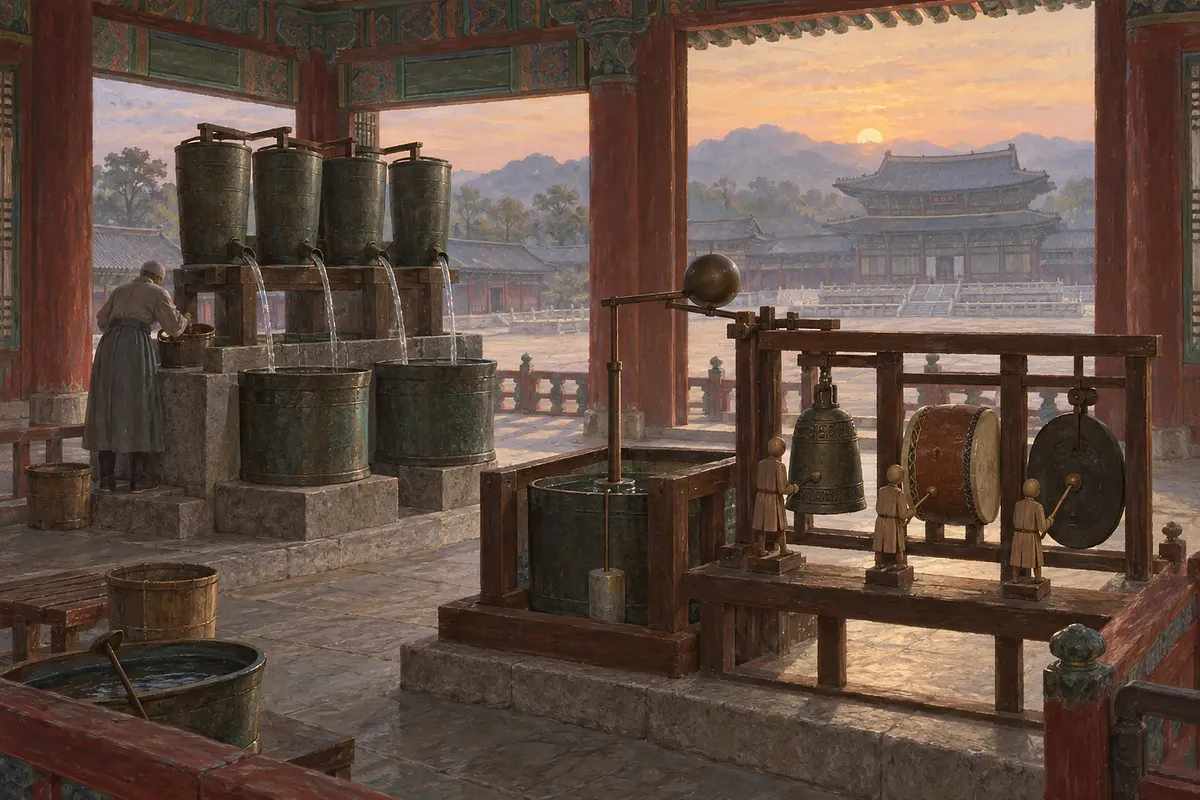
Jang Yeong-sil and others completed the Jagyeongnu in 1433. Its automatic time signals solved the problem of having someone watch a water clock and announce the time. The device, used from July 1434, is remembered for changing how Joseon kept time.
This article follows the records in the National Institute of Korean History’s Annals of King Sejong, checked in October 2026.
What problem was the Jagyeongnu built to solve?
The Jagyeongnu was designed to remove the need for a person to read and announce the time. In earlier water clocks, a marked rod rose as the water level climbed. An attendant had to watch its markings and announce the time.
A time signal announces a set time through a sound or display. Even if the water clock measured time, the signal would be wrong if the attendant misread it. The Annals of King Sejong records that Sejong was concerned about mistakes by the attendants responsible for time signals. The Jagyeongnu had a mechanism with wooden figures to do that work instead. Annals of King Sejong, 1st day of the 7th month of Sejong’s 16th year
| Category | Earlier water clock watched by a person | Jagyeongnu |
|---|---|---|
| Measuring time | Used the flow of water and markings on a rod | Used the flow of water and the rod’s movement |
| Determining the time | An attendant read the markings | A mechanism operated when the rod reached a set height |
| Announcing the time | An attendant gave the signal | Figures struck a bell, drum and gong |
| Work still requiring an attendant | Maintaining the water clock and giving time signals | Changing the water and maintaining the mechanism |
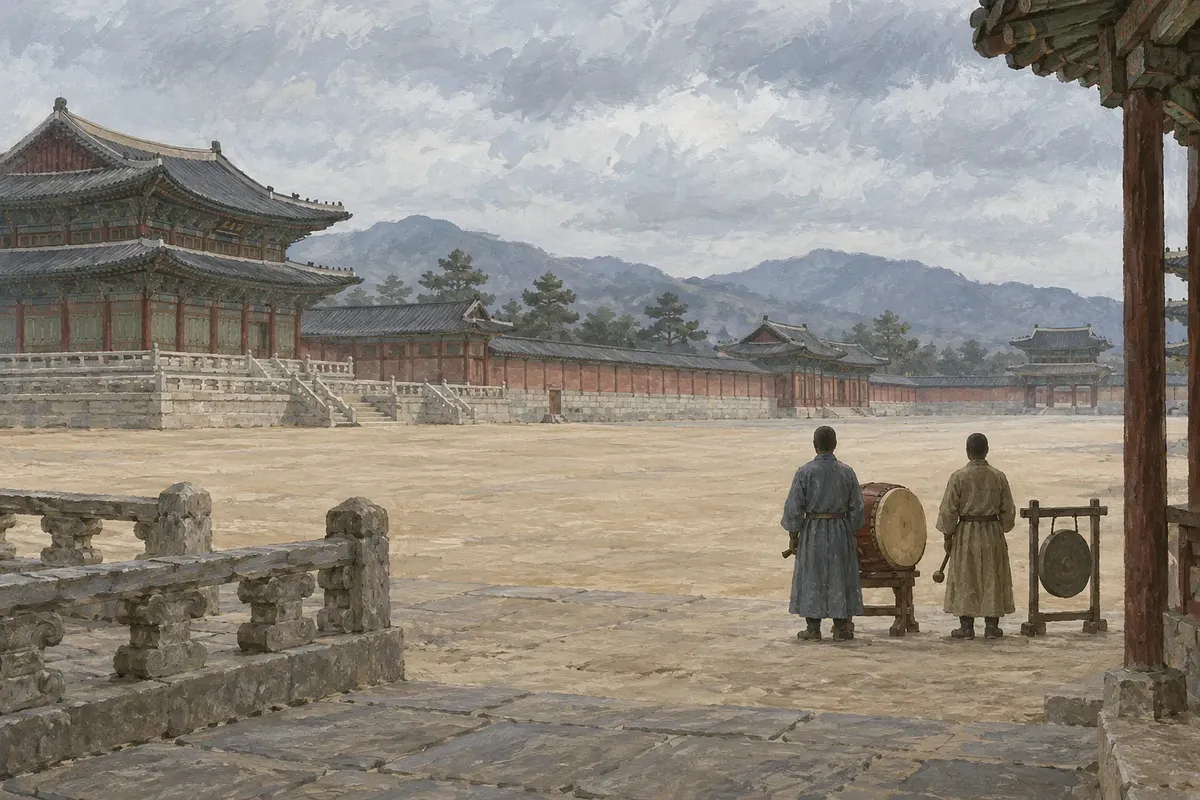
In 1437, a method was adopted to relay the palace water clock’s time signal to Uigeumbu.AI-generated image
How a technician born a government slave gained an official post
Jang Yeong-sil’s appointment to an official post faced opposition because of his social status. He is known as an early Joseon technician who was born a government slave in Dongnae County. A government slave was a male slave attached to a government office. His birth and death years are unknown.
An entry in the 1433 annals recounts an earlier discussion about appointing him to the Royal Wardrobe Office. Heo Jo opposed it because of his mother’s status. Jo Mal-saeng argued that Jang Yeong-sil was suited to the office. Sejong later accepted his ministers’ views and appointed him to a byeoljwa post.
Making the Jagyeokgungnu was the turning point at which his technical work led to a higher post. Citing his contribution to its construction, Sejong proposed giving him the additional post of hogun. The ministers agreed, and Sejong followed their view.
He has made an instrument that will be passed down for a long time, so his contribution is considerable. I wish to give him the additional post of hogun.
Sejong, Annals of King Sejong, 16th day of the 9th month of Sejong’s 15th year. The entry
A timeline distinguishing construction from use
Separate records confirm the Jagyeongnu’s completion and the start of its use. Our History Net’s account of the Jagyeongnu gives 1433 as its completion year. The annals state that the new water clock came into use on the 1st day of the 7th lunar month of 1434. The months and days below follow the lunar dates recorded at the time.
| Date | Recorded event | Source |
|---|---|---|
| 16th day of the 9th month of 1433 | Discussion of the contribution made by building the Jagyeokgungnu and granting the post of hogun | Relevant entry in the Annals of King Sejong, Sejong’s 15th year |
| 1st day of the 7th month of 1434 | Start of use of the new water clock and description of its automatic time-signal mechanism | Relevant entry in the Annals of King Sejong, Sejong’s 16th year |
| 28th day of the 6th month of 1437 | Order to relay time signals from the palace to Uigeumbu | Relevant entry in the Annals of King Sejong, Sejong’s 19th year |
| 1438 | Construction of the Okru, which also displayed changes in the heavens | Our History Net, “Astronomical Instruments and Calendrical Systems under Sejong” |
| 3rd month of 1442 | Investigation after a royal palanquin built under his supervision broke | Our History Net, “Jang Yeong-sil” |
| 1536 | Installation of an additional Jagyeongnu at Changgyeonggung Palace | National Palace Museum of Korea collection description |
The 1433 entry confirms his contribution to the construction. It alone cannot establish the completion date or testing schedule. The 1434 entry gives specific details about the start of use and the device’s construction. Our History Net, “Jagyeongnu”
How the Jagyeongnu worked
The Jagyeongnu turned a rising water level into the movement of balls to announce the time. The water-clock section measured the passage of time. The time-signal mechanism turned that movement into sounds and displays by figures.
Vessels that supplied and received water
The pasuho were vessels that released water, and the susuho were vessels that received it. The 1434 annals record four pasuho and two susuho. The susuho were used alternately when the water was changed. As the water level rose in a receiving vessel, a rod inside it rose too.
The sequence from rod to ball
When the rod reached a set height, it activated a mechanism that released a ball. A small copper ball acted on a mechanism that released a larger iron ball. The force of the falling ball moved the figures that gave the time signals.
- Water flows from a pasuho into a susuho.
- As the water rises, the rod inside the susuho rises.
- At a set position, the rod activates the mechanism that releases a small ball.
- The small ball moves a lever mechanism, releasing a large iron ball.
- The iron ball’s movement sets the figures’ time-signal actions in motion.
What did the bell, drum and gong announce?
The bell, drum and gong announced different divisions of time. The bell marked the hour, the drum marked a night watch, and the gong marked a subdivision of a watch. Figures holding plaques showing the time also appeared in turn.
| Display mechanism | What it announced |
|---|---|
| Figure striking the bell | An hour as a division of the day |
| Figure striking the drum | A watch as a division of the night |
| Figure striking the gong | A further division of a watch |
| Figure holding a time plaque | A display of the corresponding time |
Nighttime signals also needed seasonal adjustment. The annals describe a structure in which copper plates were changed according to the seasonal divisions. Automatic time signals did not eliminate the need to change the water or make seasonal adjustments. Description of the water clock’s structure in the Annals of King Sejong
How were palace time signals relayed through the capital?
In 1437, a method was adopted for relaying signals from the palace Jagyeongnu to Uigeumbu. The State Council raised the inaccuracy of the existing water clocks as a problem. It also identified attendants’ mistakes as a cause of incorrect entry and exit times.
The State Council asked for metal percussion instruments and drums to be placed at intermediate points to relay the signals. The plan was to hear the palace Jagyeongnu and give signals in sequence. Sejong accepted the proposal. Annals of King Sejong, 28th day of the 6th month of Sejong’s 19th year
| Stage | Role | What the record indicates |
|---|---|---|
| Palace Jagyeongnu | Produce the reference time signal | Establish the time at the starting point |
| Intermediate relay points | Hear the sound and give the next signal | Carry the signal beyond the palace |
| Relay to Uigeumbu | Connect the signal to time announcements in the capital | Enable multiple places to follow the same reference |
This record helps define the extent of the automation. In the palace, a machine announced the time. Outside the palace, people heard the sound and relayed the signal. Describing this as a system for sharing a common time is an interpretation based on the record.