Injoys
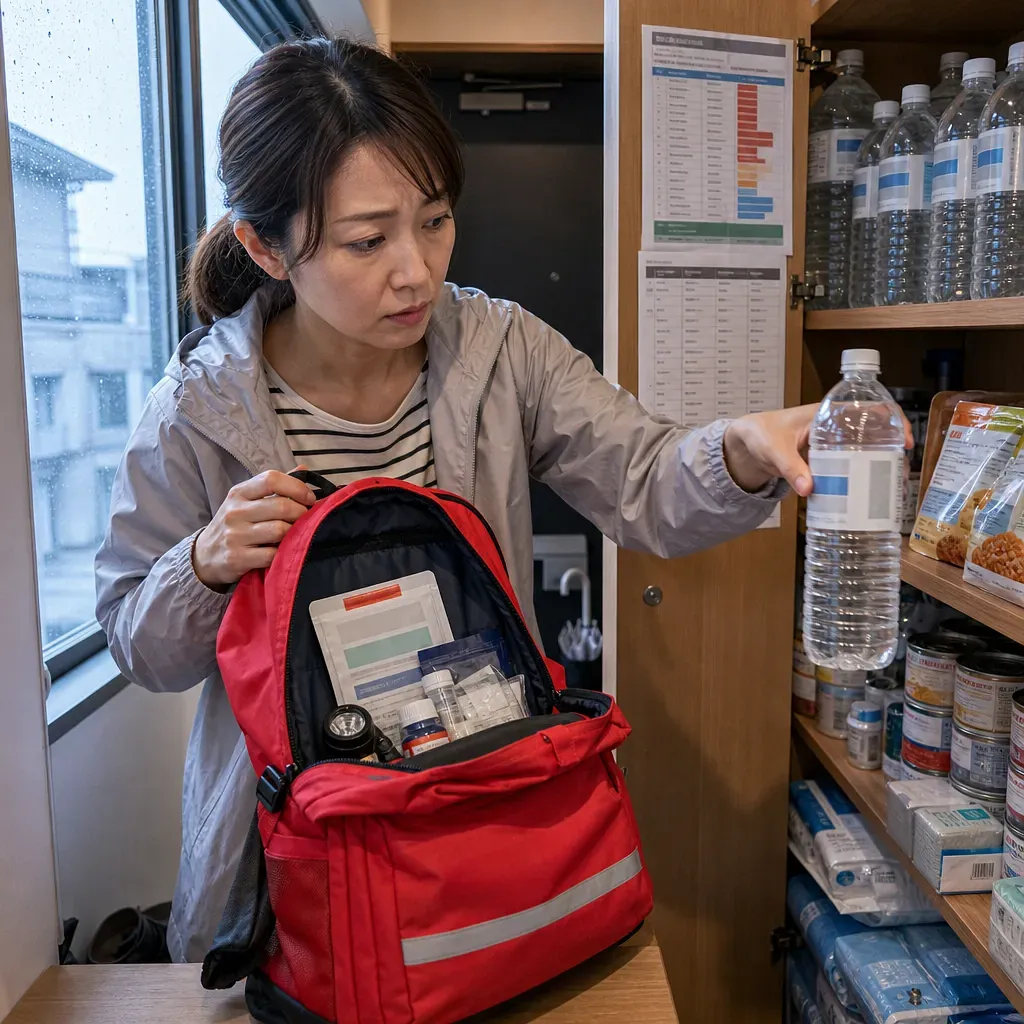
The most common mistake when preparing for disasters in Japan is either putting all water and food into an emergency backpack or, conversely, stockpiling everything only at home. A disaster preparedness backpack contains emergency items for immediate evacuation, while home supplies are resources for enduring water outages, power outages, and supply disruptions when the home is safe.
The two types of preparation do not replace each other. For most households, the best approach is to have both a lightweight backpack for each person and sufficient supplies at home.
Differences Between a Disaster Preparedness Backpack and Home Supplies
| Comparison criterion | Emergency evacuation disaster preparedness backpack | Home supplies | Distributed combination |
|---|---|---|---|
| Primary purpose | Leave a hazardous area and travel to a shelter or safe location | Cope with water outages, power outages, and supply disruptions when the home is safe | Evacuate with backpacks while maintaining long-term supplies at home |
| Storage location | Somewhere immediately accessible, such as near the entrance or bedroom | Distributed among several locations, such as the kitchen and storage cabinets | Divided between individual backpacks and home storage spaces |
| Water | An amount that can realistically be carried, plus containers for refilling | Calculated based on about 3 liters per person per day | Water for travel in backpacks and the calculated supply at home |
| Food | A small amount that can be eaten immediately without cooking | At least 3 days’ worth, and preferably 1 week’s worth | Separate portable food from stored foods eaten regularly |
| Portable toilets | A small number of portable products | Enough for the entire household to use for several days | Distributed between backpacks and the home |
| Weight | Extremely important; the backpack must be worn and tested while walking | Storage space and replacement management matter more than transport weight | Keep heavy water at home and have each person carry essential personal items |
| Cost structure | Quantities are small, but lightweight, portable products may have high unit prices | The total purchase cost may be high if everything is prepared at once, but everyday foods can be rotated | Requires more initial work but reduces waste and the risk of losing one particular bag |
| Items likely to be insufficient | Enough water, meals for several days, and large quantities of hygiene products | Identification, communications, lighting, and medications needed for immediate evacuation | Items may be missed without regular management of locations and expiration dates |
| Suitable situations | Places requiring rapid evacuation due to floods, tsunamis, landslides, and similar hazards | Earthquake-resistant homes where sheltering at home is possible | Most households where the need to evacuate depends on the type of disaster |
The key is not to pack several days’ worth of everything into a backpack, but to keep the items essential during evacuation within a weight that can actually be carried. Putting the water and food that should remain at home into the backpack can slow evacuation and increase the risk of falling.
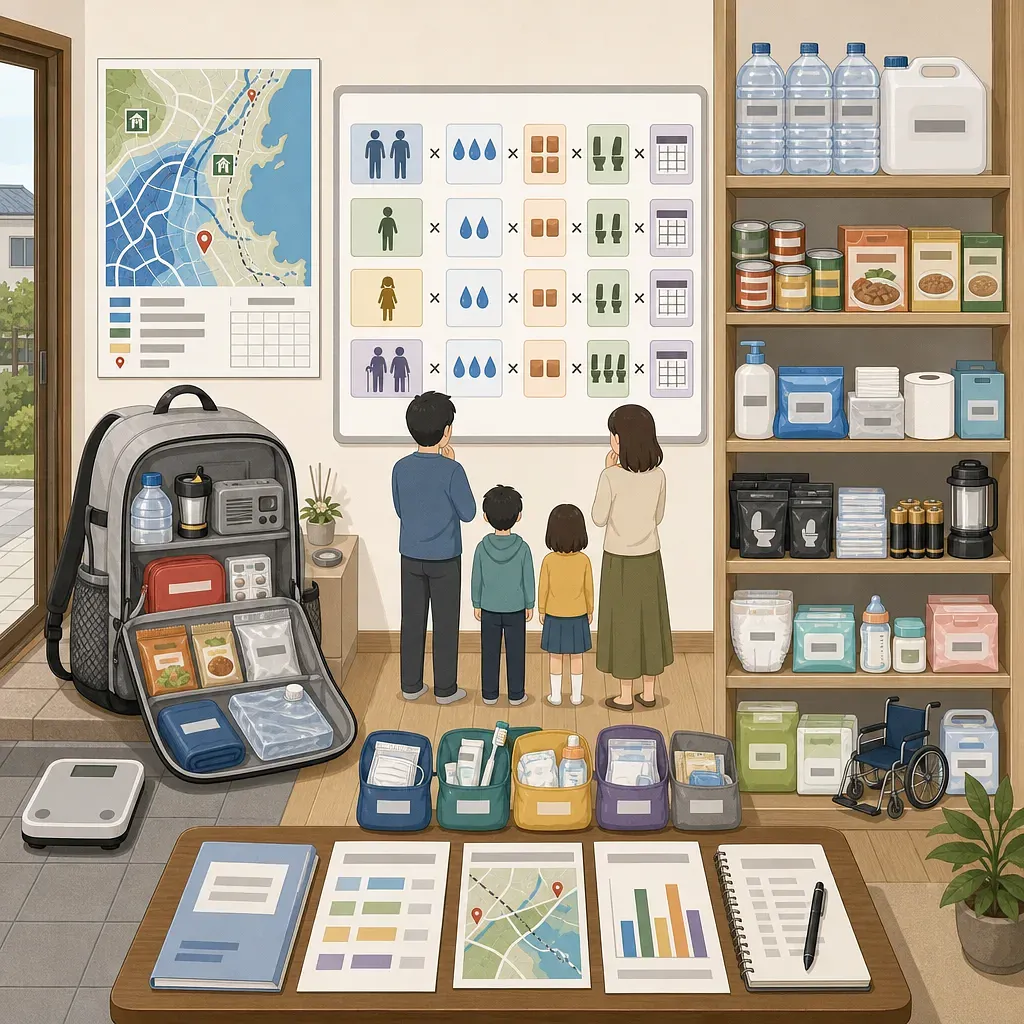
Calculating Quantities of Water, Food, and Portable Toilets
Water for Home Use
Public disaster preparedness guidance in Japan generally calculates household water as follows.
Number of household members × about 3 liters per day × number of stockpiled days
This is mainly the amount needed for drinking and simple cooking. Water needed for washing, cleaning, pets, cleaning medical equipment, and other daily uses must be considered separately.
| Household size | 3 days | 7 days |
|---|---|---|
| 1 person | About 9 liters | About 21 liters |
| 2 people | About 18 liters | About 42 liters |
| 4 people | About 36 liters | About 84 liters |
Because stored water is heavy, calculate the amount after checking the official recommendation from your local municipality; carrying several days’ worth of drinking water in a backpack is not realistic. Putting this amount into a backpack is not realistic. Dividing water among several containers rather than relying on one large container makes storage, transport, and the risk of container damage easier to manage.
Water in a Disaster Preparedness Backpack
There is no single nationwide correct amount of water to put in a backpack. It varies according to travel distance, weather, physical strength, shelter location, and whether infants will be accompanying you.
Use the following principles to decide.
- Put on the fully packed backpack and walk up and down stairs and along the actual evacuation route.
- You should be able to use both hands freely with the water packed.
- Divide the water among family members who can walk, taking differences in physical strength into account.
- Include a collapsible water container or empty container for refilling, but it does not need to be filled from the start.
- Water purification products differ in their ability to remove different types of contaminants, so do not assume they can replace a safe water source.
Food
The basic quantity of home food supplies can be calculated as number of household members × number of meals per day × number of stockpiled days. However, do not focus only on the number of meals; include foods that can be eaten without water or a heat source.
- Ready-to-eat foods: canned foods, nutrition bars, instant porridge, etc.
- Foods requiring water or a heat source: dried noodles, packaged instant rice, freeze-dried foods, etc.
- Foods regularly eaten and replenished: rice, noodles, retort-pouch foods, and side dishes with a long shelf life
- Foods for individual needs: allergy-friendly foods, low-sodium foods, easy-to-chew foods, and food for infants and young children
If you include canned food, check whether it can be opened by hand and store a can opener and utensils with it if necessary. Rather than buying emergency food and storing it separately, a rolling-stock system—using stored foods that you normally eat first and replenishing them with new products—is more effective for managing expiration dates.
Portable Toilets
When damage to sewer pipes is suspected, as well as during a water outage, pouring water into a toilet to flush it can worsen the problem. It is therefore safer to separately stock portable toilets that use solidifying agents and bags.
Use the following formula.
Number of household members × expected number of uses per person per day × number of stockpiled days
Set the expected number of daily uses according to your family’s circumstances, and confirm the quantity needed using guidance or an official calculation tool from your local municipality. This is an example for planning purposes, and the actual number may vary depending on pregnancy, health conditions, medications, and age. Toilet supplies require not only solidifying agents but also toilet bags, sealable disposal bags, gloves, disinfectant, and odor-control measures.
Is It Better to Assemble Your Own Kit or Buy a Ready-Made Disaster Preparedness Kit?
| Option | Advantages | Cost characteristics | Items likely to be omitted | Suitable situations |
|---|---|---|---|---|
| Assemble it yourself | Can be tailored precisely to the family’s circumstances and evacuation route | Using existing household items makes it easier to control additional spending | Researching items and testing weight takes time | Households with needs involving medications, allergies, infants, young children, or older adults |
| Ready-made disaster preparedness kit | Provides basic tools in a short time | Buying the bag and tools as a bundle may cost more than purchasing them individually | Adequate quantities of water and food, medications, seasonal clothing, and personal hygiene products | Those beginning disaster preparations or finding it difficult to start with an empty bag |
| Supplemented ready-made kit | Provides both basic equipment and individual customization | Additional costs arise after purchasing the kit | Duplicate items and increased total weight | Those able to inspect and supplement the kit after purchase |
Although a ready-made kit may look complete, it is actually closer to a starting point. Before buying one, check the weight of the bag itself, the quantities of water and food, the radio’s power source, the flashlight battery specifications, the number of portable toilet uses, and food expiration dates.
A low-cost kit may look advantageous when comparing price alone, but you should also consider the total cost after adding the required quantities and the actual carrying weight. It may be better to put only the necessary items into an existing backpack than to buy a kit containing many tools your family does not need.
Items to Add According to Family Composition
If You Have Infants or Young Children
- The formula, baby food, and allergy-friendly foods they normally consume
- Feeding supplies, bottle-care supplies, and disposable cups
- Diapers, wet wipes, skin-protection products, and disposal bags
- A baby carrier and a blanket for maintaining body temperature
- Contact details for guardians and the child’s medical information
Formula requires safe water and a preparation method appropriate for the product. Ready-to-feed liquid products can reduce the burden of preparation, but first check whether the child can normally consume them and what storage conditions they require.
Family Members Who Are Older Adults or Have Disabilities
- Glasses, hearing aids, and spare batteries
- Dentures and cleaning and storage supplies
- Canes, walking aids, and communication cards
- Adult diapers and skin-care products
- Foods that are easy to chew or swallow
- Alternative means of charging or powering devices normally used
If Someone Takes Medication or Has a Chronic Condition
- Medications and their original packaging or prescription labels
- A list recording medication names, dosages, and times taken
- A copy of Okusuri Techo, Japan’s medication notebook, or offline information from the relevant app
- Contact details for medical institutions and pharmacies
- Medical device consumables and backup power sources
The amount and method for obtaining extra prescription medication vary according to the type of medication and the conditions of medical care. Do not reduce doses at your own discretion or store old medication; ask a doctor or pharmacist how to prepare for disasters.
If You Have Pets
Rules for bringing pets to shelters vary by municipality and facility. Prepare a carrier, food, water, waste-disposal supplies, medication, vaccination records, and photographs, and check how pets are accommodated at the actual designated shelter.
Principles for Dividing Supplies Among Family Members
If shared family supplies are concentrated in one person’s bag, no one will be able to use them if that person becomes separated from the group or the bag is lost.
- Each person should prioritize carrying their own water, medications, light, contact details, and items for staying warm.
- Adults should divide shared items such as radios, tools, and chargers among themselves.
- Distribute supplies for infants and young children between two guardians.
- Decide the weight of children’s and older adults’ bags based on their actual walking ability rather than applying a uniform weight standard.
- Weigh the completed bags and test them on stairs and along the evacuation route while wearing shoes.
- If flooding is possible, place important documents and electronic devices in waterproof pouches.
Avoid writing sensitive personal information prominently on the outside of a bag. You may instead record the necessary information on a sealed contact card inside.