Skip to content
Injoys
How-to 🇰🇷 South Korea

This content applies specifically to South Korea.

Winter Wind Chill: Calculation and Checks Before Going Out

Before going out in winter, check both the current wind chill and the forecast for the time you plan to go out. The Korea Meteorological Administration's formula, this site's display conditions, and the 2026 service closure notice are separate matters.

Listen or read this article

17:40

Listen, or read the text only.

Winter Wind Chill: Calculation and Checks Before Going Out

Kokoro 82M AI-generated voice 18 min read

0:00 17:40

Advertisement

Download audio

File name
winter-wind-chill-weather-reading-guide-en.mp3
Format
MP3 (audio/mpeg)
Duration
17:40
File size
12.1 MB
Engine
Kokoro 82M

This audio was generated by AI.

You may download and use it freely for personal use.

Advertisement

Winter Wind Chill: Calculation and Checks Before Going Out

14 min read

Winter Wind Chill: Calculation and Checks Before Going Out
Before going out in winter, check both the current wind chill and the forecast for the time you plan to go out. The Korea Meteorological Administration's formula, this site's display conditions, and the 2026 service closure notice are separate matters.
Check the current temperature and wind chill under My Neighborhood in this site's left-hand weather panel.
Use the Compared with Yesterday indicator to check the direction of change from the previous day.
In the 48-hour hourly forecast, check the forecast for when you plan to go out and return home.
Check the latest weather alerts and cold wave impact forecasts for your area on the Korea Meteorological Administration's Weather Nuri.
On cold days, reduce outdoor activities and prepare to keep warm when going out.
Before going out in winter, check the feels-like temperature under [My Neighborhood] on this site first. “Compared with Yesterday” shows the change from the previous day. Also check the forecast for when you plan to go out in the 48-Hour Hourly Forecast. Decide how to respond to a cold wave by checking both the latest weather alerts and impact forecasts from the Korea Meteorological Administration.
The figures and service information in this article are based on records checked on November 11, 2026, and the official documents below.
What to check before going out
Check the current feels-like temperature, then the forecast for when you plan to go out. The value shown now does not necessarily describe the weather when you go out later. Matching the location and time can help you avoid confusing different values.
· Check [My Neighborhood] in the weather panel on the left side of this site. Make sure the displayed location matches where you are going. Read both the current air temperature and the feels-like temperature. · Check “Compared with Yesterday” to see whether conditions have risen or fallen since the previous day. Check whether the comparison is for air temperature or feels-like temperature. · Find your departure time in the 48-Hour Hourly Forecast. Also check the forecast for when you plan to return. · Check the latest alerts for your area on the Korea Meteorological Administration’s Weather Nuri. If a cold wave impact forecast has been issued, also read the health response guidance. · On cold days, limit outdoor activities as much as possible. When going out, keep warm with gloves, a scarf, a hat, and a mask.
The last step follows the Korea Disease Control and Prevention Agency’s health guidelines for cold waves. Older adults should avoid outdoor activities during cold waves. See the section on cold-related illnesses below for detailed guidance.
What is feels-like temperature?
Feels-like temperature is a numerical measure of how hot or cold a person feels. The winter calculation uses air temperature and wind speed. Strong winds remove heat from around the skin more quickly. This can make it feel colder even at the same air temperature.
Feels-like temperature is not a measurement of body temperature. The winter formula does not account for an individual’s clothing or health. Use the displayed value as a reference when preparing for cold weather.
The Meteorological Data Open Portal guide to feels-like temperature explains the seasonal calculation methods. The summer period is May to September. The winter period is October to April of the following year.
The winter feels-like temperature formula and wind speed units
The winter formula calculates the cold produced by air temperature and wind together. The coefficients below match those shown on the Meteorological Data Open Portal. Wind speed must be in km/h.
Feels-like temperature = 13.12 + 0.6215Ta - 11.37V^0.16 + 0.3965V^0.16Ta Ta = Air temperature(℃) V = 10-minute average wind speed(km/h)
The two terms containing wind speed can be grouped as follows. This is an algebraic rearrangement of the original formula. It is not a new calculation formula.
Wind speed term = (-11.37 + 0.3965Ta) × V^0.16
At air temperatures of at most 10℃, the value in parentheses is negative. As wind speed increases, V^0.16 also increases. Therefore, at the same air temperature, stronger winds lower the calculated value. Wind speed and the drop in feels-like temperature do not change in the same proportion.
The official calculation conditions require a wind speed of at least 1.3m/s. This converts to 4.68km/h. Be careful not to enter a value shown in m/s directly into V.
How does this site’s display change under different conditions?
This site displays feels-like temperature according to the season and calculation conditions. In winter, it applies the formula when the air temperature is at most 10℃ and the wind speed is at least 1.3m/s. Both conditions must be met.
Period and conditions | Feels-like temperature displayed on this site October to April, air temperature at most 10℃ and wind speed at least 1.3m/s | Calculated using the Korea Meteorological Administration’s winter formula October to April, air temperature higher than 10℃ | Displayed as the same value as the air temperature October to April, wind speed lower than 1.3m/s | Displayed as the same value as the air temperature May to September | Calculated using the summer formula, which accounts for humidity
If the air temperature and feels-like temperature are the same, first check the site’s display conditions. Conditions may fall outside those for applying the winter formula. Do not conclude from that display alone that it is not cold.
This site’s feels-like temperature is a value calculated by the site using the formula. It may differ from the feels-like temperature published by the Korea Meteorological Administration. Check [My Neighborhood] on this site for the current value.
Comparing observed and forecast values
Observed and forecast feels-like temperatures use different data in their calculations. The Open Portal explains that its calculations are based on observed values. It also notes that these differ from the forecast values in Weather Nuri’s Weather and Life Index.
Category | Basis of the value | What to check when comparing Open Portal winter feels-like temperature | Observed values | Check whether it is the daily minimum feels-like temperature Feels-like temperature in the Weather Nuri Weather and Life Index guide | Forecast values | Check whether the information is specific to a group or environment This site’s feels-like temperature | A value calculated by the site by applying a formula to input data | Check the location, time, and seasonal display conditions
The Open Portal’s winter data gives the daily minimum feels-like temperature. Comparing it directly with a current value means comparing different reference points. When comparing two screens, check the following in order.
· Check whether you are comparing the same area or observation station. · Check whether the values are for the same time. · Check that you have not mixed current values with daily minimum values. · Check whether the data is observed or forecast.
Why you should check the current feels-like temperature even when it is warmer than yesterday
“Compared with Yesterday” tells you the direction of change. Check the feels-like temperature separately to see how cold it is now. It may still be cold even if the air temperature has risen since the previous day. You also need to distinguish changes in air temperature from the effects of wind.
Display item | Question it answers | Information to check alongside it Current air temperature | What is the air temperature now? | Current feels-like temperature Feels-like temperature | What is the calculated level of cold? | Location and reference time Compared with Yesterday | How has it changed since the previous day? | Item being compared and reference time 48-Hour Hourly Forecast | What weather is expected when you go out? | Forecasts for departure and return times
Check the on-screen explanation for the exact comparison time used in “Compared with Yesterday.” The same time on the previous day and the daily minimum are separate reference points. If there is no explanation, do not assume a particular basis for comparison.
When deciding whether to go out in the morning, use the forecast for your departure time. It is better not to substitute the current value or daily minimum. Check the updated forecast again before leaving.
Notices about feels-like temperature services ending in 2026
Read service termination notices together with the name and scope of the service concerned. Weather Nuri and the Open Portal list different end dates. No evidence was found to support treating the two dates as the same date.
Where the notice appears | Announced end date | Confirmed scope Weather Nuri Weather and Life Index | May 1, 2026 | Notice that the Feels-Like Temperature Index service is ending Open Portal Weather and Life Index | May 11, 2026 | Notice that the feels-like temperature service in that menu is ending Feels-like temperature under the Open Portal’s Climate Statistical Analysis | No end date listed | The winter formula and information on observed data remain available
The Open Portal Weather and Life Index guide includes the following wording.
Feels-like temperature service discontinued (2026.5.11.~)
The Weather Nuri Weather and Life Index guide explains feels-like temperatures for different groups and environments. This information may differ from the general feels-like temperature on the main screen. The termination wording alone is not enough to conclude that all feels-like temperature displays are ending.
The reason for the difference in dates has not been confirmed. It has also not been explicitly confirmed whether the notices apply to all winter feels-like temperature information. To confirm exactly what is covered, check the Korea Meteorological Administration’s notice for the service concerned or contact the agency. Distinguish this site’s own calculated values from those published by the services above.
How to read the 4 levels of cold wave impact forecasts
Cold wave impact forecasts explain expected damage and recommended responses. The risk levels are Attention, Caution, Warning, and Danger. The Korea Meteorological Administration explains that it also considers local vulnerability and exposure to cold.
Level | Risk level described by the Korea Meteorological Administration Attention | Slight disruption to daily activities, with some harm expected among vulnerable groups Caution | Some damage expected in parts of the area Warning | Significant damage expected in various locations, with impacts lasting for a short period Danger | Damage expected across most of the area, with extreme impacts in various locations lasting for an extended period
The Korea Meteorological Administration’s forecasting operations guide lists the conditions for issuing these forecasts. They are issued when at least the Attention level is expected in the health sector. They are issued 1 time a day, at 11:30 on the previous day. Forecasts are issued by weather alert area.
Are the criteria for each level based on feels-like temperature?
The Korea Meteorological Administration’s criteria for issuing health forecasts use morning minimum air temperature. They distinguish cases where the air temperature drops sharply. They also separately distinguish cases where low temperatures persist.
The following table gives the criteria in the attachment to the January 19, 2026 press release. The figures are morning minimum air temperatures, not feels-like temperatures. Read the regional thresholds together with the required duration.
Level | Areas outside the mountainous areas of Jeju Island | Southern and eastern coasts and the mountainous areas of Jeju Island | Other areas | Duration Attention | At most -3℃ | At most -5℃ | At most -9℃ | At least 2 days Caution | At most -5℃ | At most -7℃ | At most -12℃ | At least 2 days Warning | At most -7℃ | At most -9℃ | At most -15℃ | At least 2 days Danger | At most -12℃ | At most -14℃ | At most -20℃ | At least 1 day
The criteria for a sharp drop in air temperature are as follows. Do not apply the conditions in the table to changes in feels-like temperature. You also cannot determine the level from this site’s “Compared with Yesterday” display alone.
Level | Criteria for a sharp drop in morning minimum air temperature Attention | A drop of at least 7℃ from the previous day to at most 3℃ Caution | A drop of at least 10℃ from the previous day to at most 3℃, and at least 3℃ below normal Warning | A drop of at least 15℃ from the previous day to at most 3℃, and at least 3℃ below normal Danger | No separate figure listed in the attachment’s column for sharp-drop criteria
The source is Attachment 1 of the Korea Meteorological Administration press release on strengthening the cold wave impact forecast communication system. When deciding whether to go out, check the latest level issued for your area. Do not treat it as using the same criteria as the colors in the winter feels-like temperature calculation chart.
Preventing cold-related illnesses and what to do if you have symptoms
Cold-related illnesses are illnesses directly caused by cold. Hypothermia is a typical example affecting the whole body. Common examples affecting parts of the body include frostbite and chilblains.
The Korea Disease Control and Prevention Agency’s December 31, 2025 guidance emphasizes keeping warm. Drinking alcohol can prevent you from noticing that your body temperature is falling. The agency warns that this can increase the risk of cold-related illnesses. Do not try to cope with the cold by drinking alcohol.
Follow the Korea Disease Control and Prevention Agency’s health guidelines when preparing to go out.
· Check weather information, including the feels-like temperature, before going out. On cold days, limit outdoor activities as much as possible. · Wear thermal underwear or layers of thin clothing. Keep warm with gloves, a scarf, a hat, and a mask. · If your clothes or shoes get wet, promptly change into dry ones. This action is specified in the Korea Disease Control and Prevention Agency’s health guidelines for cold waves.
Older adults are less able to maintain their body temperature than adults in general. They should avoid outdoor activities during cold waves. Children and people with underlying medical conditions also need to take extra care in the cold.
People with cardiovascular or cerebrovascular disease should avoid sudden exposure to cold. They should also avoid strenuous physical activity. These guidelines come from the Korea Disease Control and Prevention Agency’s cold wave preparedness guidance.
See a doctor if you have symptoms of a cold-related illness. The Korea Disease Control and Prevention Agency recommends the following actions.
· Move to a warm place. · Remove wet clothing. · Keep your body warm with blankets or similar items.
Common mistakes when reading feels-like temperature
Read feels-like temperature together with its calculation conditions and comparison criteria. Even if the numbers look the same, the data may mean different things. In particular, avoid confusing the following.
Common mistake | What to check Entering a wind speed of 1.3m/s directly into V in the formula | V is measured in km/h, and 1.3m/s equals 4.68km/h Concluding that it is not cold because the feels-like temperature and air temperature are the same | This site displays the air temperature when conditions fall outside the winter calculation conditions Directly comparing the current value with the daily minimum | Check whether the location, time, and data type are the same Reducing cold-weather preparations because it is warmer than yesterday | Check both the current feels-like temperature and the forecast for when you go out Estimating the cold wave impact forecast level from the feels-like temperature color | Check the impact forecast issued by the Korea Meteorological Administration for your area Interpreting a service end date as the date the feels-like temperature formula is abolished | Check the service name and scope stated in the notice
0:00 0:00
1 / 69

Advertisement

Download text

File name
winter-wind-chill-weather-reading-guide-en.txt
Format
TXT (text/plain)
Paragraphs
69

Downloads exactly what you see as a text file.

Please cite the source when quoting.

Advertisement

Large text

Makes the text larger and the colors clearer. Turn it on if the text feels too small.

Prepare to stay warm before going out on cold days.

Key points

  • Check the current temperature and wind chill under My Neighborhood in this site's left-hand weather panel.
  • Use the Compared with Yesterday indicator to check the direction of change from the previous day.
  • In the 48-hour hourly forecast, check the forecast for when you plan to go out and return home.
  • Check the latest weather alerts and cold wave impact forecasts for your area on the Korea Meteorological Administration's Weather Nuri.
  • On cold days, reduce outdoor activities and prepare to keep warm when going out.

Before going out in winter, check the feels-like temperature under [My Neighborhood] on this site first. “Compared with Yesterday” shows the change from the previous day. Also check the forecast for when you plan to go out in the 48-Hour Hourly Forecast. Decide how to respond to a cold wave by checking both the latest weather alerts and impact forecasts from the Korea Meteorological Administration.

The figures and service information in this article are based on records checked on November 11, 2026, and the official documents below.

What to check before going out

Check the current feels-like temperature, then the forecast for when you plan to go out. The value shown now does not necessarily describe the weather when you go out later. Matching the location and time can help you avoid confusing different values.

  1. Check [My Neighborhood] in the weather panel on the left side of this site. Make sure the displayed location matches where you are going. Read both the current air temperature and the feels-like temperature.
  2. Check “Compared with Yesterday” to see whether conditions have risen or fallen since the previous day. Check whether the comparison is for air temperature or feels-like temperature.
  3. Find your departure time in the 48-Hour Hourly Forecast. Also check the forecast for when you plan to return.
  4. Check the latest alerts for your area on the Korea Meteorological Administration’s Weather Nuri. If a cold wave impact forecast has been issued, also read the health response guidance.
  5. On cold days, limit outdoor activities as much as possible. When going out, keep warm with gloves, a scarf, a hat, and a mask.

The last step follows the Korea Disease Control and Prevention Agency’s health guidelines for cold waves. Older adults should avoid outdoor activities during cold waves. See the section on cold-related illnesses below for detailed guidance.

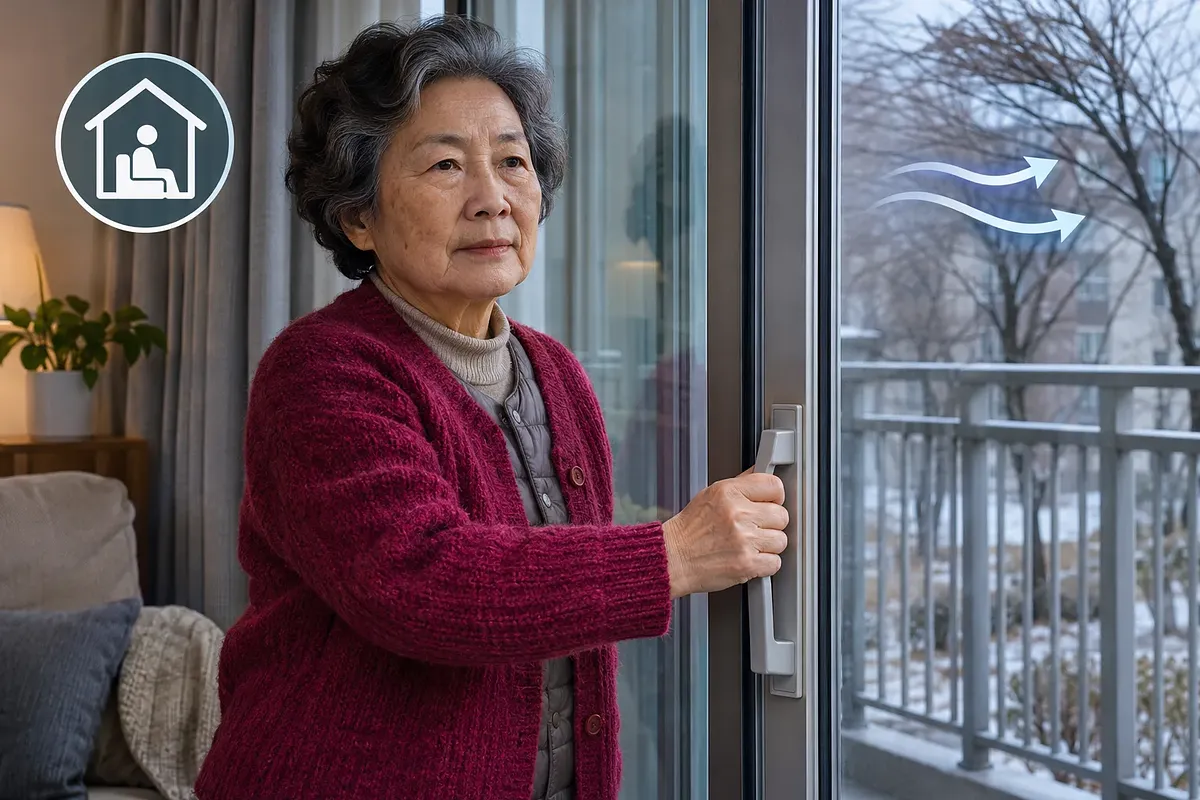
Limit outdoor activities on cold days.

What is feels-like temperature?

Feels-like temperature is a numerical measure of how hot or cold a person feels. The winter calculation uses air temperature and wind speed. Strong winds remove heat from around the skin more quickly. This can make it feel colder even at the same air temperature.

Feels-like temperature is not a measurement of body temperature. The winter formula does not account for an individual’s clothing or health. Use the displayed value as a reference when preparing for cold weather.

The Meteorological Data Open Portal guide to feels-like temperature explains the seasonal calculation methods. The summer period is May to September. The winter period is October to April of the following year.

The winter feels-like temperature formula and wind speed units

The winter formula calculates the cold produced by air temperature and wind together. The coefficients below match those shown on the Meteorological Data Open Portal. Wind speed must be in km/h.

Feels-like temperature = 13.12 + 0.6215Ta - 11.37V^0.16 + 0.3965V^0.16Ta
Ta = Air temperature(℃)
V = 10-minute average wind speed(km/h)

The two terms containing wind speed can be grouped as follows. This is an algebraic rearrangement of the original formula. It is not a new calculation formula.

Wind speed term = (-11.37 + 0.3965Ta) × V^0.16

At air temperatures of at most 10℃, the value in parentheses is negative. As wind speed increases, V^0.16 also increases. Therefore, at the same air temperature, stronger winds lower the calculated value. Wind speed and the drop in feels-like temperature do not change in the same proportion.

The official calculation conditions require a wind speed of at least 1.3m/s. This converts to 4.68km/h. Be careful not to enter a value shown in m/s directly into V.

How does this site’s display change under different conditions?

This site displays feels-like temperature according to the season and calculation conditions. In winter, it applies the formula when the air temperature is at most 10℃ and the wind speed is at least 1.3m/s. Both conditions must be met.

Period and conditions Feels-like temperature displayed on this site
October to April, air temperature at most 10℃ and wind speed at least 1.3m/s Calculated using the Korea Meteorological Administration’s winter formula
October to April, air temperature higher than 10℃ Displayed as the same value as the air temperature
October to April, wind speed lower than 1.3m/s Displayed as the same value as the air temperature
May to September Calculated using the summer formula, which accounts for humidity

If the air temperature and feels-like temperature are the same, first check the site’s display conditions. Conditions may fall outside those for applying the winter formula. Do not conclude from that display alone that it is not cold.

This site’s feels-like temperature is a value calculated by the site using the formula. It may differ from the feels-like temperature published by the Korea Meteorological Administration. Check [My Neighborhood] on this site for the current value.

Comparing observed and forecast values

Observed and forecast feels-like temperatures use different data in their calculations. The Open Portal explains that its calculations are based on observed values. It also notes that these differ from the forecast values in Weather Nuri’s Weather and Life Index.

Category Basis of the value What to check when comparing
Open Portal winter feels-like temperature Observed values Check whether it is the daily minimum feels-like temperature
Feels-like temperature in the Weather Nuri Weather and Life Index guide Forecast values Check whether the information is specific to a group or environment
This site’s feels-like temperature A value calculated by the site by applying a formula to input data Check the location, time, and seasonal display conditions

The Open Portal’s winter data gives the daily minimum feels-like temperature. Comparing it directly with a current value means comparing different reference points. When comparing two screens, check the following in order.

  1. Check whether you are comparing the same area or observation station.
  2. Check whether the values are for the same time.
  3. Check that you have not mixed current values with daily minimum values.
  4. Check whether the data is observed or forecast.

Why you should check the current feels-like temperature even when it is warmer than yesterday

“Compared with Yesterday” tells you the direction of change. Check the feels-like temperature separately to see how cold it is now. It may still be cold even if the air temperature has risen since the previous day. You also need to distinguish changes in air temperature from the effects of wind.

Display item Question it answers Information to check alongside it
Current air temperature What is the air temperature now? Current feels-like temperature
Feels-like temperature What is the calculated level of cold? Location and reference time
Compared with Yesterday How has it changed since the previous day? Item being compared and reference time
48-Hour Hourly Forecast What weather is expected when you go out? Forecasts for departure and return times

Check the on-screen explanation for the exact comparison time used in “Compared with Yesterday.” The same time on the previous day and the daily minimum are separate reference points. If there is no explanation, do not assume a particular basis for comparison.

When deciding whether to go out in the morning, use the forecast for your departure time. It is better not to substitute the current value or daily minimum. Check the updated forecast again before leaving.

Notices about feels-like temperature services ending in 2026

Read service termination notices together with the name and scope of the service concerned. Weather Nuri and the Open Portal list different end dates. No evidence was found to support treating the two dates as the same date.

Where the notice appears Announced end date Confirmed scope
Weather Nuri Weather and Life Index May 1, 2026 Notice that the Feels-Like Temperature Index service is ending
Open Portal Weather and Life Index May 11, 2026 Notice that the feels-like temperature service in that menu is ending
Feels-like temperature under the Open Portal’s Climate Statistical Analysis No end date listed The winter formula and information on observed data remain available

The Open Portal Weather and Life Index guide includes the following wording.

Feels-like temperature service discontinued (2026.5.11.~)

The Weather Nuri Weather and Life Index guide explains feels-like temperatures for different groups and environments. This information may differ from the general feels-like temperature on the main screen. The termination wording alone is not enough to conclude that all feels-like temperature displays are ending.

The reason for the difference in dates has not been confirmed. It has also not been explicitly confirmed whether the notices apply to all winter feels-like temperature information. To confirm exactly what is covered, check the Korea Meteorological Administration’s notice for the service concerned or contact the agency. Distinguish this site’s own calculated values from those published by the services above.

How to read the 4 levels of cold wave impact forecasts

Cold wave impact forecasts explain expected damage and recommended responses. The risk levels are Attention, Caution, Warning, and Danger. The Korea Meteorological Administration explains that it also considers local vulnerability and exposure to cold.

Level Risk level described by the Korea Meteorological Administration
Attention Slight disruption to daily activities, with some harm expected among vulnerable groups
Caution Some damage expected in parts of the area
Warning Significant damage expected in various locations, with impacts lasting for a short period
Danger Damage expected across most of the area, with extreme impacts in various locations lasting for an extended period

The Korea Meteorological Administration’s forecasting operations guide lists the conditions for issuing these forecasts. They are issued when at least the Attention level is expected in the health sector. They are issued 1 time a day, at 11:30 on the previous day. Forecasts are issued by weather alert area.

Are the criteria for each level based on feels-like temperature?

The Korea Meteorological Administration’s criteria for issuing health forecasts use morning minimum air temperature. They distinguish cases where the air temperature drops sharply. They also separately distinguish cases where low temperatures persist.

The following table gives the criteria in the attachment to the January 19, 2026 press release. The figures are morning minimum air temperatures, not feels-like temperatures. Read the regional thresholds together with the required duration.

Level Areas outside the mountainous areas of Jeju Island Southern and eastern coasts and the mountainous areas of Jeju Island Other areas Duration
Attention At most -3℃ At most -5℃ At most -9℃ At least 2 days
Caution At most -5℃ At most -7℃ At most -12℃ At least 2 days
Warning At most -7℃ At most -9℃ At most -15℃ At least 2 days
Danger At most -12℃ At most -14℃ At most -20℃ At least 1 day

The criteria for a sharp drop in air temperature are as follows. Do not apply the conditions in the table to changes in feels-like temperature. You also cannot determine the level from this site’s “Compared with Yesterday” display alone.

Level Criteria for a sharp drop in morning minimum air temperature
Attention A drop of at least 7℃ from the previous day to at most 3℃
Caution A drop of at least 10℃ from the previous day to at most 3℃, and at least 3℃ below normal
Warning A drop of at least 15℃ from the previous day to at most 3℃, and at least 3℃ below normal
Danger No separate figure listed in the attachment’s column for sharp-drop criteria

The source is Attachment 1 of the Korea Meteorological Administration press release on strengthening the cold wave impact forecast communication system. When deciding whether to go out, check the latest level issued for your area. Do not treat it as using the same criteria as the colors in the winter feels-like temperature calculation chart.

Cold-related illnesses are illnesses directly caused by cold. Hypothermia is a typical example affecting the whole body. Common examples affecting parts of the body include frostbite and chilblains.

The Korea Disease Control and Prevention Agency’s December 31, 2025 guidance emphasizes keeping warm. Drinking alcohol can prevent you from noticing that your body temperature is falling. The agency warns that this can increase the risk of cold-related illnesses. Do not try to cope with the cold by drinking alcohol.

Follow the Korea Disease Control and Prevention Agency’s health guidelines when preparing to go out.

  1. Check weather information, including the feels-like temperature, before going out. On cold days, limit outdoor activities as much as possible.
  2. Wear thermal underwear or layers of thin clothing. Keep warm with gloves, a scarf, a hat, and a mask.
  3. If your clothes or shoes get wet, promptly change into dry ones. This action is specified in the Korea Disease Control and Prevention Agency’s health guidelines for cold waves.

Older adults are less able to maintain their body temperature than adults in general. They should avoid outdoor activities during cold waves. Children and people with underlying medical conditions also need to take extra care in the cold.

People with cardiovascular or cerebrovascular disease should avoid sudden exposure to cold. They should also avoid strenuous physical activity. These guidelines come from the Korea Disease Control and Prevention Agency’s cold wave preparedness guidance.

See a doctor if you have symptoms of a cold-related illness. The Korea Disease Control and Prevention Agency recommends the following actions.

  1. Move to a warm place.
  2. Remove wet clothing.
  3. Keep your body warm with blankets or similar items.

Common mistakes when reading feels-like temperature

Read feels-like temperature together with its calculation conditions and comparison criteria. Even if the numbers look the same, the data may mean different things. In particular, avoid confusing the following.

Common mistake What to check
Entering a wind speed of 1.3m/s directly into V in the formula V is measured in km/h, and 1.3m/s equals 4.68km/h
Concluding that it is not cold because the feels-like temperature and air temperature are the same This site displays the air temperature when conditions fall outside the winter calculation conditions
Directly comparing the current value with the daily minimum Check whether the location, time, and data type are the same
Reducing cold-weather preparations because it is warmer than yesterday Check both the current feels-like temperature and the forecast for when you go out
Estimating the cold wave impact forecast level from the feels-like temperature color Check the impact forecast issued by the Korea Meteorological Administration for your area
Interpreting a service end date as the date the feels-like temperature formula is abolished Check the service name and scope stated in the notice
Open the link

Opens in a new window.

Advertisement

Sign-in required

Sign in with your Google account to like, comment, and save highlights.

FAQ

When is the winter feels-like temperature calculated?

The Weather Data Open Portal defines winter as October through April of the following year. The feels-like temperature is calculated when the air temperature is at most 10℃ and the wind speed is at least 1.3m/s. Both conditions must be met.

Are wind speeds of 1.3m/s and 4.68km/h the same?

They are the same speed. The wind speed variable V in the winter feels-like temperature formula is measured in km/h. Do not enter a value given in m/s without converting it.

Why does it feel colder when the wind is stronger, even at the same air temperature?

Wind speeds up heat loss around the skin. The winter formula also accounts for the effect of wind speed. Within its applicable range, the calculated value decreases as wind speed increases if the air temperature stays the same.

Why are the feels-like temperature and air temperature the same on this site?

From October to April, the site displays the feels-like temperature as equal to the air temperature when the air temperature is higher than 10℃. It does the same when the wind speed is less than 1.3m/s. This does not mean it is not cold.

Is this site's feels-like temperature a value published by the Korea Meteorological Administration?

This site's feels-like temperature is a value the site calculates using a formula. It may differ from the value published by the Korea Meteorological Administration. When comparing values, check that the location and time also match.

If it says it is warmer than yesterday, can I take fewer precautions against the cold?

Do not judge based only on the change from the previous day. Check both the current feels-like temperature and the forecast for when you plan to go out. It may still be cold even if the air temperature has risen since the previous day.

Does the 2026 discontinuation notice apply to all feels-like temperature services?

No basis has been found for concluding that all feels-like temperature displays have been discontinued. Weather Nuri lists May 1. The Open Portal's Living Weather Index lists May 11. Check with the Korea Meteorological Administration about the difference in dates and exactly which services are affected.

Are cold wave impact forecast levels determined by the feels-like temperature?

The Korea Meteorological Administration's material dated January 19, 2026 presents criteria for the health sector. It distinguishes between a sharp drop in the morning minimum temperature and persistently low temperatures. Do not use the colors in the feels-like temperature calculation table to infer the impact forecast level.

When are cold wave impact forecasts issued?

According to the Korea Meteorological Administration's guidance, they are issued when at least the Attention level is expected in the health sector. They are issued once a day, at 11:30 on the previous day. They are provided by weather alert area.

What should I do if I have symptoms of a cold-related illness after exposure to the cold?

See a doctor. The Korea Disease Control and Prevention Agency advises moving to a warm place. Remove wet clothing and keep warm with blankets or similar items.

Sources

Data formats

This content is available in several machine-friendly formats.

Data-only languages (machine translated, files only)

Indonesian JSON MD Portuguese JSON MD Chinese (Traditional) JSON MD Deutsch JSON MD

Verification

This article was drafted with AI and then reviewed and edited by a person.

Reviewed by 신익희 · 편집장 · 2026-11-12

Figures in this article were checked against the source material during generation. · 2026-11-12

This translation has been cross-checked by AI. · 2026-11-12

Reuse & AI usage

Search indexing and AI citation with attribution are welcome. See the license policy for details.

CC BY · License

Loading…

Loading…

Loading…

Where this content lives

Related content

From Injoys

Request the content you want and take 70% of what it earns

Just leave the subject. We handle production, review, translation and distribution.

See how revenue sharing works

Comments