Skip to content
Injoys
Knowledge Base

Tripitaka Koreana: Mongol Invasions and Preservation

The Tripitaka Koreana is a collection of Buddhist scripture woodblocks that Goryeo created anew to replace the First Tripitaka Koreana woodblocks destroyed during the Mongol invasions. It distinguishes the dates of the engraving and the completion ceremony and explains the significance of textual correction and Haeinsa Temple's preservation system.

Listen or read this article

18:51

Listen, or read the text only.

Tripitaka Koreana: Mongol Invasions and Preservation

Kokoro 82M AI-generated voice 19 min read

0:00 18:51

Advertisement

Download audio

File name
palman-daejanggyeong-mongol-invasions-and-preservation-en.mp3
Format
MP3 (audio/mpeg)
Duration
18:51
File size
12.9 MB
Engine
Kokoro 82M

This audio was generated by AI.

You may download and use it freely for personal use.

Tripitaka Koreana: Mongol Invasions and Preservation

13 min read

Tripitaka Koreana: Mongol Invasions and Preservation
The Tripitaka Koreana is a collection of Buddhist scripture woodblocks that Goryeo created anew to replace the First Tripitaka Koreana woodblocks destroyed during the Mongol invasions. It distinguishes the dates of the engraving and the completion ceremony and explains the significance of textual correction and Haeinsa Temple's preservation system.
The First Tripitaka Koreana was created in response to the Khitan invasion, while the Tripitaka Koreana was recarved during the Mongol invasions.
The National Heritage Portal dates the production of the surviving Tripitaka woodblocks to 1237~1248.
Daejangdogam and Bunsa Daejangdogam oversaw woodblock production, while Sugi and others compared editions and corrected errors.
According to the National Heritage Portal, the Tripitaka Koreana preserved at Haeinsa Temple comprises 81,258 woodblocks.
Janggyeong Panjeon was inscribed on the World Heritage List in 1995, and the Printing Woodblocks of the Tripitaka Koreana and Miscellaneous Buddhist Scriptures were added to the Memory of the World Register in 2007.
The Tripitaka Koreana is a set of Buddhist scripture woodblocks recarved by Goryeo during the Mongol invasions of the 13th century. In response to the loss of the First Tripitaka, the state mobilized its institutions and its expertise in textual correction and woodblock carving. The woodblocks preserved at Haeinsa are remembered for the accuracy of their texts and their successful long-term preservation.
The Korean History Portal, National Heritage Portal, and UNESCO records on which this article is based were checked in September 2026.
What Is the Tripitaka Koreana?
The Tripitaka Koreana refers to the woodblocks of Goryeo's Second Tripitaka preserved at Haeinsa. A Tripitaka is a collection of Buddhist teachings and related literature. The woodblocks are wooden printing plates carved with characters so that the texts could be printed on paper.
At the core of the Tripitaka are the Three Baskets of scripture, monastic discipline, and treatises. The scriptures contain the Buddha's teachings. The monastic discipline covers the rules of life for monastic communities. The treatises explain and discuss Buddhist doctrine.
Term | Meaning | Point to distinguish First Tripitaka | The first Tripitaka produced by Goryeo | Produced in response to the Khitan invasion Second Tripitaka | The Tripitaka produced again after the woodblocks of the First Tripitaka were lost | The woodblocks now known as the Tripitaka Koreana Woodblock | A wooden printing plate carved with characters | The physical objects preserved at Haeinsa Printed copy | A book printed on paper after ink was applied to the woodblocks | Multiple copies could be produced from the same woodblocks Janggyeong Panjeon | The buildings that house the woodblocks | Architectural heritage distinct from the woodblocks themselves
The name Tripitaka Koreana, also known in Korean as the Eighty Thousand Tripitaka, comes from the fact that there are approximately 80,000 woodblocks. UNESCO's inscription description gives the total as 81,258. This number is not the number of book volumes or types of scripture. UNESCO Memory of the World description
The Mongol Invasions and the Loss of the First Tripitaka
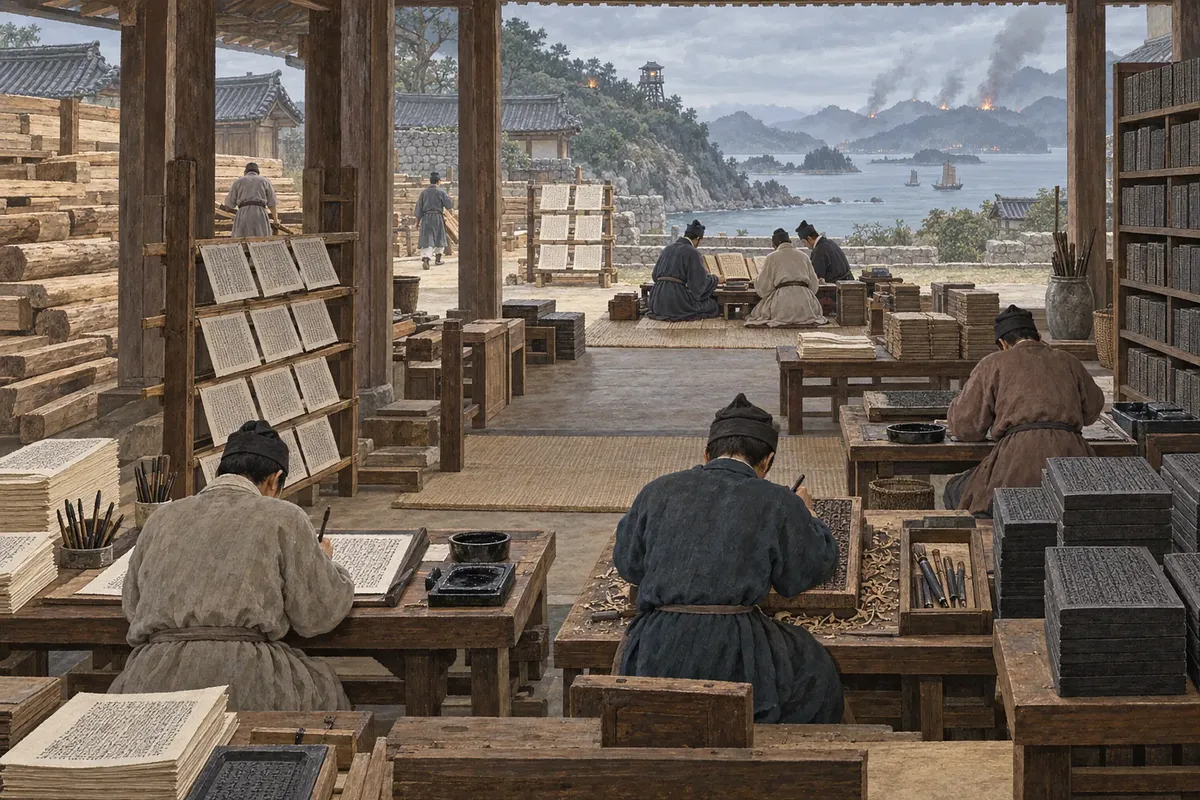
The direct background to the second production project was the loss of the First Tripitaka woodblocks during the war. The Korean History Portal dates the destruction of the woodblocks at Buinsa to 1232. In the same year, the Goryeo court moved the capital to Ganghwado.
The earlier First Tripitaka began with prayers to repel the Khitan invasion. The second production project was also linked to the belief that the power of Buddhism could protect the country. At the time, producing the Tripitaka was also a state project to preserve Buddhist culture.
Yi Gyubo's “Prayer of the King and His Subjects for the Carving of the Tripitaka” reveals the reason for producing it again. The text distinguishes Buddhist teachings from the physical tools that contain them. Its argument is that because the woodblocks had been destroyed, they had to be made again.
It is the natural order for tools to be made or destroyed, and when they are destroyed, repairing and remaking them is also something that must be done. Korean History Portal translation of “Prayer of the King and His Subjects for the Carving of the Tripitaka,” volume 25 of the Collected Works of Minister Yi of the Eastern Kingdom
This sentence expresses a contemporary voice arguing for the reproduction of the woodblocks. The wording of the quotation follows the translation as given. The prayer expresses the hope that the war would end. Korean History Portal source and commentary
Timeline from the First Tripitaka to UNESCO Inscription
The history of the Tripitaka Koreana spans production, correction, relocation, and preservation. The completion of the carving should be distinguished from the ceremony marking the completion of the project. The timeline below also identifies the scope of the events described by each source.
Year or period | Event | Source 1011 | The First Tripitaka was commissioned in response to the Khitan invasion | Korean History Portal, “Tripitaka Koreana” 1232 | The capital was moved to Ganghwado, and the First Tripitaka woodblocks were destroyed | Korean History Portal, “Tripitaka Koreana” 1236 | The year widely given as the start of the second production project | UNESCO Memory of the World nomination form 1237~1248 | Period given for the carving of the surviving Tripitaka woodblocks | National Heritage Portal, “Tripitaka Koreana Woodblocks at Haeinsa, Hapcheon” 1251 | Ceremony commemorating the completion of the Tripitaka | New History of Korea, “Reasons for Producing the Goryeo Tripitaka and the Period of Its Carving” Around 1398 | Transfer of the woodblocks from Ganghwado to Haeinsa | Korean History Portal, “Tripitaka Koreana” 1995 | Janggyeong Panjeon at Haeinsa inscribed as World Heritage | UNESCO World Heritage Centre 2007 | Tripitaka Koreana and miscellaneous woodblocks inscribed on the Memory of the World Register | UNESCO Memory of the World
Why the Production Dates Differ Between 1237~1248 and 1236~1251
The two periods differ depending on how the carving itself is distinguished from the overall project. The National Heritage Portal dates the production of the Tripitaka woodblocks to 1237~1248. UNESCO's World Heritage description also uses these carving dates.
Period | Scope described | Point to note 1237~1248 | Carving period based on publication records remaining on the woodblocks | 12 calendar years when both the starting and ending years are included 1236~1251 | Period described as extending from the start to the completion of the second production project | The nomination form describes it as a 16-year project 1251 | State ceremony commemorating completion | Does not mean that all woodblocks continued to be carved through this year
New History of Korea uses the colophons on the woodblocks as evidence for determining the dates. A colophon records when and by which institution a block was carved. This commentary distinguishes the completion of carving in 1248 from the celebratory ceremony in 1251.
However, the difference in dates cannot be attributed entirely to a preparation period. New History of Korea also presents an interpretation that preparations began in 1233. The starting year of the project therefore remains subject to differing interpretations among sources. Review of the carving dates in New History of Korea
What Roles Did the Daejangdogam and Sugi Perform?
The second production project developed from a religious undertaking into an organized production project. The Daejangdogam and its branch office, the Bunsa Daejangdogam, were agencies responsible for producing the woodblocks. The institutional names remaining on the woodblocks provide evidence of their participation.
Organization or personnel | Role | Surviving evidence Daejangdogam | Managed the state-level Tripitaka production project | Publication records on the woodblocks and written documents Bunsa Daejangdogam | Shared responsibility for producing the woodblocks | Woodblocks bearing the name Bunsa Daejangdogam Correctors including Sugi | Compared editions and organized the scriptural texts | Supplementary Record of Corrections to the Newly Carved Tripitaka of Goryeo Calligraphers and carvers | Wrote the text for carving and carved the characters into the woodblocks | Lettering on the woodblocks and production records
The Korean History Portal describes Ganghwado and Namhae as the project's main bases. However, there are differing views on the precise locations of the institutions and the carving sites. The storage site and the production site should not be assumed to have been the same place. Review of the Daejangdogam and carving sites in New History of Korea
Sugi and others compared Goryeo's First Tripitaka edition with Song and Khitan editions. Textual collation is the process of examining differences among editions and establishing the text. The second production project therefore went beyond simply copying the old woodblocks.
The Supplementary Record of Corrections to the Newly Carved Tripitaka of Goryeo contains details of this correction work. It reviewed such matters as the titles and volume counts of scriptures and content that was missing or mixed together. The fact that reasons for corrections were recorded provides a basis for assessing the accuracy of the scriptures. New History of Korea, “Composition of the Goryeo Tripitaka”
Achievements of Woodblock Printing and the Reproduction of the Scriptures
The achievement of the Tripitaka Koreana lies in preserving the corrected text on woodblocks that could be used for repeated printing. Woodblock printing transfers text carved into a single block onto paper. It differs from metal movable type printing, which combines individually cast characters.
Technique or task | Function | Result Comparison of editions | Review of different versions of the text | Compilation of scriptures with fewer errors Precise carving | Carving the established text into wooden blocks | A basis for repeated printing Preservation of the woodblocks | Maintenance of the original printing plates | Support for later publication and study of the scriptures
UNESCO highly values the editorial and textual collation standards of the Goryeo Tripitaka. It also explains that the text has been used as a standard edition in the study of Chinese-language Buddhist scriptures. Its accuracy should be understood as the result of this comparison and correction work.
It is inaccurate to turn this into a claim that it contains not even a single erroneous character. Nor does completeness mean that it contains every Buddhist text in the world. The term is used in the context of assessing the collected body of transmitted scriptures and the preservation condition of the woodblocks. UNESCO explanation of its Memory of the World value
How Were the Woodblocks Preserved After Their Transfer to Haeinsa?
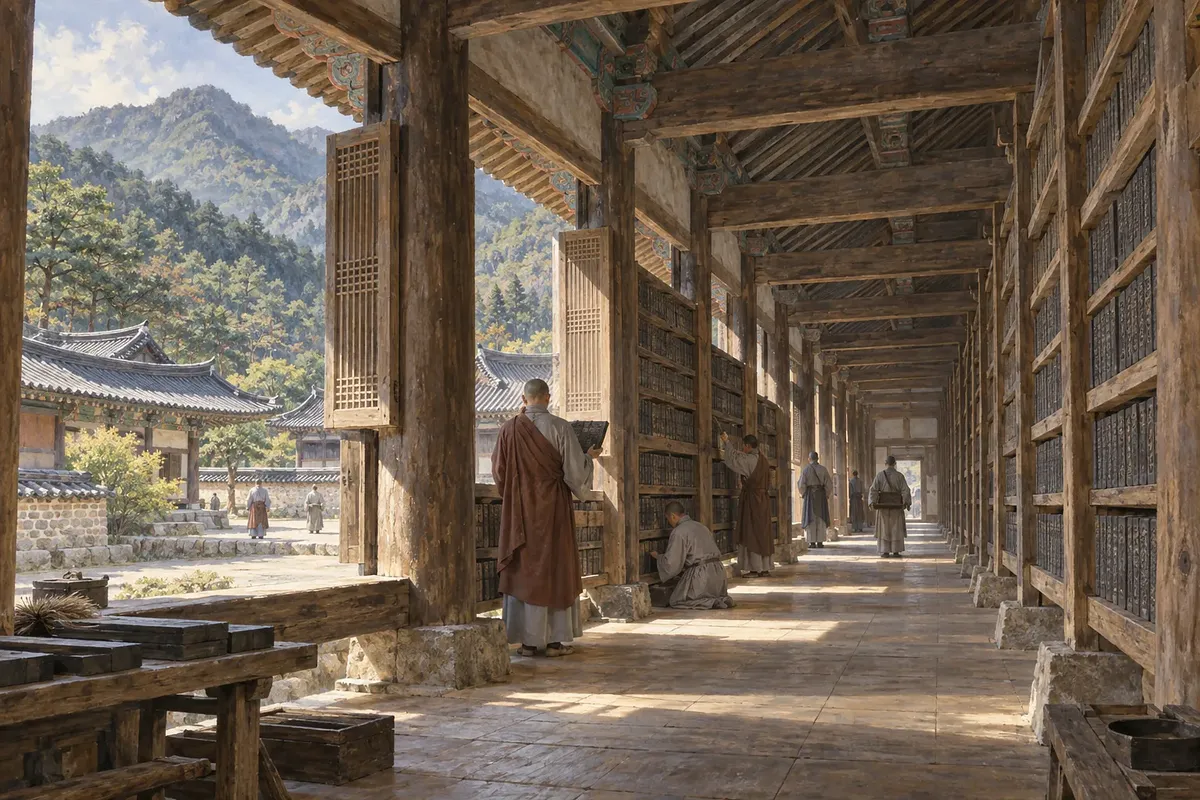
Janggyeong Panjeon has preserved the woodblocks through natural ventilation and the regulation of temperature and humidity. After they were made, the woodblocks were stored on Ganghwado. Their transfer to Haeinsa is generally dated to around 1398.
There are gaps in the records concerning the exact route and timing of the transfer. The Korean History Portal explains the transfer by considering records from 1398 and other evidence together. The present complex of Janggyeong Panjeon buildings is a product of the history of preservation during the Joseon period. Korean History Portal, “Tripitaka Koreana”
Preservation element | Method or role Position and size of windows | Securing airflow inside the buildings Building layout and surrounding environment | Regulating temperature and humidity through natural conditions Racks holding the woodblocks | Supporting the storage and management of the woodblocks Continuous inspection and repair | Maintaining the condition of the wooden blocks and storage facilities
The National Heritage Portal explains that the windows at the front and rear differ in position and size. UNESCO also identifies the climate-adapted architectural design as central to preservation. At the same time, it specifies that the woodblocks and racks require continuous repair. National Heritage Portal description of Janggyeong Panjeon, UNESCO description of the state of preservation
Records and Interpretation
The purposes stated in historical records should be distinguished from the interpretations of later researchers. The prayer conveys the justification given by those who promoted the production of the woodblocks. The project's political function belongs to the realm of interpretation and must be examined together with other records.
What the Records Confirm
“Prayer of the King and His Subjects for the Carving of the Tripitaka” prays both for the reproduction of the woodblocks and for overcoming foreign invasion. The colophons on the woodblocks identify the production institutions and dates. Records in the History of Goryeo concerning completion attest to the existence of a state ceremony.
Widely Used Explanations and Political Interpretations
Public history sources explain the second production project as an example of state-protecting Buddhism. State-protecting Buddhism refers to the belief that the power of Buddhism could defend the country. New History of Korea also includes the Choe U regime's intention to stabilize public sentiment in its interpretation.
This is not evidence that every participant had the same political purpose. Participation in a state project must be distinguished from individual motives. The prayer alone also cannot prove that producing the woodblocks drove back the Mongol forces. Interpretation of the motives for production in New History of Korea
Issues on Which Sources Still Differ
Different explanations remain concerning detailed dates and locations. Even accounts provided by the same institution may not agree. The following points should not be combined and presented as established facts.
· Year the First Tripitaka was destroyed: This article follows the Korean History Portal's date of 1232. The UNESCO nomination form gives 1234. · Start of the second production project: The explanation that it began in 1236 is distinguished from the view that preparations began earlier. · Carving sites: Researchers differ on the roles of Ganghwado and Namhae and on the locations of the institutions. · Transfer to Haeinsa: The account dating it to around 1398 is separate from confirming the detailed transfer route.
Can the Scriptural Text Survive Even If the Woodblocks Burn?
If printed copies remain elsewhere, the text can survive even after the woodblocks are lost. The woodblocks of the First Tripitaka were lost, but some printed copies survive. The second production project also compared the First Tripitaka edition with other Tripitaka editions.
This example shows that several different things are preserved as cultural heritage. Preserving the original woodblocks is distinct from transmitting the text. Preserving records of corrections makes it possible to examine the reliability of the text.
What survives | What can be verified or continued Woodblocks | Carving techniques and original printing plates Printed copies | The scriptural text as printed at the time Correction records | Differences among editions and the basis for corrections Storage architecture | The environment and management methods that preserved the original blocks over time
UNESCO describes these woodblocks as a system for producing and distributing knowledge. At Haeinsa, scriptures were printed as needed and used for education and research. Preservation therefore also includes maintaining the foundation for reusing that knowledge. UNESCO Memory of the World nomination form
The Difference Between World Heritage and Memory of the World
Janggyeong Panjeon at Haeinsa and the Tripitaka woodblocks were inscribed on different UNESCO lists. Janggyeong Panjeon is the architectural heritage that houses the woodblocks. The Memory of the World inscription covers the Tripitaka Koreana and miscellaneous woodblocks.
Inscribed property | List and year | Focus of evaluation Janggyeong Panjeon at Haeinsa | World Heritage, 1995 | Architecture and preservation techniques for protecting the woodblocks Tripitaka Koreana and miscellaneous woodblocks | Memory of the World, 2007 | Documentary value of the scriptures and the transmission of printing and knowledge
The miscellaneous woodblocks are Buddhist woodblocks inscribed together with the Tripitaka woodblocks. It is therefore inaccurate to limit the scope of the Memory of the World inscription to the Tripitaka Koreana woodblocks alone. The two inscriptions demonstrate the respective value of the documentary materials and their storage facilities. UNESCO World Heritage inscription information, UNESCO Memory of the World inscription information
0:00 0:00
1 / 63

Advertisement

Download text

File name
palman-daejanggyeong-mongol-invasions-and-preservation-en.txt
Format
TXT (text/plain)
Paragraphs
63

Downloads exactly what you see as a text file.

Please cite the source when quoting.

Large text

Makes the text larger and the colors clearer. Turn it on if the text feels too small.

Goryeo recarved the Tripitaka after the earlier set of blocks was lost during the Mongol invasions.AI-generated image

Key points

  • The First Tripitaka Koreana was created in response to the Khitan invasion, while the Tripitaka Koreana was recarved during the Mongol invasions.
  • The National Heritage Portal dates the production of the surviving Tripitaka woodblocks to 1237~1248.
  • Daejangdogam and Bunsa Daejangdogam oversaw woodblock production, while Sugi and others compared editions and corrected errors.
  • According to the National Heritage Portal, the Tripitaka Koreana preserved at Haeinsa Temple comprises 81,258 woodblocks.
  • Janggyeong Panjeon was inscribed on the World Heritage List in 1995, and the Printing Woodblocks of the Tripitaka Koreana and Miscellaneous Buddhist Scriptures were added to the Memory of the World Register in 2007.

The Tripitaka Koreana is a set of Buddhist scripture woodblocks recarved by Goryeo during the Mongol invasions of the 13th century. In response to the loss of the First Tripitaka, the state mobilized its institutions and its expertise in textual correction and woodblock carving. The woodblocks preserved at Haeinsa are remembered for the accuracy of their texts and their successful long-term preservation.

The Korean History Portal, National Heritage Portal, and UNESCO records on which this article is based were checked in September 2026.

What Is the Tripitaka Koreana?

The Tripitaka Koreana refers to the woodblocks of Goryeo's Second Tripitaka preserved at Haeinsa. A Tripitaka is a collection of Buddhist teachings and related literature. The woodblocks are wooden printing plates carved with characters so that the texts could be printed on paper.

At the core of the Tripitaka are the Three Baskets of scripture, monastic discipline, and treatises. The scriptures contain the Buddha's teachings. The monastic discipline covers the rules of life for monastic communities. The treatises explain and discuss Buddhist doctrine.

Term Meaning Point to distinguish
First Tripitaka The first Tripitaka produced by Goryeo Produced in response to the Khitan invasion
Second Tripitaka The Tripitaka produced again after the woodblocks of the First Tripitaka were lost The woodblocks now known as the Tripitaka Koreana
Woodblock A wooden printing plate carved with characters The physical objects preserved at Haeinsa
Printed copy A book printed on paper after ink was applied to the woodblocks Multiple copies could be produced from the same woodblocks
Janggyeong Panjeon The buildings that house the woodblocks Architectural heritage distinct from the woodblocks themselves

The name Tripitaka Koreana, also known in Korean as the Eighty Thousand Tripitaka, comes from the fact that there are approximately 80,000 woodblocks. UNESCO's inscription description gives the total as 81,258. This number is not the number of book volumes or types of scripture. UNESCO Memory of the World description

Haeinsa’s preservation system helped carry the Tripitaka Koreana into the present.AI-generated image

The Mongol Invasions and the Loss of the First Tripitaka

The direct background to the second production project was the loss of the First Tripitaka woodblocks during the war. The Korean History Portal dates the destruction of the woodblocks at Buinsa to 1232. In the same year, the Goryeo court moved the capital to Ganghwado.

The earlier First Tripitaka began with prayers to repel the Khitan invasion. The second production project was also linked to the belief that the power of Buddhism could protect the country. At the time, producing the Tripitaka was also a state project to preserve Buddhist culture.

Yi Gyubo's “Prayer of the King and His Subjects for the Carving of the Tripitaka” reveals the reason for producing it again. The text distinguishes Buddhist teachings from the physical tools that contain them. Its argument is that because the woodblocks had been destroyed, they had to be made again.

It is the natural order for tools to be made or destroyed, and when they are destroyed, repairing and remaking them is also something that must be done.

Korean History Portal translation of “Prayer of the King and His Subjects for the Carving of the Tripitaka,” volume 25 of the Collected Works of Minister Yi of the Eastern Kingdom

This sentence expresses a contemporary voice arguing for the reproduction of the woodblocks. The wording of the quotation follows the translation as given. The prayer expresses the hope that the war would end. Korean History Portal source and commentary

Timeline from the First Tripitaka to UNESCO Inscription

The history of the Tripitaka Koreana spans production, correction, relocation, and preservation. The completion of the carving should be distinguished from the ceremony marking the completion of the project. The timeline below also identifies the scope of the events described by each source.

Year or period Event Source
1011 The First Tripitaka was commissioned in response to the Khitan invasion Korean History Portal, “Tripitaka Koreana”
1232 The capital was moved to Ganghwado, and the First Tripitaka woodblocks were destroyed Korean History Portal, “Tripitaka Koreana”
1236 The year widely given as the start of the second production project UNESCO Memory of the World nomination form
1237~1248 Period given for the carving of the surviving Tripitaka woodblocks National Heritage Portal, “Tripitaka Koreana Woodblocks at Haeinsa, Hapcheon”
1251 Ceremony commemorating the completion of the Tripitaka New History of Korea, “Reasons for Producing the Goryeo Tripitaka and the Period of Its Carving”
Around 1398 Transfer of the woodblocks from Ganghwado to Haeinsa Korean History Portal, “Tripitaka Koreana”
1995 Janggyeong Panjeon at Haeinsa inscribed as World Heritage UNESCO World Heritage Centre
2007 Tripitaka Koreana and miscellaneous woodblocks inscribed on the Memory of the World Register UNESCO Memory of the World

Why the Production Dates Differ Between 1237~1248 and 1236~1251

The two periods differ depending on how the carving itself is distinguished from the overall project. The National Heritage Portal dates the production of the Tripitaka woodblocks to 1237~1248. UNESCO's World Heritage description also uses these carving dates.

Period Scope described Point to note
1237~1248 Carving period based on publication records remaining on the woodblocks 12 calendar years when both the starting and ending years are included
1236~1251 Period described as extending from the start to the completion of the second production project The nomination form describes it as a 16-year project
1251 State ceremony commemorating completion Does not mean that all woodblocks continued to be carved through this year

New History of Korea uses the colophons on the woodblocks as evidence for determining the dates. A colophon records when and by which institution a block was carved. This commentary distinguishes the completion of carving in 1248 from the celebratory ceremony in 1251.

However, the difference in dates cannot be attributed entirely to a preparation period. New History of Korea also presents an interpretation that preparations began in 1233. The starting year of the project therefore remains subject to differing interpretations among sources. Review of the carving dates in New History of Korea

What Roles Did the Daejangdogam and Sugi Perform?

The second production project developed from a religious undertaking into an organized production project. The Daejangdogam and its branch office, the Bunsa Daejangdogam, were agencies responsible for producing the woodblocks. The institutional names remaining on the woodblocks provide evidence of their participation.

Organization or personnel Role Surviving evidence
Daejangdogam Managed the state-level Tripitaka production project Publication records on the woodblocks and written documents
Bunsa Daejangdogam Shared responsibility for producing the woodblocks Woodblocks bearing the name Bunsa Daejangdogam
Correctors including Sugi Compared editions and organized the scriptural texts Supplementary Record of Corrections to the Newly Carved Tripitaka of Goryeo
Calligraphers and carvers Wrote the text for carving and carved the characters into the woodblocks Lettering on the woodblocks and production records

The Korean History Portal describes Ganghwado and Namhae as the project's main bases. However, there are differing views on the precise locations of the institutions and the carving sites. The storage site and the production site should not be assumed to have been the same place. Review of the Daejangdogam and carving sites in New History of Korea

Sugi and others compared Goryeo's First Tripitaka edition with Song and Khitan editions. Textual collation is the process of examining differences among editions and establishing the text. The second production project therefore went beyond simply copying the old woodblocks.

The Supplementary Record of Corrections to the Newly Carved Tripitaka of Goryeo contains details of this correction work. It reviewed such matters as the titles and volume counts of scriptures and content that was missing or mixed together. The fact that reasons for corrections were recorded provides a basis for assessing the accuracy of the scriptures. New History of Korea, “Composition of the Goryeo Tripitaka”

Achievements of Woodblock Printing and the Reproduction of the Scriptures

The achievement of the Tripitaka Koreana lies in preserving the corrected text on woodblocks that could be used for repeated printing. Woodblock printing transfers text carved into a single block onto paper. It differs from metal movable type printing, which combines individually cast characters.

Technique or task Function Result
Comparison of editions Review of different versions of the text Compilation of scriptures with fewer errors
Precise carving Carving the established text into wooden blocks A basis for repeated printing
Preservation of the woodblocks Maintenance of the original printing plates Support for later publication and study of the scriptures

UNESCO highly values the editorial and textual collation standards of the Goryeo Tripitaka. It also explains that the text has been used as a standard edition in the study of Chinese-language Buddhist scriptures. Its accuracy should be understood as the result of this comparison and correction work.

It is inaccurate to turn this into a claim that it contains not even a single erroneous character. Nor does completeness mean that it contains every Buddhist text in the world. The term is used in the context of assessing the collected body of transmitted scriptures and the preservation condition of the woodblocks. UNESCO explanation of its Memory of the World value

How Were the Woodblocks Preserved After Their Transfer to Haeinsa?

Janggyeong Panjeon has preserved the woodblocks through natural ventilation and the regulation of temperature and humidity. After they were made, the woodblocks were stored on Ganghwado. Their transfer to Haeinsa is generally dated to around 1398.

There are gaps in the records concerning the exact route and timing of the transfer. The Korean History Portal explains the transfer by considering records from 1398 and other evidence together. The present complex of Janggyeong Panjeon buildings is a product of the history of preservation during the Joseon period. Korean History Portal, “Tripitaka Koreana”

Preservation element Method or role
Position and size of windows Securing airflow inside the buildings
Building layout and surrounding environment Regulating temperature and humidity through natural conditions
Racks holding the woodblocks Supporting the storage and management of the woodblocks
Continuous inspection and repair Maintaining the condition of the wooden blocks and storage facilities

The National Heritage Portal explains that the windows at the front and rear differ in position and size. UNESCO also identifies the climate-adapted architectural design as central to preservation. At the same time, it specifies that the woodblocks and racks require continuous repair. National Heritage Portal description of Janggyeong Panjeon, UNESCO description of the state of preservation

Records and Interpretation

The purposes stated in historical records should be distinguished from the interpretations of later researchers. The prayer conveys the justification given by those who promoted the production of the woodblocks. The project's political function belongs to the realm of interpretation and must be examined together with other records.

What the Records Confirm

“Prayer of the King and His Subjects for the Carving of the Tripitaka” prays both for the reproduction of the woodblocks and for overcoming foreign invasion. The colophons on the woodblocks identify the production institutions and dates. Records in the History of Goryeo concerning completion attest to the existence of a state ceremony.

Widely Used Explanations and Political Interpretations

Public history sources explain the second production project as an example of state-protecting Buddhism. State-protecting Buddhism refers to the belief that the power of Buddhism could defend the country. New History of Korea also includes the Choe U regime's intention to stabilize public sentiment in its interpretation.

This is not evidence that every participant had the same political purpose. Participation in a state project must be distinguished from individual motives. The prayer alone also cannot prove that producing the woodblocks drove back the Mongol forces. Interpretation of the motives for production in New History of Korea

Issues on Which Sources Still Differ

Different explanations remain concerning detailed dates and locations. Even accounts provided by the same institution may not agree. The following points should not be combined and presented as established facts.

  • Year the First Tripitaka was destroyed: This article follows the Korean History Portal's date of 1232. The UNESCO nomination form gives 1234.
  • Start of the second production project: The explanation that it began in 1236 is distinguished from the view that preparations began earlier.
  • Carving sites: Researchers differ on the roles of Ganghwado and Namhae and on the locations of the institutions.
  • Transfer to Haeinsa: The account dating it to around 1398 is separate from confirming the detailed transfer route.

Can the Scriptural Text Survive Even If the Woodblocks Burn?

If printed copies remain elsewhere, the text can survive even after the woodblocks are lost. The woodblocks of the First Tripitaka were lost, but some printed copies survive. The second production project also compared the First Tripitaka edition with other Tripitaka editions.

This example shows that several different things are preserved as cultural heritage. Preserving the original woodblocks is distinct from transmitting the text. Preserving records of corrections makes it possible to examine the reliability of the text.

What survives What can be verified or continued
Woodblocks Carving techniques and original printing plates
Printed copies The scriptural text as printed at the time
Correction records Differences among editions and the basis for corrections
Storage architecture The environment and management methods that preserved the original blocks over time

UNESCO describes these woodblocks as a system for producing and distributing knowledge. At Haeinsa, scriptures were printed as needed and used for education and research. Preservation therefore also includes maintaining the foundation for reusing that knowledge. UNESCO Memory of the World nomination form

The Difference Between World Heritage and Memory of the World

Janggyeong Panjeon at Haeinsa and the Tripitaka woodblocks were inscribed on different UNESCO lists. Janggyeong Panjeon is the architectural heritage that houses the woodblocks. The Memory of the World inscription covers the Tripitaka Koreana and miscellaneous woodblocks.

Inscribed property List and year Focus of evaluation
Janggyeong Panjeon at Haeinsa World Heritage, 1995 Architecture and preservation techniques for protecting the woodblocks
Tripitaka Koreana and miscellaneous woodblocks Memory of the World, 2007 Documentary value of the scriptures and the transmission of printing and knowledge

The miscellaneous woodblocks are Buddhist woodblocks inscribed together with the Tripitaka woodblocks. It is therefore inaccurate to limit the scope of the Memory of the World inscription to the Tripitaka Koreana woodblocks alone. The two inscriptions demonstrate the respective value of the documentary materials and their storage facilities. UNESCO World Heritage inscription information, UNESCO Memory of the World inscription information

Open the link

Opens in a new window.

Advertisement

Sign-in required

Sign in with your Google account to like, comment, and save highlights.

FAQ

Was the Tripitaka Koreana made during the Khitan invasions or the Mongol invasions?

The Tripitaka Koreana now housed at Haeinsa Temple was created during the Mongol invasions. The earlier First Tripitaka Koreana was made in response to the Khitan invasions.

Why was the Tripitaka Koreana made again?

New woodblocks were needed to replace the woodblocks of the First Tripitaka Koreana, which had been destroyed. The project also embodied the hope of repelling the Mongol invasions through the power of Buddhism.

Does the Tripitaka Koreana have exactly 80,000 woodblocks?

The National Heritage Portal states that there are 81,258 Tripitaka woodblocks. The name Tripitaka Koreana refers to the approximately 80,000 woodblocks. The number of woodblocks and the number of book volumes are different units of measurement.

When was the Tripitaka Koreana produced?

The National Heritage Portal dates the production of the surviving woodblocks to 1237~1248. The period 1236~1251 is widely used to cover the recarving project from its beginning to its completion. A ceremony marking its completion was held in 1251.

What did Sugi do in the production of the Tripitaka Koreana?

Sugi and others compared editions from Goryeo, Song China, and Khitan to establish the text. Details of this correction work survive in the Supplementary Record of Corrections to the Newly Carved Goryeo Tripitaka.

Were all the Tripitaka Koreana woodblocks carved at Haeinsa Temple?

The place of production cannot be determined solely from the current storage location. The Daejangdogam and Bunsa Daejangdogam were involved in carving the woodblocks. Scholars disagree about the exact carving locations and the roles of each center.

Was the Tripitaka Koreana printed with metal movable type?

The Tripitaka Koreana woodblocks are wooden printing blocks with characters carved into them. Books printed from them on paper are woodblock editions. This differs from printing with assembled metal movable type.

If the First Tripitaka Koreana was burned, how can its contents be known?

Some copies printed from the woodblocks of the First Tripitaka Koreana survive in Korea and abroad. The destruction of the woodblocks does not mean that all printed copies were also destroyed.

Is it true that the Tripitaka Koreana contains no typographical errors at all?

Claims that it contains no errors whatsoever should be avoided. It is reasonable to explain that it is highly accurate because multiple editions were compared and corrected. The correction records provide a basis for assessing its accuracy.

When was the Tripitaka Koreana moved to Haeinsa Temple?

It is generally said to have been moved to Haeinsa Temple around 1398. Uriyeoksanet examines the timing of the transfer by considering the relevant records together. Scholars continue to disagree about the exact route and detailed timeline.

What features of Janggyeong Panjeon helped preserve the woodblocks?

Its architectural design, which is well suited to natural ventilation and the control of temperature and humidity, helped preserve the woodblocks. Relevant features include the locations and sizes of the windows and the arrangement of the buildings. Continued inspection and repairs are also necessary for long-term preservation.

Is the Tripitaka Koreana a World Heritage Site or part of the Memory of the World Register?

The Printing Woodblocks of the Tripitaka Koreana and Miscellaneous Buddhist Scriptures were inscribed on the Memory of the World Register in 2007. Haeinsa Temple Janggyeong Panjeon, where they are housed, was inscribed on the World Heritage List in 1995. The documentary heritage and the storage buildings must be distinguished.

Sources

Data formats

This content is available in several machine-friendly formats.

Data-only languages (machine translated, files only)

Indonesian JSON MD Portuguese JSON MD Chinese (Traditional) JSON MD Deutsch JSON MD

Verification

This article was drafted with AI and then reviewed and edited by a person.

Reviewed by 신익희 · 편집장 · 2026-09-25

Figures in this article were checked against the source material during generation. · 2026-09-25

This translation has been cross-checked by AI. · 2026-09-25

Reuse & AI usage

Search indexing and AI citation with attribution are welcome. See the license policy for details.

CC BY · License

Loading…

Loading…

Related content

From Injoys

Request the content you want and take 70% of what it earns

Just leave the subject. We handle production, review, translation and distribution.

See how revenue sharing works

Comments