Injoys

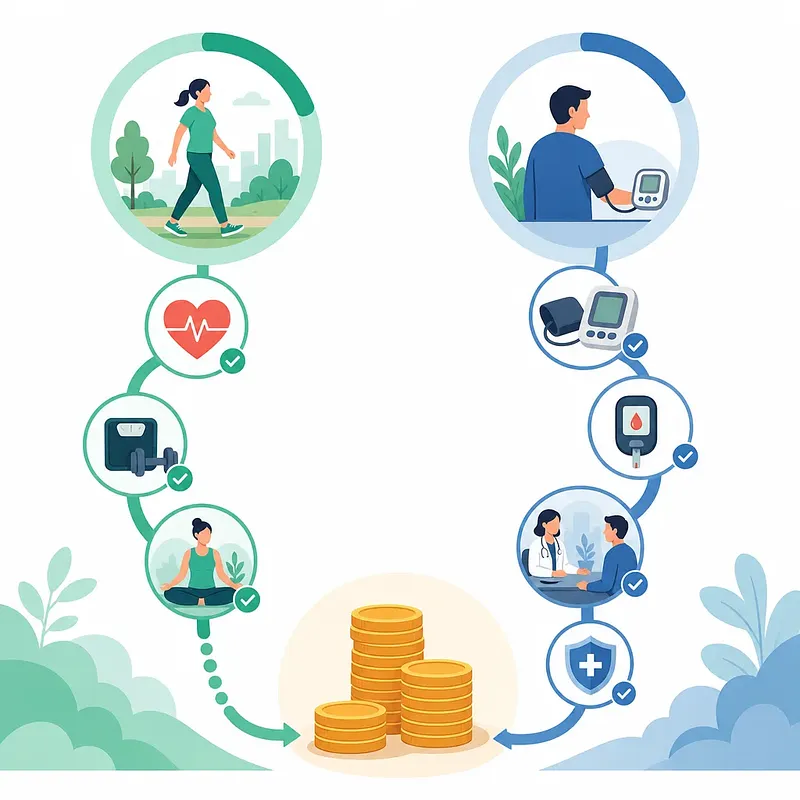
The Healthy Living Practice Incentive Program lets eligible participants earn points for health management activities such as walking. The prevention track offers up to 120,000 points over 2 years. The management track offers up to 80,000 points over 1 year. Check your eligibility with the National Health Insurance Service before applying.
These maximum amounts are based on the K-Gonggam guidance dated July 23, 2026. Detailed conditions are available on the Service’s program overview page.
Eligibility for the Prevention and Management Tracks
Your participation track depends on your health screening results and enrollment in the chronic disease management program. You cannot simply choose the track with the higher points limit. Check which track you can apply for on the Service’s eligibility check screen.
| Category | Prevention track | Management track |
|---|---|---|
| Basic eligibility | People aged 20 to 64 identified as at risk through a national health screening | Patients with hypertension or diabetes enrolled in the Primary Care Chronic Disease Management Program |
| Additional requirements | Meet the body mass index requirement and either the blood pressure or fasting blood glucose requirement | Have a care plan established |
| Location requirement | Your registered residential address at the time of application must be in an area offering the prevention track | Nationwide |
| Maximum points over the participation period | 120,000 points over 2 years | 80,000 points over 1 year |
The prevention track requires a body mass index (BMI) of at least 25.0kg/㎡. BMI is a measure calculated from height and weight. You must also meet either the blood pressure or fasting blood glucose requirement.
- Blood pressure requirement: Systolic pressure of at least 120mmHg or diastolic pressure of at least 80mmHg
- Fasting blood glucose requirement: At least 100mg/dL
This does not mean that meeting just one of the obesity, blood pressure, or blood glucose criteria is enough. The management track’s care plan is a personalized health management plan developed by a clinic. Taking medication alone does not mean you are enrolled. Detailed eligibility requirements are provided in the National Health Insurance Service program overview.

The management track is for patients with hypertension or diabetes enrolled in primary care chronic disease management with a care plan.
What to Check First for Your Situation
For the prevention track, you need to check both your screening results and your residential address. For the management track, first check whether the clinic treating you participates in the program. Even with the same health condition, your application outcome may differ depending on your program enrollment status.
| Current situation | What to check first |
|---|---|
| Your health screening flagged obesity or elevated blood pressure or blood glucose | Whether you meet the prevention track’s combined requirements |
| Your workplace is in an area offering the prevention track | Your registered residential address, not your workplace address |
| You are being treated for hypertension or diabetes | Enrollment in the Primary Care Chronic Disease Management Program and your care plan |
| You are outside the prevention track’s age range | Whether you meet the management track’s eligibility requirements |
| Some time has passed since your screening or care plan was established | Your individual application deadline as shown by the Service |
The Service’s regional table lists 50 areas offering the prevention track from December 15, 2025. It lists the management track as available nationwide from September 30, 2024. Before applying, check the latest list of prevention-track areas in the Service’s program overview. (Confirmed figure: 50 areas offering the prevention track, from December 15, 2025 · Source nhis.or.kr · As of 2025-12-15 · Checked 2026-11-04)
How Many Points Can You Earn for Walking?
Walking points are awarded on days when you meet your track’s requirements. For the prevention track, the amount depends on your daily step count. For the management track, it depends on the step target set in your care plan.
| Prevention track daily step count | Points earned per day |
|---|---|
| At least 5,000 but less than 6,000 steps | 50 points |
| At least 6,000 but less than 7,000 steps | 60 points |
| At least 7,000 but less than 8,000 steps | 70 points |
| At least 8,000 but less than 9,000 steps | 80 points |
| At least 9,000 but less than 10,000 steps | 90 points |
| At least 10,000 steps | 100 points |
The prevention track’s walking points limit is 70,000 points over 2 years. The annual walking limit is 35,000 points. Participation in health management programs and improvements in health indicators are separate earning categories.
Under the management track, you earn 100 points per day when you reach your step target. The walking category has a limit of 20,000 points over 1 year. Points are also awarded for blood pressure and blood glucose self-monitoring, education and counseling, and reviews and evaluations. Check the Service’s points criteria table for each category’s requirements.
Common Mistakes When Reading the Maximum Points
The maximum points are not earned through walking alone. They are the combined limit for several activities. The prevention and management tracks also use different earning periods.
| Easily misunderstood statement | Correct interpretation |
|---|---|
| The prevention track offers 120,000 points every year | Up to 120,000 points across all categories over 2 years |
| The management track pays 80,000 points when you apply | You must meet the activity-specific requirements over 1 year to earn up to 80,000 points |
| Walking more lets you earn unlimited points | Daily requirements and category-specific earning limits apply |
| The track with the higher maximum is more advantageous | Your eligibility determines your participation track |
A Calculation Using Matching Time Periods
Dividing the prevention track’s 120,000 points by 2 years gives an annual average of 60,000 points. This calculation helps explain the difference between the two tracks’ earning periods. It does not mean that a fixed amount of 60,000 points is awarded every year.
Comparing walking alone, the prevention track’s annual limit is 35,000 points. The management track’s walking limit is 20,000 points over 1 year. Actual earnings depend on the activities that meet each track’s qualifying criteria.